General George A. Custer

"Clausewitz, you genuis!
You'll be mighty proud of your best pupil this day!"
Author's Statement.
People overly idolizing him and passing it on to others have driven the true character, professionalism as an officer, and behavior of George A. Custer far into the deep shadows. The responsibility of such act is mostly from news paper reporters searching for a romantic and adventurous story to publish, people who enjoyed telling a good story, historians, until recently made up and colored events for the lack of facts that were lost, or concealed, and the military community, in deep respect to Libbie Bacon Custer, “the Princess of the Officers Corps,” suppressed certain facts and recommended Custer's body to be buried in the West Point Cemetery; a place reserved only for great and honorable Commanders.
In spite of Intel being just a trace, and with a judicious and fair attitude toward George Armstrong Custer I began a long and arduous Journey in research in the subject's life and behavior. In view of the lack of Intel I was forced to rely heavily on the knowledge of my training as a young cavalryman under then Col. George S. Patton, Jr., acquired knowledge of Custer's code for his cultural, social, moral, and political behavior, which was in no small part affected by the primitive medical environment during the 100 years prior to the fifth decade of the twentieth century. In the eighth decade of the twentieth century I was able to paint an adequate profile of Custer based on his attitude, and behavior. “A contrast worth mentioning between two Generals; Custer versus Patton.”
Custer's Birth And Boyhood
George Armstrong Custer was born in a back room in New Rumley, Harrison County, Ohio, on December 5, 1839, the third child of Emanuel H. and Maria Ward Kirkpatrick Custer. His father owned and operated a blacksmith shop and served as the local justice of the peace. Emanuel's families were of German Descent. His great-great-grandfather was Paulus Kuster or Kuester.
Emanuel Custer, George Armstrong's great-Grandfather, was born in Allegany County in 1754, served as a sergeant in the militia during the Revolutionary War, and married Anna Maria Fadley, with whom he had seven children.
The parents doted over the curly headed, blue-eyed, healthy baby whom they called Armstrong. As he grew and began talking, he garbled his name as Autie, and to his family he was Autie for the rest of his life.
Autie was the first of five children born to Emanuel and Marie. Navin Johnson followed Autie, born on July 29, 1842, a frail, sickly child whom Autie protected. The third child, Thomas Ward, born on March 15, 1845, would shadow his oldest brother and strive to emulate every thing he did. Boston followed three years later, born on October 31, 1848. Autie was Boston's hero and an older brother to brag about and to worship. The last child was a female, Margaret Emma, born June 5, 1852, whose life in it's entirety would be entwined with her brothers
The Custer household vibrated with life and with love. There seemed to be no difference between the Custer brood and the three children from the previous marriages and, indeed there was none among the children. Family meant inclusiveness, devotion, and loyalty, a lesson never forgotten.
Although both parents lavished affection upon their offspring, Maria was the quiet, steady counterpoint to the loud mouth, impulsive Emanuel.
Out of all the children, however, Autie was special both to his parents and his siblings. Bright and impulsive, he “was irrepressible as a boy,” according to one of his teachers. Mischief clung to Autie; in the words of a schoolmate, “George was a wide awake boy full of all kinds of all pranks and willing to take all kinds of chances.” As he grew older, Autie emulated his father as a practical joker. Usually with Tom in tow, Autie eagerly sought victims for their tricks. The boys especially enjoyed ones that involved their father. It would be a lifelong practice relished by the Custer brothers.
At the age of six Autie begin attending the one-room log school in town. The school provided him with fertile ground for his mischievousness and a new victim for his pranks, and he soon emerged as the leader among his classmates. “He was rather a bad boy in school.” Claimed the teacher's son, “but one thing would be said of him, he always had his lessons, yet he was not considered an unusually bright lad.” In fact, he was bright, according to one of his Biographers. He hated homework and seldom completed the lesson beforehand, skimming over them before the recitations. Once he learned to read well, he smuggled novels into the class and placed them inside a textbook during reading periods.
In 1849, the Custer's decided to improve their living by selling their property, including the black smith shop and buying an eighty-acre farm just outside of town. Emanuel still did blacksmithing work while trying to scratch an income from the hilly, thin new farm they bought. In turn the children attended Creal School, apparently a subscription school taught A. B. Creal. Perhaps because of the cost of the school or because of Autie's dislike for the schoolwork, the parents apprenticed him to Joseph R. Hunter a furniture maker in Cadiz. The apprentice ship failed; Audie was extremely unhappy, and the Custer' decided to send him to school in Monroe, Michigan.
Custer's Birth and Boyhood Days Give Way to a Trundle Bed and Beyond
Autie spent most of the next three years with the Stebbins Academy for Boys. Whether he was a more serious student in these schools is speculative; what is reasonable to assume was that his impulsive behavior and penchant for practical jokes continued. The Minister of Monroe Methodist Church, which the Reeds attended, remembered Autie as the instigator of devilish plots both during the service and Sunday school. On the surface, he appeared attentive and respectful, but underneath, the mind boiled with disruptive ideas. During prayer meetings, the boys rifled birdshot with their thumbs through the congregation. “We knew who was the promoter of such schemes,” asserted the minister, “for George was easily their leader.”
When the Stebbins Academy closed in early 1855, Autie returned to the family farm outside of New Rumley, Monroe, however, had become his adopted home and would increasingly be so as the years passed. Back in Ohio, his education resumed at the McNeely Normal School as Hopedale. McNeely was a boarding school, with the students residing in small cottages. Autie attended it intermittently during the next eighteen months. At sixteen years of age increasingly his attention turned toward young women, with whom his cousin alleged, he was quite a favorite.” A fellow student remembered him: Custer what was he appeared. There was nothing hidden in his nature. He was kind and generous to his friends; bitter and implacable towards his enemies.”
Autie interrupted his education at McNeely to accept a teaching position at the Beech Point School in Athens Township. He earned $28.00 a month and evidently used the money to pay for his own schooling. He roomed with a boarder and walked to the school. A friend of his described him a “big-hearted, whole-souled fellow,” and with his zest for life and fun-loving disposition, he proved to be a popular teacher. “What a pretty girl he would have made,” thought one of his female students. Ironically, perhaps fittingly he became the target of student pranks. At Christmas 1855, the students locked him out of the schoolhouse. When the boys went outside for wood, he sneaked inside. Upon their return, a scuffle ensued. And they shoved him out the door. Finally, he sought assistance from School board members who reopened the building. He apparently did not finish the winter term at Bench Point.
In the spring of 1856, Autie returned to McNeely while also securing a teacher's certificate. By midsummer he had finished at McNeely, and a month later he accepted a teaching position in District Number Five in Cadiz Township. He boarded with the Alexander Holland family. Holland was superintendent of an infirmary that consisted of three log houses. The Holland's lived in one of the houses, and Autie arrived in the late summer, to occupy the other one.
Here it comes!! The Biographer in the form of a noble Knight of yester years to champion the cause of his fallen hero. His pen flipping as a sword in every direction to destroy all except the fallen who has destroyed himself.
The Biographer writes, “Controversy, caused in part by lack of creditable evidence, gnaws at various aspects of Custer's life. The lack of documentation, the irretrievable silence of the past, the motives of contemporaries-friend and enemy alike—and the biases of later chroniclers conspire against the historic record. A prime example of such dispute is the events that transpired in the Holland household.
Nevertheless, the fact is that Autie fell passionately in love with teenaged Mary Jane “Mollie” Holland; Autie's Biographer writes: “What is uncertain is the nature of the relationship. Was it sexually consummated? And how far did Alexander Holland go in ridding himself and Mollie of the suitor? The attraction was mutual, and undoubtedly the first such emotional experience for each of them. The couple spent as much time together as possible, and after a day in school with twenty-five students, Autie would break all records of speed to return to the Holland home.
Autie was more comfortable expressing his thoughts on paper,“ poetry form” in particular to the pretty ladies ”. As love sick as he was he allowed his feelings to express himself eloquently in writing a poem to Mary.
They talked about a marriage and a future together; at least Autie did. He ended one letter to her with the words, “Farewell my only love until we meet again from your true & faithful Lover, ‘Bachelor Boy.'” A few days later, he wrote again, “You occupy the first place in my affections and the only place as far as love is concerned…If any power which I possess or control can aid in or in any way hasten our marriage it shall be exerted for that object.”
The Biographer writes; “ The couple sometimes met on a trundle bed. Whether or not Autie and Mollie were sexually involved remains elusive. One biographer alleges that he shared a bed with her and at least three other women before the age of twenty, but that claim seems to be only reasonable speculation. As a married man, Autie enjoyed sex as is evident in his correspondence with his wife. At seventeen years old, healthy, virile and impulsive by nature. He surely wanted to explore the mystery. If Mollie shared the ache and accepted the risks, their relationship was more than kisses and poetry. Regardless when Alexander Holland learned of the trundle bed, he banished the schoolteacher from his home.”
Custer's biographer can certainly wield a pen with grace in Custer's interest as a noble knight of the sixteenth century could yield a sword to champion the cause of his Fair or Royal Lady. The several paragraphs written about Autie's sex desires and behavior could have been reduced to two small paragraphs or less. After all Autie, was in his late teens, virile, healthy, very impulsive by nature, lacking in self-discipline, and irresponsible.
Autie moved nearby. Despite her father's wishes, Mollie continued to see Autie, meeting when they could at a neighbor's house. This arrangement did not diminish the youthful romance rather it enhanced or/and inflamed the situation. Mollie and Autie each had a daguerreotype taken individually, which they exchanged. Fortunately for her father, a solution to the Custer problem was approaching from beyond the horizon.
In the spring of 1856, Custer decided to try to acquire an appointment to the United States Military Academy at West Point. A desire he often discussed with Mollie as they planned their future The Academy offered many attractions to him. His boyish dreams of military glory might be fulfilled, the education provided there was one of the best in the country, and therefore a graduate of West Point might obtain a lucrative civilian position. Autie was acquainted with a local man who had attended West Point and was now worth huge sums of money. Evidently money seemed always to entice him.
The average person, however, would consider this to be a difficult task for them, but Autie pursued it. The local congressman was John a Bingham, an anti-slavery, even abolitionist, Republican. His politics were anathema to Emanuel Custer, who refused to intercede on behalf of his son. It probably would not have mattered if Emmanuel had tried, because the Republican Party was barely two years old and preparing for its first presidential campaign. Appointments to the academy were political patronage that rewarded new Republican supporters.
Undaunted by the prospects, Autie sent a letter to Mr. Bingham on May 27th, 1856, expressing his desire and including a short résumé in the body of the letter.
Mr. Bingham promptly replied, stating that he had already appointed one man and also an alternate. Autie promptly wrote back and in the letter he asserting in detail that he was qualified as a candidate for West Point. He included in his letter, “that if that young man from Jeff County failed to show up or if you hear of any other vacancy, I should be glad to hear from you.” A month later, the Congressman interviewed Autie in his Cadiz home
The Congressman was aware of the Custer family's political affiliation and it would have been wise for Autie to absent himself from the campaign of 1856. He was the son of Emanuel, and as the father later boasted about him, “Of course he was a democrat. My boys are all Democrats. I wouldn't raise any other kind.” Autie embarked on another imprudent act of behavior, by openly participated in repugnant demonstration that definitely annoyed the Congressman. Had something to do with the ”border ruffians” in reference to the fighting in Kansas.
In this time area, Alexander Holland learned about the trundle bed. Since Holland and the Congressman were great political friends at least, Holland went to the congressman and requested that his daughter's suitor be given the appointment. Holland knew that a cadet could not be married and Autie being in West Point for five years, the passions of Autie's and Mollie should subside. It is possible that a Merchant and a friend of Emanuel Custer's, despite their polar views on politics, interceded with the Congressman. The intervention worked, nevertheless, whoever's it may have been. In November Mr. Bingham wrote the Secretary of War Jefferson Davis requesting the appointment and noting the physical profile of the candidate and that he was academically qualified.
In January 1857, the secretary of war notified Mr. Bingham of the appointment and later in the month Autie accepted in writing and his parents signed their permission.
The Secretary of War included with the notification a form letter that warned candidates of the academy's rigorous academic standards. It should have been a sobering message to Autie, for he had been an indifferent student at best. Instead the academy presented a daunting challenge, therefore he never hesitated, and he saw Mollie for the final time, still speaking of marriage. He bid farewell to all and then boarded the train for West Point.
West Point
Cadet Armstrong Custer from the Twenty-First Congressional District of Ohio reported to the adjutant's office in the Library at the United States Military Academy in June 1857. After days of instructions by upperclassmen over one hundred candidates underwent the entrance examination before a board of staff and faculty in the Academic Building. On June 20th, the class of 1862, composed of sixty-eight members, was admitted to the academy.
Since the birth of West Point, the academy had trained officers for the Regular Army, and had measured men. Discipline, routine, class work, and traditional proscribed a cadet's existence. The education provided by West Point equaled or was far more superior than that offered in most of the civilian colleges or universities. It's graduates had not only fought his country's wars, but built bridges, constructed forts, explored and mapped vast stretches of the frontier, built levees along the river, designed costal defenses and sundry of other professions.
Permanence and solidity marked the academy and its grounds. Located on a high bluff above the Hudson River where Revolution forts had guarded the narrows of the river, it was a place of granite, limestone, and brick. The buildings edged the center of the grounds, a forty-acre swath of grass known as the Plain.
Within this setting, authorities regulated cadet behavior with a strict code of conduct, enumerated in a system of demerits . Called “skins” by cadets, demerits were issued for various breaches of the codes. The purpose was to instill discipline, to enhance or create a gentleman within each cadet. If a cadet received 200 demerits in a year, he could be expelled from the institution.
“At West Point all is monotony,” grumbled a cadet a decade earlier. “What is said of one day will answer for its almost years after.” Cadets of the 1850s would have shared his sentiments. Routine still measured time. In the classroom, on the drill field, in the barracks, even in the Mess Hall, the sameness of each day blended into weeks and months. The exuberance of youth confronted an institution governed by order, discipline, and tradition. The plebes were introduced to academy life by beginning with the annual summer camp held in July and August. After commencement in June, the corps moved from the barracks to the open ground south of the West Point Hotel, where old Fort Clinton and stood, and erected a camp comprising of eight rows of white tents. In each tent, cadets slept on blankets on wooden floors with a gun rack as the only piece of furniture.
Camp instruction focused on soldierly conduct and military drill, under the direction of officers and upper-class cadets. Each day began with reveille at 5:00 a.m., followed by policing of grounds, drill, breakfast, drill, dinner, policing, drill, dress parade, supper, and tattoo at 9:30 p.m. Mistakes sent cadets to the guard tent. “If my hat or even my head was falling off,” claimed one of the novice soldiers. “I would have no right to raise my hand to save it.” Fortunately, formal socials were provided on Saturday nights visits by military personnel, politicians, and civilians, particularly the lovely ladies enlivened the weeks spent in tents.”
Some where near the middle of the first encampment Autie informed friends by mail and other media how he was enjoying this new experience at West Point. He described it as the most romantic spot he had ever seen. “He was becoming accustomed to the discipline, he added, relating how some of his fellow corpsmen sneaked off the post to visit the town of Buttermilk Falls, about a mile south of the academy. Some of them were caught and would be punished, perhaps even dismissed. “This seems hard,” he asserted, “but military law is very severe and those who overstep its boundaries must abide the consequences.”
This was a curious statement for Custer to make, since he had already begun to ”overstep the boundaries.” “Fanny,” as his fellow cadets had nicknamed because of his blond hair and fair complexion, had compiled several demerits by the time he wrote the letter in August. Most of his demerits were minor infractions. Mostly his demerits denoted slothfulness in behavior and dress on his part.
Custer's class, plebes and upperclassman moved into the barracks at the end of summer camp. Custer's friendship extended across sectional lines, however, he gravitated toward Southerners—among their ranks he would find his closest friends.
“Custer was beyond a doubt the most popular man in his class,” a friend proclaimed. “West Point has had many a character to deal with,” insisted another one, “but it may be a question whether it ever had a cadet so exuberant, one who cared so little for it's serious attempts to elevate and burnish, or one on whom its tactical officers kept their eyes so constantly and unsympathetically searching as upon Custer. And yet how we all loved him.”
In him the cadets saw a spirit and zest for life that even the academy's disciplinary rigor could not smother. Custer's defiance of rules, nighttime adventures, indifference to schoolwork, and pranks resulted in laughter in barracks rooms and probably secret admiration. He remained immature, impetuous, and rebellious. Authority was meant to be tested, whether it was at a prayer meeting in the Monroe Methodist Church or at a drill on the Plain at West Point.
Custer understood that breaches meant consequences. While his immature, but frivolous frolics kept him in constant hot water, Custer could abide by the rules, not earning a demerit for several months, when his demerits total reached levels that could result in dismissal. He even had minor infraction removed by walking extra duty tours. Custer accumulated demerits unequaled by any other cadet in his class.
If you can classify, killing, cooking and eating a certain officer's chicken for supper, tying tin cans to a canine's tail, and painting his leg with iodine and faking a limp to be excused from drill then his pranks possessed a variety and a richness of imagination!!!!
The pattern of Custer's disciplinary and academic record at the academy began during his initial term in September 1857. When the Corps returned to the barracks from summer camp, the academic year commenced. For the past three years Secretary of War Jefferson Davis had been working to extend the course of study from four to five years. When the decision was announced, the corps nearly mutinied. It remained unsettled into 1859, but when the candidates reported in on June 1857, they expected to spend five years at the Point. The addition of a year allowed the expansion of the curriculum with emphasis on courses that would enhance and improve the graduated cadet. The academic requirements challenged the best of the corpsman and could overwhelm the mediocre, ill prepared, or ill disciplined members. Custer if lucky would probably fit into the latter group,
Custer acknowledged that he comfortably fitted into the last group, “there were only two position in a class, ‘head and foot', and since he was disinclined to strive for the “head”, he aspired for the “foot.” Due to his attitude toward life particularly small emphasis on academics, he made a remark, “whether I know my lesson or not: I am not going to allow it to discourage me. In the words of a cadet, “Custer's course at West Point may be described in the remark that he merely scraped through. “He was anything but a good student.
During 1857—1858 academic year, Custer studied mathematics, which included algebra, geometry, and trigonometry, and English, including grammar. After his January 1858 examinations and with his demerit record, he ranked fifty-eight in class of sixty-eight. At the end of the scholastic year, “June”, he stood fifty-second in mathematics, and fifty-seventh in English. The class now stands at sixty-two, as six members were deficient and were either dismissed or resigned. Further research on your part will reveal that his standing at West Point in responsibility and academics deteriorates constantly. He compiled an even more dismal delinquency record with 192 demerits, only eight short of the 200 that could result in dismissal. At year's end he ranked over all fifty-sixth in a class now totaling 60 members
In June, the Class of 1862, with the conclusion of their examination and the end of their second year, departed for their first furlough since they entered the academy. It had been eagerly anticipated for weeks, probably for months, by the third-classmen. For Custer, it could mean a reunion with Mollie Holland, who had been in his thoughts for a long time. During the year, he and she had exchanged letters, the contents of which intrigue as to the nature of their relationship.
Whether Custer and Mollie saw each other when he returned to Ohio during the summer eludes historical inquiry. Undoubtedly, he visited her town, dashing in his cadet uniform. If she saw her, it was probably the last time. He never forgot Mollie, regarded her affectionately, and during the Civil War sent her a photograph of himself as a brigadier general and a silver star taken from the uniform of a captured Confederate General. Mollie had been his first love, a memory that always lingered softly.
Custer spent most of his two–month furlough at his family home in New Rumley and at the Read home in Monroe. His family in its entirety certainly celebrated his homecoming. Autie was special and deeply missed. Emanuel had much more to brag about and Maria to fret about. When the time came for his departure, at least Autie and his mother wept—it would always be that way. He bid farewell to his family as he departed to report to West point at a designated time.
On Monday, August 29th, Custer was admitted to the Post Hospital at West Point. Commission Regular Army Officers served as surgeons, and to one of them Custer reported to. His illness was diagnosed as gonorrhea; an infectious disease prior to the year 1940 was most usually incurable. Thanks to the wonder drugs, “penicillin and sulfa drugs” that were ushered in, in that year. Custer contracted the disease while on furlough, either from an infected female acquaintenance or more likely from a prostitute. It was a common malady among cadets who had been on furlough. The pain of this disease and treatments are severe.
In Custer's case the severity of the disease and the duration of the symptoms cannot be determined. He never wrote about it and if he discussed it with friends, they maintained a subsequent silence. However he wrote two letters in the fall, he noted that he had been ill for some time and that “I was detained in the hospital during the beginning of the present term.” In time, like others so afflicted, he would be free of the disease. If the illness persisted, as he seemed to indicate in the letters, the possibility increased significantly that the infection caused sterility.
Custer's illness affected his class work or as he stated in a letters put him “behind in studies. ”With the increase in his course load, Custer struggled throughout the academic year. He studied French, Spanish, drawing, swordsman, infantry drill, natural philosophy, astronomy, optics, and acoustics. At the conclusion of examinations in June 1860, Custer ranked again near the bottom of his class, which now consisted of fifty-seven members. In general merit, which included a cadet's disciplinary record, he was last in the class.
The demerits totaled 191 for this year, one less than during the previous twelve months. Confronted with the reality of dismissal if he did not alter his behavior, Custer obeyed the rules, finishing the academic year without another demerit. The authorities rewarded him and others for their conduct by allowing them off post for one day in July
The discordant voices in the barracks could not be masked by the uniform stride of the corpsmen on the Plain. Few, if any, cadets avoided discussion of the forthcoming presidential election. Politicians in the slaveholding states had warned of the consequences if the outcome favored Republican Abraham Lincoln, and their predictions of secession meant difficult choices from that region. As the election near ed, a group of Southern cadets hanged a figure of Lincoln in effigy in front of the barracks. They removed it before daylight so few others knew of the act. But in early November, Lincoln and the Republican Party won an electoral victory.
Custer wrote to his sister Ann Reed expressing his disappointment. “The election has passed, I fear that there will be much trouble.” The Southern cadets he informed her, were resigning from the academy as their states seceded. A few of the Southern cadets had all ready submitted resignations. “ You cannot imagine how sorry I will be to see this happen,” he continued, “as the majority of my best friends and all my roommates except one have been from the South.” Duties at the academy might be suspended, he thought, but he knew that if war resulted the country “would be impoverished.” I sincerely hope we may be spared this Sorrow.” While many of the Southern cadets were leaving, there were a great number that hesitated. They were torn by conflicting allegiance and personal interest. For members of the Class of 1861, in particular, a resignation meant that over four years of rules, discipline, class work, and all the other sacrifices demanded by the academy would be lost. If war could be avoided after commencement, they could then leave as graduates. They wrote home for advice, conversed with friends, and waited. At least in January, midterm examinations consumed their time.
The previous months of excitement and discord had evidently affected study habits. As the examination board declared thirty-three cadets academically deficient, including Custer. Most of them were allowed to take a reexamination, but the panic mode intensified. Many tried to bribe the instructor's aids for a copy of that particular test. When that ploy failed, failed, they sneaked into his office, pried open a locked desk, took the exam back to the barracks, copied it, and returned it to the desk. According to one witness, Custer, meanwhile, in a desperate fix entered an instructor's room at the hotel and began copying test until he heard someone approaching. He ripped the page from the book and fled. But the professor discovered it and prepared a different one.
This same witness grumbling about Custer says, “He has narrowly escaped several before, but unluckily he did not take warning, and now it is too late, and he will always have cause to repent of his folly.” But for reasons neither Custer nor the witness understood, the former was reinstated, the only one in the class. He was declared “not proficient” only in ethics, while passing infantry and cavalry tactics, chemistry, and drawing.
The Confederate States of America was formed in January, with Jefferson Davis as president, in Montgomery, Alabama. Many more events occurred during that time frame.
With Lincoln's inauguration March 4, the national crisis quickened. If there was to be a war, it appeared that it could ignite at either of two forts in South Carolina and Florida, where Confederates officials demanded their abandonment by the federal government.
In April, tenth day of the month, Custer wrote his Sister describing the excitement at West Point as “so great.” War is the main topic here and “I have not thought of hardly anything else. The enlisted personnel were leaving for duty with the army. “When war is once begun between the states.” he asserted, “it will be beyond the power of human foresight to predict when and where it will terminate or what will be prepared to leave, without graduating, to drill the recruits that would pour into the army in the event of war.
Two days after Custer wrote the letter to his sister. Southern artilleryman opened fire on Fort Sumter in the harbor of South Carolina; the cannon's roar echoing across the nation. The Fort's commander surrendered on the fourteenth, and Lincoln reacted with a call of volunteers to save the union. Within a week, thirty-seven Southern cadets chose allegiance to their states and boarded a steamer home. West Point's academic staff recommended that the remaining members of the Class of 1861 be graduated at once, and that the course work of 1862 be accelerated so its members could graduate in May.
Recent events inspired Custer to write to his sister again in the latter part of April. Earlier she had corresponded with him, hoping that he would be spared from conflict, “but in times like the present.” He responded, “we should discard all private and personal desires and consider nothing but the prosperity and welfare of our country,” All citizens must “reflect upon the obligations we are under the government.” Because of the education he had received at the academy, if he refused to volunteer, he would be guilty of “the basest ingratitude.” In fact, he had offered his services to the governor of Ohio, he informed his sister. If the Secretary of war allowed a transfer from regular to volunteer service, he preferred to be in a unit from his native state. Duty with volunteers, he added, would also mean a higher rank for him.
An order, on May 6th, came down from the War Department and was read to the corps at West Point, directing the forty-five members of the class of 1861 to report to the adjutant general's office in Washington, D.C., for duty with the army. The instructions also designated the Class of 1862 as the First Class and appointed its commissioned and noncommissioned officers. That same day, the class members began an intense abbreviated course of instruction that would substitute their fifth year. By the end if the month, Custer noted that “the class are beginning to look thin and pale,” from the lack of sleep and amount of study. “We are also anxious to be prepared fully for the duties of our calling,” he explained. Then: “if it is my lot to fall in the defense of my country's rights, I will lay down my life as freely as if I had a thousand lives at my disposal.”
The second class of 1861 was graduated on June 24th. Custer's Irish friend, Patrick H. O'Rourke, placed first in the class of thirty- four members, while Custer placed last. As the Ohioan joked later, “only thirty-four graduated, and of these thirty-three graduated above me. ”He had compiled another 192 demerits during the year, for a four-year total of 726 demerits, the most in the class. His best subject his final year was artillery tactics; his worst, cavalry tactics.
The graduates drifted away from West Point to various assignments as orders were received. Custer's orders had not arrived by June 29th, when he was appointed officer of the day for the summer encampment. During the evening two of the Upperclassmen taunted a plebe. After the Plebe had threatened them with a bayonet, the three Upperclassmen walked away. The Plebe then reported the incident to Custer at the guard tent, and while there, one of the Upperclassman appeared and called the Plebe a coward. The Upperclassman “a damned fool,” the Plebe shot back, and the Upperclassman punched him in the face. The two antagonists grabbed each other, stumbling into the tent ropes. As other cadets gathered to witness the struggle, Custer exclaimed, “Stand back boys, let's have a fair fight,” Finally, several of the onlookers separated the pair. When two academy officers approached, the crowd dispersed. The next morning, Custer reported to the Commandant and was placed in arrest.
The court-martial convened on July 5th, with nine officers comprising the board. The charges, each with a specification, were neglect of duty and “conduct to the prejudice of good order and military discipline.” In the specifications, Custer failed to “suppress a quarrel between two cadets,” and, “ did give countenance to a quarrel. ” The Upperclassman and the Plebe testified that it was not a serious matter, only a “scuffle.” Custer was fortunate to have such friends and character witness to assist him in ending the affair. However, the four-page letter that Custer submitted in his behalf to the Court helped immensely. He argued that he had regarded the fight as a “trifling” matter. Continuing, he asked for the court's understanding. “I plodded my way for four long years,” he averred, and now all he wanted to do was join his classmates in the conflict. The court considered his statement, and then found him guilty on both charges. The Judge Advocate released the sentence, to be “reprimanded in orders,” on July 15th, adding that “the court was lenient in the sentence, owing to the peculiar situation of Cadet Custer represented in his defense, and in consideration of his general good conduct as testified to by his immediate Commander.
In Washington, meanwhile, Congressman John A. Bingham, who had appointed Custer to the academy, interceded on his behalf at the War Department. Custer or someone else at West Point probably apprised him of the incident. Bingham's efforts resulted in orders for Custer to report for duty at the capital. On July 18th , the last member of the class boarded a steamer for New York City. He surely looked back as the boat churned into the current, for West Point would always be a special places for him-as his wife related afterward, “its traditions were dear to him.”
The first thing Custer did when he arrived in New York was to purchase a lieutenant's uniform, a sword, a pistol, and spurs at Horstmann's, and posed for a photograph for his sister. He then boarded a train for Washington, and for an obligation demanded of all a divided nation's citizenry.
Look!! A legend “who”, is older than the capital itself. No other then Lieutenant General Winfield Scott himself. A teenager when President John Adams moved into the new Executive Mansion, he had received his appointment to the Army from Adams' successor, Thomas Jefferson, in 1808. Since then, the army had been his life, and in it, he had fashioned one of the most distinguished careers in military history. In 1847, his army had captured Mexico City in a brilliant campaign, ending the conflict with Mexico. When the Civil War began, Scott was the country's most respected soldier, definitely a legend.
At seventy-five years of age, however, his once magnificent six-foot five-inch frame was now little more than a tired hulk, ravaged by time and obesity. Proud and vain, “Old Fuss and Feathers, ”and his men had dubbed him, could neither work long hours nor sit on a horse. Field command was physically impossible, but from his office at the War Department, he could use this ample abilities and experience as Abraham Lincoln's chief military advisor. He had no illusions or romantic notions about the forthcoming nightmare, predicting that it would require four years, and incalculable manpower to subdue the rebellious states. His words, however, went unheeded.
Since Fort Sumter, the two sections had raced toward a bloodletting, convinced that one battle would settle the issue. Scott and other professionals knew better. The thousands of recruits flooding into regiments required training and time, a seasoning, to make of them an army. But in a democracy, soldiers' voices could be silenced by the clamor of politicians and citizens. Northerners demanded an advance on Richmond, Virginia, the relocated Confederate capital, a scant hundred miles south of Washington. A union army went forth into the Old Dominion in mid-July. By Saturday, the twentieth, twenty-five miles southwest of Washington, Northerner and Southerner confronted each other across a creek called Bull Run.
Custer had arrived early in the morning on that Saturday to report to the adjutant general's office at the War Department in the afternoon. He visited briefly with a friend and then went to the military headquarter to receive his assignment. He noted that the building was ablaze with activity as everyone waited for news of fighting at the front. In the adjutant general's office, he learned that he had been assigned to Company G, Second United States Cavalry, and Major Palmer commanding. The Regiment was with Brigadier McDowell's Army at Centerville, Virginia, just east of Bull Run.
Custer then was ushered into the office of General Scott by the Adjutant General. The old warrior, whom Custer had seen only from a distance at West Point during a visit, was surrounded by officers and member of Congress, all of who were studying maps. The interview was brief, asking Custer what he preferred. Custer stammered that he wanted to join his company at once. Scott issued the order, but cautioned him that he might not find a horse in the city. If he succeeded he should report back at 7 PM for dispatches to be delivered to the Theater Commander.
Custer eventually found a horse after searching for several hours. Fortunately for him he met an enlisted man that had been assigned duty at the Point when Custer was a cadet. He loaned the horse to Custer since they were going the same way. Incidentally the mounts' name was Wellington, the same horse that was assigned him at West Point. Around nightfall, with the dispatches, Custer and his companion crossed the Potomac River on the Long Bridge. They rode most of the night arriving Centerville about 3 a.m. Custer delivered the Correspondence at Army Headquarters, ate breakfast, and learned that the Army would attack that morning. Since no one knew the location of Custer's Regiment, he rode forward in search of it.
Custer Is In The Army.
Custer caught up with his unit near the army's van, and later joined his company. He departed West Point just less then fours days ago. He had had little or no sleep during the past forty-eight hours, and finds himself among strangers, uncertain as to where he is or where he is going. Poor Boy! “George Custer” is finally in the Army!!!!
That Sunday's battle at Bull Run, or Manassas, marked both a beginning and an end. The offensive scheme of McDowell's was beyond the comprehension, and capabilities of his ill-trained and ill-disciplined officers and soldiers. The volunteers in both armies fought with a spirit and valor that portended the terribleness of future engagements. Attacks require coordination of units; tactics the Federals could not attain. When Confederate reinforcements arrived on the field, the defenders counterattacked, routing the northern delusions of a quick resolution died on the field amid carnage of 5000 casualties.
The second United States Cavalry supported artillery batteries through out much of the battle. Confederate artillerymen dueling with their Counterparts, too many times overshooting the targets and hitting the Union Cavalrymen. “I remember well,” Custer wrote in his memoirs, “the strange hissing and exceedingly vicious sound of the first cannon shot I heard as it whirled through the air.” He had heard cannon fire before at the Academy, “but a man listens with changed interest when the direction of the balls is toward instead of away from him.”
While the Union Army was torn apart, some of the mounted units acted as a rear guard. Custer's Company was one of the last bodies of organized troops to abandon the field. Legend has it that, “though famished, exhausted, spent, Custer never let up, never slackened control,” He rode in the rear of the company as it retreated throughout the night. Arriving in Alexandria, the horsemen halted in a rain. Custer dismounted, crawled under a tree and slept. When he awoke hours later, he could barely walk because of stiffness and soreness. Despite the defeat, he had admired how the volunteers had fought.
The Bull Run disaster resulted in the dismissal of McDowell by the Lincoln administration and appointment of thirty-four-year-old Major General George B. McClellan to command of the Army of the Potomac. A West Pointer, second in the Class of 1846, McClellan had had a distinguish antebellum career, with service on Scott's staff in the Mexican War, as an academy instructor, as an engineer officer, as an observer during the Crimean War in Europe, and the inventor of the, “McClellan saddle,” which became standard equipment for officers and mounted unit. He resigned his commission in 1857;and became part of the railroad industry. When Fort Sumner fell, Governor Williams Dennison of Ohio appointed him major general of state volunteers. A month later, Lincoln commissioned him a major general in the Regular Army, assigning him to command of troops in a department that embraced Kentucky and Western Virginia.
During the two months, in “June and July”, General McClellan won minor victories in the mountains of western Virginia, protecting the vital Baltimore and Ohio Railroad and fostering the allegiance of the citizens that eventually led to the creation of West Virginia. With the North clamoring for success after Bull Run, Lincoln summoned McClellan to Washington. The general possessed ability in the administrative and organizational aspects of an army and began at once to restore morale and reforge the Union command.
Each element of the Army underwent reorganization. On the third day of August, Congress enacted a law that reorganized all mounted Regular Army units into a uniform command designated as “Cavalry.” The antebellum dragoon, mounted rifle, and cavalry regiments were either renamed or renumbered. Custer's regiment, “The Second United States Cavalry” became the Fifth and was attached to the brigade of Brigadier General Philip Kearney.
Like General McClellan, Kearney had joined the army after Bull Run, and he assumed command of the New Jersey regiments. He needed staff officers. Since Custer was the junior lieutenant in the Fifth United States Cavalry he was assigned to the general's staff. Custer served with General Kearney who had lost his left arm in the Mexican War, for several weeks, rising from aide-de-camp to assistant adjutant general. Custer described General Kearny in his memoirs as “a very peculiar, withal a very gallant leader,” and as “the strictest disciplinarian” of all Generals he knew. Custer's services on the staff terminated when an order was issued forbidding Regular Army officers from serving under volunteer officers.
In the first week of October, Custer was granted a leave of absence because of illness until the first week of December. Although the seriousness or nature of the illness is unknown, the leave was extended until February 1862. After he returned to the army for duty, he wrote to a friend, stating that he had been so sick at one time that he was not expected to live.
As he had during his academy furlough in 1859, Custer divided his time during the leave between parents' home and his sisters'' home in Monroe, Michigan. New changes had come about in his family structure. Emanuel bought a farm in Wood County in Northwest Ohio. Nineteen-year-old Nevin and thirteen-year-old Boston helped their father, while sixteen-year-old Tom, whose hero was his older brother Autie, had enlisted as a private in the 21st Ohio.
It is natural that Monroe would attract Custer more then a rural area. For a young man in a uniform in an officer's uniform particularly, the community's social inducements were evident.
In Monroe before he reached his sister's home, he had been out drinking with a male companion. They were publicly drunk and disorderly, stumbling along the street together and as he came in view of the Reed's home Ann—“my darling sister,” as he called her —was embarrassed and angered by the spectacle and secured a promise from him that he would never drink any beverages containing alcohol. Throughout the rest of his life he remained true to this promise.
On the periphery of this little drama, observing every move was a lovely lady named Libbie Bacon, a woman whose character; grace and beauty made her a consort fit for a king. Needless to comment, such a character's behavior was distasteful to her.
By the first week of February 1862, Custer had rejoined his command. Since his departure four months earlier, no major engagement had occurred along the Virginia front. While the Confederates were encamped around Centerville, with outposts and detachments pushed to ward Washington, the Federals remained behind their works outside of the capital. Recruits swelled the army's ranks, and when weather permitted, the fields bristle with regiments on drill. President Lincoln had prodded for movement, an advance that might silence the criticism of the administration. McClellan, however, deflected such, advice or interference. A man of obsessive caution, he accepted as accurate inflated estimates of Rebel strength. The Army required time and training—Scott had said as much before Bull Run—before it met the enemy again. The lumbering beast that he commanded would not move until McClellan, not civilians, gives the order.
While McClellan may have refused to unsheathe the weapons, he had recast an amalgam of regiments, brigades, and batteries into an army. He labored long hours with the details of organization, supply, drill, and morale. His skill as a commander became evident throughout the command. With the cavalry, however, McClellan limited its role. Although the mounted arm had problem with arms and equipment and with untrained recruits. McClellan further crippled its effectiveness by his interpretation of its function. To him, cavalry acted as outpost guards, as mounted sentries to prevent surprise enemy attacks. When it performed scouting duty, it did so in small numbers and within limited areas.
It is shocking to learn that McClellan chose not to organize the cavalry into an independent and self-sustaining arm. While his counterpart at Centerville, Confederate General Joseph E. Johnson, was forming a cavalry brigade that could operate independently logistically and tactically under the command of Jeb Stewart. McClellan was attaching individually mounted regiments to infantry units. His cavalry commander, Brigadier General Stoneman acted as an administrator, not as a tactical commander. The results was that the cavalry were for the most part scattered around and used as escorts, strikers, dog-robbers and orderlies for the generals and their numerous staff officers. Thus the devastating tactical affect inherent to cavalry was diminished to aught. In time Jeb Stuart would demonstrate the capabilities of a unified mounted force.
Routine duty marked the days during February for cavalry offers like Custer. He secured a pass to visit the capital, and enjoyed a day of socializing with friends and young women with a former academy classmate. “Everywhere”, he informed his sister, “we were offered fashionable wines and liquors, but Nowhere did I touch a drop.” They spent some time with Elbert's sweetheart prodding Custer to joke to his sister, that “I am not blessed with such treasure.”
General Johnson on March 9,1862, abandoned their lines around Centerville marching south toward central Virginia and behind the Rappahannock and Rapidan rivers. Johnson had anticipated for weeks some movement by McClellan, believing that if the Federal undertook an offensive, his position was indefensible. Without informing President Jefferson Davis, and destroying a huge stockpile of foodstuffs, Johnson directed his army out of its winter encampment.
When intelligence of Johnson moving out of Centreville reached McClellan, McClellan ordered the cavalry to trail the retreating enemy and to probe for information. The mounted units began the pursuit immediately, including the Fifth United States. Twenty miles south of Manassas Junction, the Yankees collided with the Confederate rear guard. Custer volunteered for the assignment to drive in the enemy pickets. He was given fifty men, with another company as support.
Riding at the head of the column he saw the enemy videttes. He ordered a charge at a gallop. The rebels fired on the Yankees and fled southward across a bridge over a small stream. The Yankees pursued until they encountered an enemy force about 300. They opened with carbines — “the bullets rattled like hail several whizzed close to my head,” Custer declared to his parents. Before Custer could retire from the battlefield, just a few of his men were wounded and one horse killed. When he reached Headquarters he reported directly to his commander, and then was interviewed by the press. Next he wrote to his parents describing the action. He informed them that he was well and weighed over a 170 pounds, hadn't changed clothes in several days. He boasted in his letter that he also led a cavalry charge for the first time and he had acquired a black foxhound as a companion; booty of war.
In his letter to his parents he also informed them that because of the
Confederate withdrawal the Union army expected to move southward on transports
down the Potomac River. He assured them with McClellan in command victory will
result, Custer expresses his admiration for the General, somewhat like a
schoolboy worshipping his hero or idle. “I have more confidence in him than any
man that I know.” Custer writes. “ I am willing to forsake everything
and follow him to the ends of the world and would lay down my life for him if
necessary. He is amongst us now, I wish you could see him, each officer and
private worship him, and would fight any one who would say anything against
him.”
On the same day that the letter was written, the Federal units began to
embark on the transports in the river. President Lincoln had finally succeeding
in getting McClellan to act. As usual the president and McClellan differed the
president approved his McClellan plan to advance on Richmond from the east, up
the Virginia Peninsula between York and James River. At the Peninsula tip laid
Fortress Monroe and toward there McClellan's vast host came by water.
Almost 400 vessels — steamers, barges, schooners — hauled over 120,000 men, 1500 horses, 44 batteries, and 1,150 wagons from Washington to the Peninsula in twenty days. Custer described is as “the greatest expedition ever fitted out” as he prepared to board the Felicia on March 26th. Morale ran high with the Federal army, because they were “going south under the greatest and best of men; Genl. McClellan.” Custer repeated that he would sacrifice his life for the “just cause” in which they were engaged. By month's end, Custer and his regiment had disembarked at Fort Monroe.
Authorities in Richmond had learned of the massive operation soon after it began. Johnson's army was still positioned behind the Rappahannock River, approximately fifty miles north of the Confederate capital. There were approximately 11,000 troops on the Peninsula under John Magruder held Yorktown, twenty miles up the York River from Fortress Monroe. If Magruder is expected to hold off the Yankee's he must be reinforced. Fortune smiled on the Confederates because McClellan preferred maneuver to battle, and when he studied Magruder's works behind the Warwick River, he begin siege operation, planning to Plummer the defenses with heavy cannon. That would take time—the commodity that the Confederates needed to transfer Johnston's units to the Peninsula
Custer came under fire twice during the siege while on reconnaissance missions. The first time, he and another officer crawled up a hill to locate a rebel battery. The second time he was with the infantry and encountered enemy sharpshooters. For one hour, the skirmish flared; “everyone got behind a tree and blazed away as hard as he could.” wrote Custer. “ I got awful tired of my hiding place” until reinforcements scattered the Confederates. The next day the dead were buried in blankets. “It seemed hard,” he observed, ‘but it could not be avoided. Some were quite young and boyish, and, looking at their faces, I could only think of my own younger brother.
Projecting self in the center of His war stories of combat, brought responses from the family. His father wrote, describing his mother's concern: “she troubles her self so much about you and Thomas and she doant like to here of you being so venturesome, she thinks that there is no caul for you to throw your self in so much danger.” Ann Reed also cautioned him: “ My dear Brother I want you to be very careful of yourself. Don't expose yourself you know how much your parents depend on you and how much we all love you.”
Before he received the letters from his father and sister, Custer assured his sister that he was in excellent health” and “in good spirits as it is possible.” It is said,” he continued, “that there is no real or perfect happiness during this life, this may be true but I often think that I am perfectly happy.” His optimism he attributed to his “disposition.”
Custer received another assignment for staff duty. The circumstances of the transfer are unclear, but the evidence suggests that he was appointed an assistant engineer to the army's chief of topographical engineer. His assignment to “Baldy” Smith, as the general was known in the army, was unexpected and beyond his previous experience. Accompanying the army was a balloon corps, under the direction of Professor” Thaddeus S.C. Lowe, who developed a portable hydrogen generator for the gas required for the balloons. McClellan had utilized them from the campaign's outset whenever the weather permitted,
Custer's first trip in the balloon was quite eventful, he was so frightened that he sat in the bottom of the basket, gripping both sides as it climbed in the air. One of Lowe's assistant worked the balloon as the Lieutenants surveyed the Confederate works. Smith sent him up alone three more times. On the night of May 3rd, while in the balloon, Custer detected the Confederate abandonment of Yorktown and retreat up the Peninsula. He notified Smith, who telegraphed McClellan's headquarters.
The Yankees entered the empty works on the fourth. Custer and another staff officer crossed a dam on the river at high speed and were the first Federals into that sector. McClellan ordered a pursuit. Both armies crept slowly westward during the day as rain and marching men churned the muddy roads into muck that mired wagons and artillery pieces. It was necessary for the infantrymen to pitch in assist with moving the vehicles forward, while the teamsters abused the animals by whipping them. Then on the morning of the fifth, the Northerners collided with Johnston's rear guard at Williamsburg, the old colonial capital of Virginia.
The Battle of Williamsburg began early in the morning when Union Joseph Hooker's division, followed Lee's Mill Road, approached Fort Magruder, an earthen redoubt a mile and a half east of the town. It really doesn't matter how the fight started out in the wet woodlands, once Hooker deployed his brigades and posted the artillery, the combat escalated into a fierce engagement. Baldy Smith's division, on Hooker's right covered Yorktown Road. Smith learned from a black contraband that a road cut through the woods, crossed a dam on Cub Creek, and continued on toward Williamsburg, beyond the enemy flank. The Confederates had built a redoubt as the dam, but no troops manned it. Smith sent Custer to ascertain the accuracy of the man's story.
Custer returned with the confirmation, Smith immediately requested permission from Sumner, McClellan's designated commander in the field, to advance across the dam with his entire division. Sumner denied the request—Smith held the center of the Union line. Smith prodded, and Sumner relented, agreeing to one brigade. Smith selected Brigadier General Winfield Scott Hancock's brigade, bolstering its strength with two regiments and two batteries. Smith assigned Custer to Hancock,
Hancock was an aggressive brigadier, the best in the division. He rode to his leading regiment, the Fifth Wisconsin, Colonel Amasa Cob commanding. Pointing to Custer, Hancock told Cob, “He says that he has found a place where he can cross the stream and turn the enemy's left flank; you will follow him with your regiment and effect a crossing if possible. Keep a sharp lookout for surprises and keep me advised of everything of importance.” Cobb formed the regiment, and Custer led it on an “obscure wagon track through heavy timber,” When the men cleared the trees, Custer took them across the dam. Cobb shifted his companies into a battle line, while Custer rode back to report to Hancock.
Hancock closed to within almost a mile of Fort Magruder, aligning his men and cannon on a rise above a Wheatfield. The Confederates countered the threat with a brigade that advanced to the attack. The Southern regiment did not charge in concert, and Hancock's troops and guns ripped the unit apart, turning the Wheatfield into a slaughter pen. The Federals counterattacked, pushing into woods beyond the field. Custer rode in front of the line, capturing a captain and five soldiers. He claimed that he also seized an enemy battle flag—white with a red cross, made of silk—none of the Confederate regiments reported the loss. He “was in the thickest of the fight from morning till night,” he boasted to Ann Reed. Hancock cited Custer in his report.
John Lea, a classmate of Custer's at West Point was one of the Confederate prisoners. He was wounded in the leg and Custer obtained permission to attend to the Mississippian. While the army reassumed the pursuit, he remained behind two days. As the two friends separated Custer gave Lea stockings and some money. The Confederate officer scribbled in Custer's notebook that if the Federal was captured the Southerners should treat him well.
Custer overtook the army as it marched leisurely up the Peninsula. By May 20th advance elements of McClellan's command reached the Chickahominy River, a stream that flowed southeasterly across the region, emptying into the James River. Normally forty feet wide, the river had over run its banks because of he recent rains, inundating the forested bottomlands along its course. Beyond the Chickahominy, the Confederates manned old fieldworks about three miles from Richmond.
Johnston ordered the bridges burned and detached units to guard the crossing as the Rebels had passed the river. While the Union army closed on the river, details of engineering officers reconnoitered along the stream's northern bank for crossing sites. Custer accompanied Bernard, the army's chief engineer, wading into the waters on several occasions to test the depth at various locations. It was dangerous duty—enemy sharpshooters could be hidden anywhere in the woods beyond the river—but Custer never hesitated. He possessed an absolute fearlessness that had attracted the attention of superior officers.
The Federals on May 24th attempted a crossing at several sites on the Chickahominy. At New Bridge, seven miles below Mechanicsville, Custer and several staff officers conducted the operation with a force of infantry and cavalry. At a signal, two Companies of the Fourth Michigan, led by Bowen and Custer, dashed to a ford located one half mile above the burned span that the two officers had discovered the day before. While one company crossed the river, the second company moved downstream where the remainder of the regiment engaged the Confederates at New Bridge. The Southerners—Louisianans and Georgians—repulsed the sortie at the bridge until the Yankees on their side of the stream plowed into their flank. The Confederates turned to meet this threat as Custer plunged his mount into the rivers and recrossed to the opposite bank. Four companies of the Federals from Michigan charged down the slope. As they come upon the bank, Custer met them, shouting urging them on. They waded through the water with their rifles and cartridge belts above their head, scrambled up the opposite side of the bank and paced a horrific amount of firepower into the ranks of the enemy. The Confederates fell back a considerable distance to their main position. They lost fifty men as prisoners of war to the Federals. Bowen deployed the Michigan force in a ditch while Custer advanced with a line of skirmishers. For the next few hours, both sides exchanged gunfire until Bowen ordered a withdrawal. In his report of the action, Bowen noted Custer's bravery and courage.
The results of the action were communicated to McClellan, who described the affair in a message as “very gallant”. Custer's superiors, either Humphreys, Smith, or both commended Custer to McClellan. McClellan sent for Custer, and as McClellan recalled the meeting: “He was then a slim, long–haired boy, carelessly dressed. I thanked him for his gallantry, and asked him what I could do for him. He replied with modestly that he had nothing to ask, and did not suppose that he had done anything to deserve extraordinary reward.” McClellan then asked Custer would he be interested in serving on the general's staff as an aid-de-camp. He brightened, assured the general that he would regard such service as the most gratifying he could perform. Orders were immediately issued to that effect.
Custer joined the staff in late May. For months, he had written of his admiration for McClellan and of his willingness to follow him to the end of the earth. No other superior officer would Custer have deeper affection. Libbie writes that Custer adored General McClellan. It was the hero worship of a small boy. McClellan's evaluation of Custer “simply a reckless, gallant boy, undeterred by fatigue, unconscious of fear; but his head was always clear in dangers, and he always brought clear and intelligent reports of what he saw when under the heaviest fire. I became attached to him.
Staff duty at army headquarters was not easy it entailed numerous responsibilities. Aides-de-camp conducted reconnaissances, delivered written and oral messages, relayed intelligence from subordinate commanders, acted as the commander's representative with units in action, and oversaw troop movements. This could mean hours in the saddle, infrequent meals and exposure to enemy fire. Legend has it, that it was good training for Custer and that it would prove invaluable. Perhaps so! Evidently it didn't help much at Greasy Grass.
The campaign took a dramatic turn shortly after Custer was assigned to the staff. That was when Major General Thomas J. “Stonewall” Jackson upset the well planned campaign of General McClellan, a plan approved by Lincoln. That is until Jackson threatened Federal units in the Shenandoah Valley. On May 24th, McClellan learned that Lincoln had suspended the movement. The next day the president wired that Jackson had captured Winchester and was threatening to march on the Potomac. “I think the time is near when you must either attack Richmond or give up the job and come to the defense of Washington,” Lincoln advised.” Let me hear from you instantly.”
Although McClellan reacted with righteous indignation to the message—for a long time he had believed that Lincoln and Secretary had deliberately undermined his operations—he replied that “the time is near when I shall attack Richmond.” Already units of the army had crossed to the of south side of Chickahominy and halted near the crossroads of Seven Pines and Fair Oaks Station on the Richmond and York River Railroad. To the north, on the army's right flank, Union troops held Mechanicsville, from where the spires of Richmond could be seen by the Yankees. It appeared that the “one desperate blow” McClellan had predicted to his wife was now approaching.
On the last day of May the blow came not from McClellan but from Johnston. Like McClellan, the Confederate commander had had his own difficulties with his president, Jefferson Davis, who had been urging an offensive against the enemy. With the Union army divided by the river, Johnston acted. The attack targeted the Yankees at Seven Pines and Fair Oakes, and for two days the combat was the fiercest of the campaign. Johnston's plan of assault along converging roads faltered because of misunderstandings, the terrain, and command errors that allowed the Federals to hold the ground but only after reinforcements crossed the flooded stream.
One of the Confederate prisoner at Seven Pines /Fair Oaks was Lieutenant James B. Washington, an aid—de—camp of Johnston. On the thirty-first, Washington stumbled into Federal pickets while carrying messages from his commander. Taken to McClellan's headquarters, the great-grandnephew of George Washington met Custer, an acquaintenance from the academy. Washington once said that Custer was “the rarest man I knew at West Point.” As he had with Gimlet Lea, Custer befriended the officer and among other things he gave him some money before he was sent to the rear. Washington and his family never forgot the kindness.
During the battle, Johnston fell wounded, and on June 1st,Davis assigned General Robert E. Lee to command the army. The war in the East now followed a different road. Lee possessed all the attributes of a great chieftain, none more important than his audacity, his willingness to accept risks in the struggle against long odds. Within less than four weeks, Lee had fashioned an offensive against McClellan. Jeb Stuart's cavalry rode around the Union army, confirming that McClellan's right flank was vulnerable. Lee brought Jackson's troops from the Shenandoah Valley and on June 26th attacked the Federals at Mechanicsville.
McClellan repulsed the assaults, but Lee's aggressiveness convinced McClellan that he must make a retrograde from Richmond. While the 5th Corps fought the Confederates at Gaines's Mill, north of the Chickahominy, McClellan began his retrograde movement across the Peninsula to the James River. The Army of the Potomac, for four days was in a race for its life. McClellan's staff was involved in all phases of the operation.
Custer was sent to Mechanicsville, to report on the situation. He complied, returned to army headquarters, and was rushed back with a message for the commander of the Pennsylvania Reserves “ to maintain the honor of Pennsylvania.” After he informed the officer of McClellan words, he rode along the battle line, repeating them to each regiment, which brought cheers from the men. He than assisted the Chief Engineer in preparing a retreat route across the river. During the night of June 27 – 28th, as the Federals abandoned their position at Gain's Mills, Custer was on horseback, guiding brigades and directing the removal of the wounded.
Custer spent four consecutive days in the saddle, snatched a few hours of sleep when he could. He generally ate one meal each day, breakfast of hard bread soaked in a liquid of hot coffee. Although he was slender built, he was physically strong, with remarkable stamina. A few months earlier his regimental commander had stated that Custer “can eat and sleep as much as any one when he has the opportunity. But he can do without either when necessary!” The so-called Seven Days' Campaign ended on July 1st, when the Federals repulsed Confederate assaults at Malvern Hill. McClellan withdrew the army to Harrison's Landing, where Union gunboats on the James River shielded the troops with their armament.
While the Confederate failed to destroy a portion of the Union army, Lee's offensive relieved Richmond and secure for him the strategic initiative in Virginia. McClellan remained entrenched at Harrison's Landing and blistered the Lincoln administration with demands for more men, blaming the officials for the campaign's outcome. In a letter of July 13th, Custer reflected opinion at army headquarter by asserting that they had been outnumbered two to one. Despite the Southern victory of the operations, Federal morale held. McClellan had words of one of them, “for country, cause, and leader.” At month's end, Custer wrote that nothing interesting or exciting is transpiring here.”
On August 5th, Custer accompanied a 300-man detachment on reconnaissance toward Southern lines. Near White Oak Swamps, Custer located Rebel Cavalry while scouting ahead. The Yankees charged, and in the fighting, Custer shot an enemy officer, the first man he killed in combat. He captured another one and a “splendid double-barreled” shotgun, which he sent home to his brother Boston. The Detachment Commander cited Custer in his report for “gallant and spirited conduct.”
Just prior to the reconnaissance, orders from Washington arrived directing McClellan to begin the withdrawal of the army from the Peninsula. For many hours, the administration and McClellan had debated future operations. The General proposed the renewal of an advance on Richmond, but only after he received 50,000 additional troops. The litany was all too familiar to the president and his advisors. Instead, Lincoln recalled McClellan's corps to combine them with the newly created Army of West Virginia under Major General John Pope. Together, the forces could protect the capital while advancing overland against the Confederates. The orders were issued on August 3rd.
McClellan opposed the plan, and it was on or after August 14th that the first contingent marched for Fortress Monroe and transport ships. A week later, he was at the embarkation point, overseeing the loading of units. During the withdrawal, McClellan granted Custer a brief leave to attend a wedding. Custer's friend Gimlet Lea, while recuperating from his wound, had fallen in love with a young woman who had nursed him in her family's home. Before being exchanged and returned to duty, Lea desired to be married, asking Custer to act as groomsman. During the ceremony, Custer in his blue uniform stood beside Lea in his in his gray uniform. Custer enjoyed the hospitality. The friends parted, each bound by duty to be enemies on the battlefield.
A general without an army, McClellan and his staff boarded a steamer on August 23rd. A week later, Lee's army collided with Pope's, which included elements of the Army of the Potomac, on the old killing ground along Bull Run. The second Battle of Bull Run, or Manassas, resulted in a Union defeat, with Rebels caving in Pope's flank on Aug 30th. A week later, Lee's troops were approaching fords on the Potomac River, preparatory to a raid with the entire army into Maryland. Reluctantly, the day before, Lincoln restored McClellan to command the beaten forces. The news electrified the ranks; ”the army idolized McClellan,” claimed a New Yorker—and when he rode out of the capital to join them, cheers of “Little Mac is back!” rolled over the columns like one, long sustaining volley of musketry. “Boys, go back to your corps,” he said to them.
Lee's army crossed into Maryland, they occupied Frederick until September 10 th , when the invaders marched west beyond South Mountain. The Union Army followed cautiously, entering Fredrick on the twelfth, as they entered a soldier found a lost copy of Lee's orders, and with the information, McClellan advanced toward the mountain range. On the fourteenth, units of both armies fought for gaps, with the Southerners retiring after dark. The pursuit resumed the next day, with McClellan assigning Custer to the army's van to report developments to army headquarters. The Confederates were found on the hills between Antietam Creek and the village of Sharpsburg. An extra day was necessary for McClellan to close his units and prepare for battle. On the day of battle, the fury was unleashed according to an eyewitness that was stationed at a signal station on the mountain to the east. In his diary, he described the scene “It was the most magnificent sight I ever beheld—shells flying in all directions. Houses burning, musketry cracking and altogether the grandest sight imaginable.” But within the cauldron, the carnage was staggering; 24,000 casualties, the bloodiest day in American history. Lee's army clung to the battlefield by the slimmest of margins.
The Armies faced each other across the ravaged landscape for another days. Shield by the darkness, the Confederates recrossed into Virginia. On the twentieth, McClellan pushed two divisions over the Potomac, igniting a rearguard clash at Shepherdstown. While Lee could claim a tactical victory at Antietam, his return to the Old Dominion was a strategic success for the Federals. Lincoln seized the opportunity to issue his preliminary Emancipation Proclamation on September 22. Custer's father when hearing about it was very unhappy.
For the next month, the Union army healed and rested close to Sharpsburg. Once more, the president urged action, even visiting with McClellan during the first four days of October. The conference resolved little. During a review of the army, Lincoln sarcastically remarked to a friend that the troops were “only for McClellan's bodyguard.” McClellan had reasons to want more time: the army needed rest, and supply problems had not been resolved. The president's patience was diminishing.
Custer like most members of his unit must have welcomed the respite. Duties at headquarters slowed. On September 26th, he escorted paroled Confederate prisoners across the Potomac River under a flag of truce and enjoyed a “social moment” with a few Southerners who knew some of his academy friends. When the Lincoln visited, Custer's work increased, for he spent the entire day on horseback during the review. He wrote a letter to his sister “'After I get back to Monroe I do not intend to eat hard bread, salt pork, nor drink coffee without milk—fashionable dishes in the army.
With the president in camp, Custer wrote a revealing letter to a relative. “You ask me if I will not be glad when the last battle is fought,” he stated, “so far as my country is concerned I, of course, must wish for peace, and will be glad when the war is ended, but if I answer for myself alone, I must say that I shall regret to see the war end I would be willing, yes glad, to see a battle every day during my life. Now do not misunderstand me. I only speak of my own interests and desires, perfectly regardless of all the world besides, but as I said before, when Is think of the pain and misery produced to individuals as the miserable sorrow caused throughout the land I cannot but earnestly hope for peace, and at early date. Do you understand me?
These words came from Custer's lip, an officer who had been at Gaines's Mill, Malvern Hill, and Antietam, places that redefined war and its costs. He claims that he understands the long silences that had visited thousands of homes, but warfare offered possibilities for young man. Danger could be defied; glory could be sized. To Custer, the romances of martial pageantry was a trumpet calling. Before the stillness, he wanted his chances.
Several days after he wrote the letter, Custer was an officer without assignment. Major General Ambrose Burnside replaced McClellan in midstream. Lincoln's tolerance for McClellan's delays and complaints had dissipated. Four days, after McClellan received his orders he executed his final farewells and a final review, the general and his staff boarded a special train for Washington. The War Department ordered him to Trenton, New Jersey.
George Custer returned to Ohio to await orders. Like McClellan, he believed that the general had failed because of the opposition to him in the administration. A Democrat, McClellan had not shared the government's war aims and the course of the conflict would take after the Emancipation Proclamation went into effect on January 1, 1863. Custer overlooked, even denied, McClellan's flaws as an army commander. Although Custer's relish for fighting would be the antithesis of McClellan's caution, his affection and respect for his superior was deep and unending. He had witnessed while on the staff the bond that could be fused between a general and his men. He would remember.
Libbie
Elizabeth Clift Bacon!! Who is she?? At first I thought I knew her, perhaps I do! In reviewing her social behavior and ambitions, she possesses an entirely different personality and ambition in life than the first impression that I had of her.
Libbie could pass through a doorway and radiate an electric
charge of cha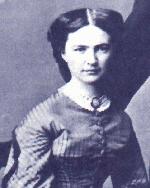 rm
that would not only change the atmosphere of a room, but would enhance the
beauty of each individual's personality that was present. In the autumn 1862,
she was twenty years of age; she was a very attractive woman, with a slender
built, brown hair, and blue eyes. She was properly educated, refined and
comfortable amid conversation with both sexes. Vivacious and appealing, she
understood the nuances of flirtation, of the shifting currents of attention and
affection between a man and a woman. Libbie had a splendid disposition and a
lovely temperament. She was superior in qualities that go to make up a noble
woman. To all that knew her, she was the one and only “Libbie.” Describing her
in a different and more profound way, she was trained to be a “Consort for a
King.”
rm
that would not only change the atmosphere of a room, but would enhance the
beauty of each individual's personality that was present. In the autumn 1862,
she was twenty years of age; she was a very attractive woman, with a slender
built, brown hair, and blue eyes. She was properly educated, refined and
comfortable amid conversation with both sexes. Vivacious and appealing, she
understood the nuances of flirtation, of the shifting currents of attention and
affection between a man and a woman. Libbie had a splendid disposition and a
lovely temperament. She was superior in qualities that go to make up a noble
woman. To all that knew her, she was the one and only “Libbie.” Describing her
in a different and more profound way, she was trained to be a “Consort for a
King.”
Bright, serious, and competitive, Libbie excelled as a student. The curriculum emphasized the development of a woman, or as the seminary's catalogue stated, the school sought to “cultivate, not only the mind but the taste and heart—to make Woman what she should be, not masculine, coarse and unlovely, but educated, and at the same time refined, and ready for good work that becomes her.” The young women studied French, literature and the dean's wife organized “Fine Arts,” Social activities. Parents were permitted weekly visits. Upon graduation, the educated young lady should be able to take her place alongside a husband, assisting him in his life's work and making their home comfortable.
Daniel S. Bacon was the father of Libbie Bacon. Mr. Bacon, circuit court judge was one of Monroe, Michigan's respected citizens. Allow me to point out; the Custer's didn't travel in the same social circle as the Bacon's.
Mr. Bacon was a transplant. When he arrived in Monroe with a teaching certificate and some money, he secured a teaching position and purchased ten acres of land and planted a nursery. Ambitious and dedicated to his dream he studied law, passed the bar and advanced in other enterprises and began to achieve more prosperity, and responsibilities in the community.
He married a very lovely lady in Monroe. They had one Son and three daughters. Libbie was the only surviving child; the mother passed on shortly thereafter. Libbie was 12 years of age.
Mr. Bacon, with Libbie's approval, married Rhoda Wells Pitts on February 23, 1859. With the passage of time Libbie and Rhoda became quite fond of one another. The terrible illness that befell Libbie in 1859 probably brought the two of them together. Her stepmother ministered to Libbie during those months of illness; the nature of the illness is uncertain.
Fully recovered, Libbie reentered the seminary and two years later graduated. Once again, she excelled at schoolwork, competing for the coveted rank of class valedictorians. At graduation she stood first in class and delivered the customary farewell address.
Her academic achievement particularly the final two years secured for Libbie lifelong friendships. Libbie and friends drew the attention of many young men. Seminary women belonged to Monroe's upper social class and offered prospective beaux acceptance within the city's most respected families. Libbie's physical attractiveness and spirited personality lured a variety of attentive men.
The War Between the States summoned many eligible young men from
Monroe. When they returned on leave, they drew attention in their uniforms from
their female friends. Libbie dreamed of marrying a soldier and accompanying him
to the battlefield. Her father did not approve of the visitors in uniform,
writing to his sister in 1862: “Libbie like her Aunt Harriet has many suitors,
many of the mustached, gilt-striped and Button kind, more interesting to her
than to me. My wife and I have a great deal of anxiety about
her, but I expect this is true of all parents of fanciful girls.”
At a
party given at the seminary on Thanksgiving Day, 1862, Libbie was introduced to
Brevet Captain George Armstrong Custer. Each knew of the other, but the Reeds
and the Custers did not socialize in the same circles as the Bacons. In fact
Libbie and her father had witnessed Custer's drunken stumble through the streets
the year before. When Conway Noble, a brother of one of Libbie's best friends,
introduced them to each other at the party, the conversation was brief. Libbie
remarked, “I believe your promotion has been very rapid?” “I have been very
fortunate,” he replied, and that ended the polite meeting.
Custer's
Biographers sugar coat his attentions and/or honor of his affections toward
Libbie. “They claim his subsequent letters to her are to be accepted as
sincere—and there is no evidence to suggest otherwise—he fell in love with her
that evening during the party at the seminary.” Allow his behavior pattern to
draw portions of his portrait, particularly this part of his portrait. Do you
remember the trundle bed and the young woman with whom he shared it? Remember
the beautiful love poems he wrote to her, declaring his undying love for her,
only to lose her for an appointment to West Point. Custer promising himself that
she was the only woman for him. As you have studied his behavior patterns, you
should have noted his crudeness in manner, lack of learning ability, immature
pranks whether it be in a church service or on the Plains at West Point, his
aggressiveness to achieve any selfish desire that he fancied. The Bottom line is
this: he is a complete donkey versus a treasure in human femininity such as
Libbie Bacon. His impulsiveness, kindled by his romantic nature, contributed to
his initial emotions. He viewed her as a challenge, a local belle who had
spurned numerous suitors. If Custer did not know already, he would learn shortly
that her father did not welcome attention to his daughter from a lowly captain
with an unsavory reputation. In his subsequent words, he confronted “well-nigh
insurmountable obstacles.” But that did not deter him. They seldom did, as
Libbie soon discovered. But this was Libbie's choice.
Libbie
did not care for Custer in the beginning. As the old adage goes “Fool with
garbage and a bit will rub off on you. That is what happened to Libbie. She
married him!
When
Custer returned to Monroe on September 16th , he intended to resume
the “attack” as Libbie described it months earlier. He was not a man easily
broken, even bent. But Libbie's feelings toward him seemed as confounding as
ever. Nettie, Libbie's dear friend wrote letters containing mixed signals,
indications both of irreconcilable difficulties and of a willingness to continue
the relationship. When Custer called, as Libbie told it later, she “saw him at
once, because I could not avoid him. I tried to, but I did not succeed.” In
fact, her resistance to him had all but ceased. She was in love with him and had
been for longer than she wanted to admit.
One
night, in her journal, she enthused: “I love him still. I know it is love from
fancy with no foundation, but I love him still and theory vanishes when practice
comes in to play. There is no similarity of tastes between us and I will never
think of it, but I
love him . His career is dear to
me.”
She
still enjoyed the attention of several young men, suffered from doubts about her
feelings toward Autie, and worried about her parents' objections to him. As an
obedient daughter, she should have rejected Autie, but he was unlike any man she
knew. She called it “my violent fancy for C,” believing that “I am under the
influence of it now.” Such emotions may pass within a year, she wrote in
mid-August, but “it seems as if devoted love for me influenced me even at this
distance. If it were possible I should say his spirit influenced and partly
controlled mine tho' miles separated us.”
Marriage.
Custer
by now has been promoted to the rank of general, Mr. Bacon has given his consent
and Libbie Bacon and George Armstrong Custer have now been joined in wedlock.
Reconstruction.
Because
the Confederate units were still operating in Texas, General-in-Chief Ulysses S.
Grant ordered Major General Philip Sheridan to New Orleans. Grant ordered
Sheridan to scour the whole state, and to be prepared for a campaign along the
Rio Grande. For two years, thousands of French troops had occupied Mexico,
overthrowing the government of Benito Juárez and installing Archduke Ferdinand
Maximilian as emperor of Mexico. The French had come on the pretext of
collecting debts owed to them by the Mexicans, but the real purpose was Louis
Napoleon's design to create as French empire in the Americas. While the War
Between the States raged, the Federal government objected officially to the
French, but with peace in the United States, military intervention to removes
Maximilian became an Option.
Grant
entrusted the operation to Sheridan, who chose Custer and Wesley Merritt as
cavalry Commanders.
Libby
Custer wrote later, that she and Custer were like children let out of school for
summer vacation. It was their first trip on a steamboat; neither of them had
traveled on a steamboat before. The scenery and the sights fascinated them. When
they arrived in New Orleans, the couple rented a room at the St. Charles Hotel,
and dined on the city's famous cuisine. New Orleans was different, she thought,
“everything has an air parisienne, and yet very Southern in its architecture.”
A block
from the St. Charles Hotel in an elegant mansion was the headquarters of Major
General Sheridan, and here Custer reported upon his arrival. Custer had not
expected the assignment, but when Sheridan asked, “Would you like to go with me”
in a confidential dispatch, he agreed. By the time Custer came to New Orleans,
Sheridan had been designating units for the campaign. In mid-June, Sheridan
telegraphed Grant that he had ordered Custer with 4000 cavalry to Houston;
Merritt with 4000 cavalry to San Antonio; the Twenty-fifth Corps, numbering
about 16,000 infantry and artillery, to Brownsville, across the Rio Grande from
Matamoras: and 7,000 men of the Fourth Corps to Galveston and Houston.
The
Custer's, domestic employees, and the general staff left by steamboat for
Alexandria, Louisiana on the Red River, the rendezvous site for the command.
Union forces had occupied Alexandria during the so-called Red River Campaign in
the spring of 1864. The town and its residents had suffered under the
occupation, with a number of houses either damaged or burned. A year later, the
scars remained evident, and in Libbie's words, “we found everything a hundred
years behind the times.” Custer selected a large, one-story, deserted house for
headquarters and residence. It had a long, wide main hall with spacious rooms
and numerous windows and doors that admitted every bit of air stirring.
The
first troops arrived on June 23rd, with the rest filtering in during
a fortnight. The command consisted of five veteran volunteer regiments, First
Iowa, Second Wisconsin, Seventh Indiana. Fifth and Twelfth Cavalry which Custer
organized into two brigades under Forsyth, Sheridan's former chief of staff, and
Thompson. The length of service among the regiments varied from less than two
years for the Seventh Indiana to nearly four years for the First Iowa.
To the
personnel of the regiments came a smoldering resentment. They thought the
Confederacy was finished. The war was over, and they deserved to be mustered out
like other units in the army. To their disgust, disappointment, misery and high
resentment they found themselves in the sweltering, mosquito-infested heat of
Louisiana, with a possibility of a campaign into Texas and even Mexico. While at
Memphis, the troopers of the Second Wisconsin had submitted a petition to be
disbanded. When the cavalrymen arrived at Alexandria, they were in no mood for
discipline, training, or restrictive orders. They had fought the war and now
they wanted to go home.
A
confrontation with Custer occurred within twenty-four hours of the first
companies' disembarkation at Alexandria. Local citizens complained to him on
June of the theft of property. He reacted by issuing an order that forbade
foraging, unless authorized by his headquarters. “Every violation of this order
will receive prompt and severe punishment,” the general declared. “Owing to the
delays of courts martial, and their impracticability when the command is
unsettled, it is hereby ordered that any enlisted man violating the above order,
or committing depredation upon the persons or property of citizens, will have
his head shaved, and in addition will receive twenty-five lashes upon his back,
well on.” If any officer failed to report violations, he would be arrested and
dishonorably dismissed from service.
Determined to impose his
will and authority from the outset, Custer had issued an arbitrary,
inflammatory, and illegal order. The Articles of War of the United States Army
required that any officer or enlisted man charged with the violations specified
by Custer should be tried before a general court-martial or before a civil
magistrate. Furthermore, the punishment of flogging had been abolished by an act
of Congress in August 1861. With this action, Custer exceeded his authority and
ignited a test of wills between him and the rank and file of the regiments.
When
Custer appealed to regimental commanders to punish those apprehended, the
officers defended the men's actions, arguing that they should be allowed a
“little liberty.” In no instance, Custer contended, did my efforts in this
direction succeed.
Through
Custer's neglect, soldiers under his command suffered. Hungry, exhausted,
medically ill, and abused, soldiers do not function normally.
When
Custer acted, he incurred the wrath of the men. While at Alexandria, he had a
deserter executed, but at the last moment spared the life of Lieutenant
Lancaster, who was convicted by a court-martial of mutiny against the commander
of the Second Wisconsin. Had he not relented, the soldiers of the regiment
threatened to kill General Custer. Lancaster was dishonorably discharged and
sentenced to three years of hard labor at Dry Tortugas Prison. Sheridan,
however, commuted the sentence, ordering his release in February 1866.
After
the incident, the men's hatred of Custer deepened, as rations remained scarce
and of poor quality; pork spoiled and was unfit to eat. By contrast, Libbie
wrote to her parents that they had ample supply of fruits and vegetables,
purchased cheaply for headquarter. In fact, Libbie enjoyed the weeks at
Alexandria, taking daily horseback rides with Autie and visiting former slaves
with Eliza. But she noticed her husband's difficulties with the troops and wrote
subsequently “they hated us, I suppose. That is the penalty the commanding
officer generally pays for what still seems to me questionable privilege of rank
and power.”
Inadequately supplied and
mounted, the command left Alexandria for Texas on August 8th. A day before, Custer issued his marching
orders. In those orders, Custer informed the officers and men that they were to
cultivate the friendliest feelings of the inhabitants of the region through
which they would pass.
The
march of 240 miles took nineteen days, much of it through country one trooper
thought seemed “as if even God himself had abandoned it.” During the first leg,
the column passed through vast pine forests, where the water was scarce and
foul. Custer had the command move in the cool of the mornings and evenings, with
drill after they encamped for the day. An Iowan claimed later that that nothing
during the war compared in hardship to this march to Hempstead. There were daily
desertions. Unable to forage without risk of punishment, the men were frequently
hungry because of the inadequate rations. Libbie Custer and Eliza endured it
all, with a spring wagon specially fitted for the general's wife.
Once
they crossed the Trinity River, the country opened into broad flatlands with
better water. The cavalry reached Hempstead on August 26th, and
established camp.
At the
end of the month, the commissary issued hardtack and hog jowls to the men. The
rations were not fit to eat, and numbers of the troopers foraged in the
vicinity, including a group from the Seventh Indiana that killed a calf. When
the owner protested to Custer, he investigated, arrested several, and had three
of them flogged and their heads shaved. Two weeks latter, a similar incident
occurred, and two privates received twenty-five lashes. The anger of the men
boiled toward Custer, with the lieutenant colonel of the First Iowa swearing
that the general would not touch another member of the regiment. Eventually, the
governor and legislature of Iowa condemned Custer Officially for his action.
These
whippings were the last recorded punishments of this kind. The rank and file of
the regiments never forgave Custer, and their later writings indicate the depth
of hatred toward him. They blamed him for “incompetence or criminal negligence”
in not securing adequate supplies and described his orders as inconsistent and
tyrannical. One of the soldiers offered an explanation for Custer's actions: He
was very immature, just barely 25 years of age, and had the usual egotism and
self-importance of a young man. He did not distinguish between a regular soldier
and a volunteer. He had no sympathy in common with the private soldiers, but
regarded them simply as machines created for the special purpose of obeying his
imperial will. It was a damning indictment of a commanding officer, and one in
stark contrast to the views of members of the Michigan Brigade and Third Cavalry
Division.
Custer's
Biographers are at work again to justify his actions. Quote: “But nothing in
Custer's experience had prepared him for the situation he encountered at
Alexandria. During the war, he had known only loyalty and devotion from the
officers and men of his commands. Bound in a common cause, he led and they
followed, with few discipline problems and with an officer corps of merit. He
attended to their welfare, but to be sure, the government met the needs of the
Union soldiers in the field. In Louisiana and Texas, however, Custer encountered
a rank and file whose sense of betrayal by the government fostered ill
discipline and strident resentment. While it would appear that any general would
have had difficulty with the regiment, Custer reacted with illegal punishment
and unbending discipline. Had he not imposed his authority, endorsed by
Sheridan, the men could have become marauders throughout the region. He deserved
credit for preventing this, but his methods in violation of the Articles of War,
cannot be justified.” End of Quote.
I agree
with the Biographer “His method in violation of the Articles of War, cannot be
justified.” An officer's authority and responsibility is within the law and
should not exceed his superior's guidelines. The Biographer mentions that the
government met the needs of the Union Soldier during the War Between the States.
Do not forget that the needs or/and supplies for the soldier is a combined
efforts of every supply echelon to keep these needs flowing. Evidently Sheridan
through his staff took excellent care of his subordinate commander. Custer on
the other hand evidently did not develop enough in the area of responsibility to
take care of his men. Knowing their attitudes he could have made an effort to
build their spirit and morale. Many general officers personally have had to
inspire their men. Napoleon had to do just that when he took over his first
command. Ragged and hungry and without shoes the men rallied and victory became
a reality. They were then clothed, fed, and moral was very high. Evidently
Custer was to busy socializing and having fun with Libbie to be concerned about
the personnel in his command. His officers were veterans and highly qualified.
What went wrong? Custer failed to perform, as a general officer should! Might
this be why he wore the label as boy general?
The
command remained at Hempstead for over two months. While there, the news arrived
that Louis Napoleon had ordered a withdrawal of French forces from Mexico, and
the duty now became that of an occupation force. Detachments patrolled the
countryside, welcomed by law-abiding citizens. On September 7th, the Fifth Illinois mustered out and left
for home. Discipline and supply problems still plagued the command, and about a
dozen troopers died of disease. The cooler autumn weather brought relief from
the smothering heat and humidity.
Custer's
tour of duty in Hempstead was more pleasurable than their time in Alexandria.
Shortly after their arrival, Nettie Humphrey, now Mrs. Jacob Greene, and Emanuel
Custer joined them from Monroe. Autie had secured for his father an appointment
as forage agent, a job with little to do and fine pay, in Libbie's words.
Nepotism was a common practice in the army, and Autie was never averse to having
a family member benefit from it.
In late
October, orders came for the command to proceed to Austin. Custer was to assume
the post as chief of cavalry of the Department of Texas. The cavalry departed
Hempstead on October 30th , arriving in Austin on November 4, after a
march of 124 miles
The
capital had been flooded with reports of lawlessness throughout the state and
with stories of marauding Indians. Texans professing loyalty to the federal
government risked their lives. Alleged secret organizations existed to undermine
the government's authority. These conditions were the reason that Custer was
ordered to Austin, and for the next three months detachments from the capital
patrolled sections of the state, enforcing the law.
Discipline and morale
problems still plagued the regiments that came with Custer from Hempstead. The
second Wisconsin, mustered out on November 15th, and left Austin two
days later. A Captain in the First Iowa wrote a letter home that detailed the
conditions of the march from Alexandria to Hempstead, blaming Custer. It was
published in a newspaper, and when Custer learned of it, he confronted the
officer, who admitted to it and refused to retract it. Furious, the general
grabbed a horsewhip, and the captain reached for his sword. Fortunately, a Major
stepped into the office, and the general backed down without receiving the
officer's retraction of wrongdoing.
Meanwhile, life for Libbie
was of another nature. Libbie enjoyed Austin. She said it was such a pretty
place and all the socials were a success.
In
Washington, on December 28th
, the War Department mustered out over a score of generals, including
Alfred Pleasonton, George Crook, Wesley Merritt, and Custer, and granted each
officer a thirty-day leave. For Custer, he reverted to the rank of captain in
the Fifth United States Cavalry. Daniel Bacon corresponded with Senator
Zachariah Chandler of Michigan, interceding on behalf of his son-in-law for a
promotion. Nothing came of it for the present, and on January 31, 1866, he
relinquished command.
By
horseback and wagon, the Custer's left Austin. With them were the domestic
servant and Custer's staff, who had been mustered out. After as few days in New
Orleans shopping and enjoying the social whirl they went on to their various
homes. In Monroe, Custer left Libbie with her father while he boarded a train to
go to Washington to testify before the Joint Committee on Reconstruction.
While in
the capital, he attended a dinner party at Chief Justice Salmon Chase and met
with Secretary of War Edwin Stanton, who greeted the officer with “Custer, stand
up. I want to see you all over once more. It does me good to look at you again!”
Custer had come to the War Department to request Regular Army commission for his
brother and George Yates, which Stanton promised to approve. In a letter to
Libbie, he wrote that “I am so lonesome,” and that he had refused to attend the
theater or opera without her.
On the
1st of April, he arrived
in New York City. Uncertain whether to remain in the Army, he looked at other
options. Rejecting the idea of diplomatic service, he came to the financial
center to explore business opportunities for himself. His fame assured him entry
into circle of wealthy individuals, who feted the war hero and spoke of the
possibilities, particularly in railroads and mining. In the end he did not
accept a lucrative position or invest monies. Already the age was being stamped
with the glorification of money and the men who acquired it. To Libbie, he
confided, “For you and you alone I long to become wealthy, not for wealth alone
but for the power it brings. I am willing to make any honorable sacrifice.”
Custer,
while in New York, had contacted a Mexican Diplomat, about the minister's search
for an adjutant general of the Mexican army. Grant wrote an excellent letter of
recommendation for Custer to the Mexican government. If accepted Custer would
have received $10,000 in gold. Every one in the military approved, except for
the Secretary of State. He did not want an officer of the United States
directing troops against French soldiers. If Custer wanted the command, he would
have to resign from the army, an action he refused to take.
Custer
became involved in national politics, which became very unpleasant.
Months
of uncertainty diminished and Custer accepted the rank of lieutenant colonel of
the seventh cavalry. Now with his leave expiring on September 24th ,
orders arrived for him to report for duty in Kansas, and the couple packed for
the trip.
Court-Martial.
In the
summer of 1866, Fort Riley had been designated as the organizational site for
the Seventh Cavalry, and here George and Libbie Custer arrived on October
16th. Accompanied by their domestic help and a friend of Libbie's.
They had traveled leisurely from Monroe visiting friends and taking in the
sights.
From St.
Louis, the couple completed the trip to the fort. Upon arrival, they moved into
one half of a double house for officers. The quarters were spacious, with ample
number of rooms and a wide veranda. Libbie soon had her home decorated to suit
her taste. She wrote “Our house is so comfortable and cherry, we have sunlight
in the parlor all day.” Carpet on the bedroom floor, a private dressing room,
and a large parlor for entertainment added to its appeal.
Libbie
was so pleased with the accommodations and with Fort Riley that she exclaimed to
her very dear friends, “we are living in luxury.” She shopped in a town
including the market place just four miles from Fort Riley, went on rides in the
evening with her husband, attended dinners and dances, and witnessed her first
buffalo hunt when a Russian Prince visited. Her major complaint was the wind,
which she said later, blew unceasingly all the five years we were in Kansas.
Custer
reported for duty on November 1 st and assumed temporary command of the
regiment. The War Department had instituted examinations for officers in the new
regiments, and on the ninth he departed for Washington, not returning until
December 16th. By then, Colonel Smith had arrived at the fort to take
command of the Seventh. Smith was a graduate of West Point, a year before Custer
was born, led dragoons on the frontier until 1861, and served at the divisional
and corps levels during the War between the States, attaining the rank of major
general. A competent officer, Smith was rewarded for his service with the rank
of colonel of the Seventh. His association with the regiment was nominal. On
February 27, 1867. He assumed command of the District of the Upper Arkansas,
relinquishing direction of the regiment to Custer.
The
desertion rate among the men was very high due to the caliber of recruits and
the harshness of military life in the postwar army. No longer did men enter the
ranks to save the union or any other patriotic notions. Instead, volunteers
enlisted either to seek employment, to flee a shadowy past, or to seek
adventure. Recent immigrants, mostly from Germany and Ireland accounted for the
majority. Many officers through neglect of their men caused disrespect and
destroyed morale. For instance, poor and spoiled food, unfit quarters, and
disease added to the morale problem.
Of the
officers who reported for duty with the Seventh Cavalry during the summer and
autumn of 1866 and winter of 1887, a number of them would become an integral
part of the regiment's record and history. All of the officers were Civil War
veterans, with solid, if not distinguished records in most cases. Some became
excessive drinkers and I will introduce them individually at the proper time
and/or place.
Robert
M. West had received a brevet brigadier general during the War Between the
States, temporarily commanding a cavalry division during the conflict's final
months. He had little or no respect for Custer from the first day they met.
Of all
the captains, no one was more destined to shape the internal dynamics of the
regiment and history's verdict of it and Custer Than Fredrick W. Benteen. A
native Virginia, Benteen rose from lieutenant to lieutenant colonel in the war,
serving at the end under Custer's rival, James H. Wilson, during the so-called
Selma Raid. His bravery and capability as an officer were unquestioned, but
while he had a backbone of steel, he possessed a soul of vinegar and a low
tolerance for braggarts and irresponsibility people like Custer. Benteen was the
antithesis of Custer. Later, he said that he had sized Custer as boisterous
braggart during their first meeting when the latter read his congratulatory
order to the Third Cavalry Division to Benteen and as “demi-semi- quaver” after
an all-night poker game. His disrespect for Custer worsened with the passage of
time.
Factionalism among officers
infested every regiment. Within the army' caste system, in which promotion could
be measured in decades now that the conflict had ended, and within the intimacy
of post life, human frailties of pettiness, jealousy, and resentment festered.
Favoritism by a regiment commander could mean assignment to better companies,
favorable recommendations, and increased opportunities for advancement. In a
profession that measured authority, status, and pay by defined ranks, perceived
or real preference ignited internal disputes that caused divisions among
members. The effects of such internecine turmoil could weaken morale and the
combat prowess of units.
While
the internal dissension in any regiment cannot be dismissed, this was not
necessarily Custer's real problem. If Custer didn't choose Reno, and Benteen, it
was his choice to retain them on his staff or as troop commanders. Custer
defended both officers many a time, saying that they were experienced and loyal
officers, and that he had complete confidence in their abilities. Much time has
been wasted with historical inquiry concerning factionalism in the Seventh
Cavalry of the United Stated. No commander has ever enjoyed the loyalty and
obedience of his officers whether friendly or unfriendly as Custer enjoyed.
From its
birth, the United was as much an idea as a country. For those who were here and
for those who would come, it offered the opportunity for betterment. America
rewarded hard work and ambition. To Americans, progress “individual and
collective” characterized the human saga, and in America it meant the conquest
of the wilderness. The settlers put forth every effort to resist the land and
nature.
This
includes extermination of the Indians. Unrelenting in numbers that seemed
greater than the forests, the whites came, wresting the land from the natives,
banishing the tribes from the course of American society. At the end of the
Civil War, the Great Plains remained the largest final homeland of the Indians,
and here white Americans sought further expansion of civilization progress.
By
official estimates, 270,000 Indian in 125 groups dwelled in the country in 1866.
Of that population 100,000 could oppose the army and white settlers, with most
of them in the nomadic tribes of the Great Plains, “Sioux, Cheyenne; Arapaho,
Kiowa, and Comanche.” These tribes were proud, independent; they roamed the
land, following the uncounted herds of buffalo, relying on the beast for food,
clothing, shelter, and tools. Their religions and cultures revered nature; their
societies honored warriors, Plains warriors were superb horsemen and masters of
guerrilla warfare. While tribalism and intertribal animosities weakened Indians'
resistance to the whites, they were formidable opponents, mounted fighters who
when seen in single file on a horizon's edge portended a fearful resolution
between cultures divided by a chasm of blindness and misunderstanding.
Before
the War between the States, officials from Washington negotiated treaties that
reserved land drained by the North and South Platte rivers and the Arkansas
River for the Southern Cheyenne, Arapaho, Comanche, Kiowa, and Kiowa-Apache.
During the four-years of conflict between the North and South, white incursions
were met with Indian raids in Colorado, Kansas, and Nebraska. The killings
mounted, climaxing in the Sand Creek Massacre of Southern Cheyenne by Colorado
cavalrymen in November 1864. The Cheyenne lashed back until some bands signed a
treaty of peace in October 1865. The summer heat of 1866 brought a renewal,
particularly from the Sioux, who resisted the opening of the Bozeman Trail into
the Montana goldfields. The Sioux waged war into the winter, killing every
member of an 81-man force under Captain William Fetterman, near Fort Kearney, on
December 21st. Fetterman, stationed at Fort Kearney a character
similar to Custer also disobeyed his commander's orders, attacked what he
thought was a small detachment of Indians, but instead of being a small
detachment, it was proper size and properly maneuvered led by no other than a
young warrior who is now known as Crazy Horse.
By the
end of 1866, the army stood at the center of white America's confusion and guilt
over its relationship with the Indians. From the west, legislatures, citizens,
and railroad companies clamored for protection; from the east, politicians,
bureaucrats, religious organizations, and humanitarian individuals proposed
peaceful solutions. Congress mirrored its divided constituents—members of the
House of Representatives supported the use of force, if inexpensive, while
senators argued for negotiation with the tribes. The policy followed the worn
road of treaties that placed tribes on reservations, with the government
responsible for the welfare of the Native Americans. The bands that accepted
reservation life were classified as friendly Indians and those that refused were
classified as hostiles. The policy with its ambiguities and contradictions
guaranteed war.
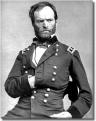 The Mad Man , Major General
William T. Sherman, commander of the Military Division of the Missouri, whose
authority embraced the Great Plains, learned of the Fetterman Massacre, he
asserted, “We must act with vindictive earnestness against the Sioux, even to
their extermination, men, women, and children. We must declare Total War.” It
shouldn't be to difficult, for Sherman to do so, he waged total war on the
little children, women and the old folks in the South; depriving them of shelter
and food by burning their homes and destroying all food commodities during the
War between the States.
The Mad Man , Major General
William T. Sherman, commander of the Military Division of the Missouri, whose
authority embraced the Great Plains, learned of the Fetterman Massacre, he
asserted, “We must act with vindictive earnestness against the Sioux, even to
their extermination, men, women, and children. We must declare Total War.” It
shouldn't be to difficult, for Sherman to do so, he waged total war on the
little children, women and the old folks in the South; depriving them of shelter
and food by burning their homes and destroying all food commodities during the
War between the States.
The
army's initial campaign against the tribes of the central and southern plains
came with warmth of spring in 1867. Following a tour of the region during the
previous year and responding to the arguments of government officials, railroad
executives, and the citizenry, Sherman had proposed to army commander Grant,
that the Southern Cheyenne, Arapaho, Kiowa, and others be settled south of the
Arkansas River, and the Sioux be moved north of the Platte River. With the
relocation of the tribes, a wide swath of Nebraska and Kansas would be opened to
the railroad and to white homesteaders. With Grants approval, Sherman ordered
two forces into the field. While the operation against the Sioux was stalled by
a delegation sent from Washington to negotiate, the second prong advanced into
the area between the Smoky Hill and Arkansas rivers in late March 1867.
Sherman
assigned the campaign against the southern tribes to Major General Winfield
Hancock. In his instruction, Sherman directed Hancock to confer with them to
ascertain if they want to fight, in which case he will indulge them. A very tall
man with a definite bearing of a professional officer, Hancock had been one of
the Union's finest generals during the war, but he had no knowledge of Indian
culture or experience in Indian warfare. His first act was to impress the
Indians with military might; he gathered a force of 1,400 troops, the largest
force yet arrayed against Plains Indians, comprising eleven companies of the
Seventh Cavalry, seven companies of the Thirty-seventh Infantry, and an
artillery battery. Departing Fort Riley at the end of March, the command arrived
on April 7th at Fort
Larned, where Hancock expected to meet with the tribal chiefs.
Fort
Larned was located on Pawnee Fork, on tho southern fringe of the traditional
buffalo range of the Southern Cheyenne, and Arapaho. Various bands of Indians
had spent the winter in the region, and by the time Hancock reached the fort, a
large village of Cheyenne, Arapaho, Kiowa, and Southern Brulé and Oglala Sioux
lay thirty-five miles upstream from Larned. W. Wynkoop and Jesse H. Leavenworth
were Indian agents assigned with the army, both of whom assured Hancock that the
chiefs sought peace, although factions—primarily young warriors—opposed
concessions to the whites. Division within the tribes was as fractious as it was
within the councils of their enemies.
In the
middle of April, after a delay caused by a snowstorm and a buffalo hunt, a small
delegation of chiefs met with Hancock and other officers, including Custer, at
the fort. Hancock spoke of peace, asserting that Indian raids against railroad
construction crews, settler cabins, and stagecoach must cease, or the chiefs
would be responsible for War. Disappointed with the number of chiefs who had
come to the fort, he then announced that he would march to the village for a
council. The chiefs departed, after consenting to the passage of the army
through their land. The two Indian Agents warned Hancock that such a force would
frighten the Indians, whose memories of Sand Creek remained fresh.
On the
morning of the thirteenth, the troops marched twenty-one miles, upstream before
encamping. White Horse of the Cheyenne and Pawnee Killer of the Sioux visited
the campsites, and Hancock agreed to meet the next morning with all the chiefs.
When the leaders did not appear on the fourteenth, the general ordered his Army
to march to the village. Proceeding a few miles, the column stopped before a
line of Cheyenne and Sioux warriors on the crest of a ridge. To Custer, the
sight was “one of the finest and most imposing military displays, prepared
according to the Indian art of war, which it has ever been my lot to behold. It
was neither more nor less than an Indian line of battle drawn directly across
our line of March; as if to say, Thus far and no further. Most of the Indians
were mounted; all were bedecked in their brightest colors, their heads crowned
with the brilliant war bonnet, their lances bearing the crimson pennant, bows
strung, and quivers full of barbed arrows.”
The
atmosphere is filled with charges of hostility induced by both sides created
from the lack of faith. Consenting to a meeting with Hancock, several chiefs
rode to a point midway between the groups, spoke with the general, and agreed to
allow the troops to bivouac near the village. The chiefs reported that the women
and children had fled upon the approach of the army. More negotiation ensued,
ending with a promise that the women and children would return to the camp.
After dark, an interpreter informed Hancock that the chiefs were preparing to
leave. Hancock ordered Custer to surround the village with cavalry. While the
troopers were moving into position, Custer with a small party crawled forward to
a lodge. Discovering the entire village was deserted, with evening meals
simmering in kettles. Only an elderly Sioux male and a small child remained.
Deserting a camp or village in this matter is an Indian tactic to save their
families from being butchered by the army.
Hancock
was furious for the Indians had out maneuvered him. He immediately ordered
Custer in pursuit of the Indians. Custer followed the trail by marching
northwest. Throughout the day, however, the size of the track narrowed as bands
of Indians, like eddies from a stream, dispersed from the main body. It was a
common native tactic, and one Custer would never forget. Custer executed another
personal blunder. He rode away, accompanied only by his dog from his unit to
hunt buffalo. While chasing a young bull he accidentally discharged his pistol
and the beast turned on him, killing Libbie's favorite horse. Some time
afterwards a squad of men found him, retrieved his saddle and brought him safely
back to his command.
Custer
marched during the night of the sixteenth-seventeenth. Before the cavalry
marched, he sent a message to Hancock: “The hasty flight of the Indians, and
their abandonment of, to them, valuable property convinces me that they are
influenced by fear alone, and it is my impression that no council can be held
with them in the presence of a large military force.”
Around
4:00 a.m. on the seventeenth the troopers forded the Smokey Hill River, and
encamped. A detachment scouted ahead for the stage line, followed hours later by
the main force. In a mixture of cold rain and sleet, they plodded east on the
eighteenth, reaching the ruins of Lookout Station that had been burned by a
party of Indians, They found the charred remains of three men and buried them.
Custer could not identify the attackers or locate their trail and, without
forage for the mounts, marched to Fort Hays to the east, having covered roughly
150 miles in four days, exhausting men and horses. Hancock, meanwhile, despite
the protests of the Indian agent, burned the village of 250 lodges on Pawnee
Fork. The flames ignited a bloody summer.
The
Seventh established a camp along Big Creek about half-mile from Fort Hays,
Custer found neither adequate forage nor the supplies that he had expected.
Within days of the command's arrival, men began deserting, a dozen of them
fleeing with horses and arms during a single night. As conditions worsened, with
surgeons reporting numerous cases of scurvy, dozens more disappeared. By the end
of May, ninety had fled. While requested additional rations and sent parties out
to kill buffalo, shortages persisted. As he had in Louisiana and Texas, he
reacted with harsh discipline, on one occasion shaving the heads of six men who
had left camp to buy canned fruit from a settler. Although they were away less
than an hour and missed no duty or roll calls, he imposed the punishment, which
Captain Albert Barnitz described as “atrocious” because all the men bodies were
in great need of fruits and vegetables.
In a
letter to his wife, Barnitz wrote a scorching description of Custer, accusing
him of being a mad man, and tyrannical in conduct. He is really quite
obstreperous and that he would lose whatever little influence for good that he
may have once possessed in the Regiment.
Theodore
Davis, a correspondence-artist for Harper's weekly, visited Fort Hays, and
described Custer as depressed and of sober mien. Davis stated also that he had
never seen him so moody. Custer had been duped by the enemy, knew it, and
allowed it to gnaw at him. In his first independent operation with the Seventh
Cavalry, he had lost the quarry—a Civil War hero outwitted by Indians. The
experience sobered him and depressed him. The conditions at Fort Hays only
exacerbated his mood, and when discipline infractions and desertions mounted, he
reacted severely.
Custer
allowed his personal problems compound his professional difficulties. He had
been away from his wife for no longer than two months, and he was yearning for
her. He wrote her a letter describing his loneliness.
Libbie,
Anna Darrah, and the housekeeper, traveled in an ambulance under escort arriving
at the Big Creek Camp a week after Custer wrote the second letter. In the
meantime Custer had prepared a large tent with a wooden floor, given to him by
Colonel Andrew Smith for them. Additional tentage was provided for the rest of
Libbie's entourage. They would be together for just a short time, perhaps a
fortnight.
In a
letter, Custer informed his wife that he had voiced in writing ‘Strong”
opposition to “an Indian War, depicting as strongly as possible as I could the
serious results that would follow.” But whether or not the army wanted a war,
the Kansas- Nebraska frontier had a minor one in the wake of Hancock's
destruction of the village. Parties of Sioux, Cheyenne, and Arapaho warriors
attacked railroad construction crews and stagecoach stations and killed
settlers. Reports of marauding Indians—many false—inundated the forts, and at
Hays, Custer assigned a detachment of men to the stations and sent out patrols,
with instructions to kill every Indian encountered, regardless of age or sex, if
they were not judged to be “friendly,” Hancock and Smith visited with him to
confer about countermeasures, by the end of May the prairie belonged to the
Indians.
A native
of Michigan, Comstock had apparently lived with Indians for two years and knew
the country between Hays and McPherson as well as any white man. He guided
Custer across the 220 miles without difficulty, arriving on June
10th. On the
7th, the cavalry had encountered about 100 warriors, who moved away
without incident. The only tragedy on the march had been Major Wyckliffe
Cooper's suicide, which Custer attributed to alcohol.
At
McPherson, Custer met with several of the Sioux Chiefs to induce them to bring
their lodges into the vicinity of the Fort, and remain at peace with the whites.
The Chief's rejected the proposal but assured him of their peaceful intentions.
Sherman arrived on the following day, and when Custer related his discussions
with the Sioux, Sherman scoffed at their desire for peace. Instead, Sherman
directed the subordinate officer to search for the Sioux by scouring the region
along the forks of the Republican River and the South Platte west of Fort
Sedgwick in Colorado. If he overtook any Indians, Sherman granted Custer
permission to pursue in any direction.
During
the conversation, Sherman mentioned that Custer could be retained along the
Platte and the tracks of the Union Pacific Railroad into the autumn. Sherman
further stated if Libbie desired to join her husband, he would arrange for
railroad passes, but she should wait until she heard from her husband at
Sedgwick. Custer recounted Sherman's words in a letter, dated June
17th, but suggested to her that if she could travel to Fort Wallace
on the Smokey Hill route. “I will send a squadron there to meet you.” I am on a
roving commission,” he noted near the end, “going nowhere in particular, but
where I please.”
The
Seventh Calvary started from McPherson on the same day he wrote to Libbie. The
Regiment covered 110 miles to the fork in the Republican River, encamping on the
21st. Here Custer
decided that he would secure supplies from Wallace, instead of Sedgwick as
Sherman directed, both being roughly seventy-five miles from his campsite. On
June 22nd, he detached Lt. Robbins and Co. D, with twelve wagons, to
Wallace, and ordered Captain West and Co. K on a scout on mission to Beaver
Creek, south of the Republican. If Libbie were at Wallace, Robbins was
instructed to return with her. On the following day he sent Major Joel Elliot to
Sedgwick with a report and to secure additional orders.
At the
Republican campsite, the remaining troopers spent the 24th repulsing
an attempt by Sioux to scatter their horses, parleying with Pawnee Killer,
pursuing the Indians, and fending off an attack. The Sioux's aggressiveness
convinced Custer to send Captain Myers and Co. E to Beaver Creek, to locate
West's company, and together, to escort the supply train from Wallace. It was a
wise decision; because the two companies overtook the wagons on the
twenty-sixth, while under attack by an estimated 300 Cheyenne and Sioux under
Roman Nose. The Indians retreated and the fight ended and the companies and the
supply train joined Custer the next day. Libbie had not been at the fort, but he
learned that the Indians were raiding along the Smoky Hill Stage line and had
attacked Wallace's garrison six days earlier.
Custer
had encountered Indians, and under Sherman's original instructions, he was
authorized to use his judgment. When Elliott's party returned on the
28th without new orders but with a suggestion from Colonel Augur to
operate on the Smokey Hill lines, the Seventh's Commander had sufficient
evidence to indicate that the raiding bands were targeting the forts and
stations on the route. Instead, complying with Sherman's orders, he marched west
along the South Fork of the Republican River before turning north toward the
Platte. In the sweltering summer heat, across a tract of waterless terrain, he
pushed his troops. His concern for Libbie's whereabouts and welfare had
increased, “I have never suffered from so much anxiety in my life.” In other
words, his responsibility to his command was over whelmed by his personal
desires and interest. This is what separates a boy general from a more
professional and dedicated general. He led his command toward the Platte hoping
that she had gone to Sedgwick instead of Wallace.
The
cavalry reached Riverside Stations on the Union Pacific Railroad west of Fort
Sedgwick on July 5th.
The last 60 miles had been a grueling march, and when they arrived,
thirty men deserted during the night. Custer wired Sedgwick for orders and
learned that Lt. Kidder and a detachment of the Second Cavalry had been sent
with instructions toward the Republican River. The commandant at Sedgwick
repeated the orders carried by Kidder, which directed Custer to Fort Wallace,
where the Indians had attacked a second time on June 26th. Along the Smokey Hill route, the
conditions had worsened, and Sherman under pressure to punish the warriors,
needed and wanted Custer's regiment.
Short of
supplies, Custer started for Wallace the next day. His urgency, in part, he
attributed later to the “great anxiety” about the fate of Kidder's party.
Consequently, he drove his command in a forced march, and after a noon halt,
thirteen men rode away in an effort to desert. Outraged, he ordered Major
Elliot, several officers and troopers, to bring them back, either dead or alive.
When Elliott's detachment overtook the deserters, one of them fired at the
Major. The detachment responded, mortally wounding one, and wounding two more.
Upon their return to camp, Custer ordered the surgeon not to treat the men.
The
March resumed at daylight, and after four gruesome days, the troops found the
remains of Kidder and eleven men south of the Republican River. They had been
dead about ten days, their bodies were a sight that paled the hardest of men,
and a burial detail dug graves. From there, they continued south, arriving at
Wallace on the thirteenth, having covered 181 miles in a week.
Expecting orders and
possible news about Libbie at Wallace, Custer found neither. Assigning Elliott
to command, he instructed troop commanders to select a dozen men with the best
mounts from each of the six troops for a detail. On the evening of the
fifteenth, with three officers and seventy-two men, Custer left Wallace, riding
east on the Smoky Hill route. It was the beginning of a journey into
controversy.
In his
memoirs, Custer argued that he undertook the trip to secure supplies at Fort
Harker because the reserve of stores at Wallace was well nigh exhausted, to
obtain new orders, to gather additional horses, and to forward medical supplies
to treat cholera victims. Except for the remark about orders, the reasons cited
by him were not true. In fact, Myles Keogh, who was at Wallace, asserted that he
had a month's supply of stores at the fort, and cholera had not struck yet at
Wallace. Instead, Custer offered rationalizations for his conduct that he came
to believe. The truth he chose to hide.
Upon his
arrival at Wallace, his apprehension about Libbie reached a breaking point. The
fears for her overrode his judgment and thus losing his focus on his
professional responsibility. Since he had left her at Fort Hays on June
1st, he had allowed his desire to be with her to affect his conduct
of operation. No other explanation of his risking the lives of men in a
dangerous ride from Wallace seems credible. Custer's conduct cannot be justified
and was deserving of the subsequent court-martial proceedings.
Some
have charged that Custer had ridden from Wallace in a jealous rage. In their
version, he had learned in a letter from an officer that Eliza was urging him to
hurry to Fort Riley to look after his wife a little closer. Allegedly, Lt Weir
and Libbie had been together too often. They diluted this charge by informing us
that Benteen, who hated Custer, was the perpetrator. Benteen was a superb
officer. If this were not Custer would not have had him in his regiment. As far
as documented evidence is concerned, there seldom ever exists any concrete
evidence of wrongdoing between male and female. They are often clever and
careful not to leave discriminating evidence behind. We do know that Libbie was
a flirt.
Relentlessly, Custer pushed
the detachment across the Kansas plains. En route, he met Benteen and wagons
with forage and two mail stages that he searched through for letters from
Libbie. East of Castle Rock Station, a trooper deserted with his spare horse,
and Custer ordered Sgt. Connelly with a detail of six men after the culprit.
Capturing the trooper at the station, the party started back for the main body,
but was attacked by Indians, who killed one man and wounded another. Connelly
overtook Custer at Downer's Station and reported the incident. Upon learning of
it, the men clamored to find their comrades, but Custer refused, although Capt
Hamilton interceded twice, asking for permission and warning that the men
threatened mutiny. Unswayed, the commander led the column east, arguing later
that he believed both men were dead and that the warriors were gone. In fact, an
infantry detail located the victims and found the wounded man to be alive.
Early on
the morning of the 18th,
the exhausted officers and men reined up at For Hays, nearly 150 miles
east of Wallace. In an almost unending march, they had covered the distance in
roughly fifty-seven hours. At Hays, Custer left the detachment with Hamilton,
ordering him to continue to Ft. Harker after a rest. During the night, twenty
men deserted. Custer, meanwhile, with Tom Custer, William Cooke, reporter
Theodore Davis, and an orderly left Hays in two ambulances. About nine o'clock
that night, the party met a supply train, which had orders for Custer to remain
at Wallace and operate between the Platte and Arkansas rivers. “The cavalry
should be kept constantly employed,” the instructions read.
The
ambulance rolled into Harker before 2:30 A.M. on the 19th, and
immediately Custer awoke Colonel Smith, district commander, spoke with officer,
and then boarded a train for Riley at three o'clock. Later that morning, he was
reunited with Libbie. Back at Harker, meanwhile a clear-headed Smith learned the
details or the ride from Wallace and telegraphed his subordinate to return to
Wallace at once, unless ordered otherwise. Custer sent a telegram, requesting a
delay, but Smith denied it. The earliest that the couple could secure passage on
a train from Riley was on the 21st, and when Custer reported that
day, Smith placed him under arrest for leaving his command without permission.
Winfield Hancock wired Smith the next day, asserting that Custer should have
been arrested as his action was without warrant and highly injurious to the
service, especially under the circumstances.
On
August 27, Grant ordered a general court-martial of Custer to convene at Fort
Leavenworth on September 17. Smith had charged Custer with absence without leave
from his command, with one specification, or instance, and with conduct to the
prejudice of good order and military discipline, with three specifications. In
the latter charge, Smith specified that he did seriously prejudice the public
interest by over marching and damaging the horses, used the ambulances without
authority, and neglected his duty by not trying to recover or bury the bodies of
the two troopers. Captain West of the Seventh filed a charge that accused Custer
of ordering that deserters be shot down without trial and of denying the wounded
men medical treatment.
Custer
pleaded not guilty and spent the weeks before the trial preparing a defense with
the assistance of his council, Captain Parsons of the Fourth Artillery, a former
academy classmate of his. In time, Custer became convinced of his innocence, and
if Libbie is to be believed, they regarded the trial as nothing but a plan of
persecution for Autie, blaming Hancock for it to cover up the failure of the
Indian expedition.
The
court found Custer guilty of all three charges but cleared him of criminality in
regard to the ambulances and the treatment of the deserters. The members ruled
that he should be suspended from rank and command for one year, and forfeit his
pay for the same time period. On November 18th, Sherman stated
officially that Grant had approved the findings and sentence, noting that the
levity of the sentence, considering the nature of the offenses of Brvt. Major
General Custer if found guilty, is to be remarked on.
The
Custer's reacted with indignation at the verdict and sentence. The couple had
persuaded themselves that the court had been prejudicial and improperly
constituted. The sentence is unjust as possible, Libbie asserted in a letter.
Custer wrote to a former Third Cavalry Division Officer, denying the accusations
and criticizing the court. The officer gave the letter to an Ohio newspaper,
which printed it. When court members read Custer's words published by other
newspapers, they asked Grant to take action, but he allowed the furor to
subside.
The
Kansas and Nebraska frontier and its native inhabitants had defeated Custer.
Seemingly, his opponents, the weather, supply problems, and terrain had
intimidated him. His actions had resulted in desertion and the deaths of men. He
had allowed his concern for his wife to affect his judgment adversely. When
confronted officially with the consequences, he deluded himself into believing
that he had been unjustly accused and treated. In their quarters at Fort
Leavenworth, as winter settled over Kansas, the Custer's were together, united
in their deluded beliefs.
When the
War Between the States ended, Major General Sheridan, the hero of the Shenandoah
Valley and Appomattox campaigns assumed command of Reconstruction in Louisiana
and Texas. For almost two years. Sheridan and his administration angered white
Southern citizens and exasperated President Andrew S. Johnson, whose policies
the general opposed. Finally a dispute with the governor of Texas resulted in
Sheridan's removal from command in the summer of 1867, and after a six- month
vacation, he reported to Fort Leavenworth, Kansas, on March 2, 1868 as commander
of the Department of Missouri. On the Kansas plains, the winds were always a
discomfort because they continue to blow without ceasing and the velocity
strong.
The
department comprised four military districts, with 6000 military personnel and
twenty-seven forts and camps. The military objective had not changed since the
previous summer when Winfield S. Hancock, was charged with the responsibility of
protecting the region between the Platte and Arkansas rivers. This failed
campaign led to the relief of Hancock from the Department and replaced by
Sheridan and spurred debate over Indian policy. Congress created a peace
commission whose purposes were to secure the area between the rivers for white
settlement and to concentrate tribes on reservations. Reformers and peace
advocates regarded the Indians as misguided creatures that could be placed on
designated lands to be Christianized and taught to be farmers. By its title, the
commission reflected optimistic assumptions, “misunderstandings” that would
encounter a different reality on the frontiers.
Commissioner of Indian
Affairs Nathaniel G. Taylor led the delegation of three senators and three
generals to a wooded valley along Medicine Lodge Creek in Southern Kansas in
October 1867. Chiefs from the Kiowa, Comanche, Cheyenne, and Arapaho met with
the commissioners, signing a treaty that ceded their traditional hunting grounds
between the Platte and the Arkansas and accepted reservations in Indian
Territory, present-day Oklahoma. In return, the commissioners promised annuities
for thirty years. Months later, at Fort Laramie, Wyoming, the Sioux agreed to
relocate on a huge reservation, which included nearly all of present South
Dakota west of the Missouri River. The treaty also granted the Sioux hunting
rights in Nebraska and Wyoming north of the Platte River and designated as
“unceded Indian territory” the Powder River County of present Montana, barring
all white incursion without consent of the tribe.
Words on
paper will not bring harmony or create peace between the whites and Indians. An
Officer of the Seventh Cavalry was present at Medicine Lodge Creek and made a
notation in his journal that the tribes have no idea that they are giving up, or
that they have ever given up the country which they claim as their own, the
country north of the Arkansas. The treaty all amounts to nothing.” He believed
that war was inevitable because of the Indians misinterpretation.
The
Southern Cheyenne reported to Fort Larned to receive promised supplies, arms,
and ammunitions. When the superintendent refused because of a Cheyenne raid on a
Kaw Indian settlement the previous month, the Indians were angered. After much
discussion the superintendent relented. On their return home, near midmorning on
October 9, 1868, a large band of painted, feathered warriors swept off the sandy
hills, tearing down upon a civilian caravan of wagons returning to Kansas from
Colorado Territory along the Old Arkansas Road. The Kiowas and Cheyenne's caught
the white farmers by surprise some ten miles east of the mouth of Sand Creek.
With war
cries and flapping blankets, they scared off the loose livestock that
accompanied the settlers' train. The few oxen and cattle of the first rush left
behind were hitched to the wagons. Before the first sun went down on those
farmers, the warriors finished off the harnessed animals, leaving the oxen to
die a slow and noisy death, while the battle raged on.
The
siege lasted for days with no hope for reinforcements. Early the third morning
the Indians captured Mrs. Clara Blinn and her two- year- old Willie. The
warriors finally decided that they had punished these intruders enough; they
hoisted their booty and two captives atop war ponies and raced for encampment to
show off their booty and captives to their cohorts. Mrs. Blinn's seriously
wounded husband and the wagon master were the only survivors left to limp on
into Fort Lyon.
It
wasn't long after the capture of Mrs. Blinn and her son that those same young
warriors sent word to the pony soldiers and Brevet Major General B. Hazen,
commander at Fort Cobb down in Indian Territory, stating their desire to ransom
the white woman and her son.
No one
in the army's higher echelons would wager on who the captors were—Cheyenne or
Kiowa or Arapaho. An unfortunate ignorance, for at the same time, from his
winter camping grounds along the Washita River, Cheyenne Chief Black Kettle
began to mediate the negotiations between the Army's General Hazen and those
warriors holding the captives. Just when it looked like Black Kettle and the
white general would make some progress in ransoming the white prisoners, General
Sheridan himself learned of the negotiations and would destroy Hansen's peace
process on the spot.
For
reasons of his own and mostly because he wanted war and to fulfill his promise
to Custer, Sheridan accused Black Kettle of being the instigator of all the
atrocities created by the Indians. It is common knowledge that Black Kettle had
done more than any other man to promote peace between the Cheyenne and the white
man. Black Kettle had less than 90 warriors, the rest of his tribe consist of
old men, old women and young boys and girls.
In
Kansas in the summer of 1868, Sheridan confronted irate settlers, businessmen,
and politicians who demanded the punishment of the marauding warriors. The
slayings on the Saline and Solomon rivers ignited weeks of fury in the state.
Sheridan's primary concern was the protection of the Kansas Pacific Railroad and
the settlements. He transferred his headquarters to Fort Hays and sent out the
Seventh Calvary and the black “buffalo soldiers” of the Tenth Calvary in
counterstrikes that brought few results.
Sheridan
created an elite force of scouts in August; it was composed of frontiersmen,
under Forsyth. When the scouts discovered a village on the north fork of the
Arikara in eastern Colorado, on September 17th,, the Sioux, Cheyenne,
and Arapaho attacked. For nine days on an island, Forsyth's repulsed Indians
sorties with Spencer repeaters, they suffered casualties that amounted to half
of the command.
Sheridan's frustrations with
the army's failures to subdue the Indians had boiled over. Nowhere on the Kansas
frontier were settlers safe, with scores of them dead and with hundreds of
livestock driven off by the raiding parties. Sheridan now regarded the
Cheyenne's and Arapahos at war, and wrote on September 19th, “that it
will be impossible for our troops to discriminate between the well disposed and
the warlike parts of those bands and absolute separation be made.” He directed
Colonel William Hazen at Fort Cobb in Indian territory to order all friendly
bands to use the post as their agency, For the Indians who refused to comply,
the commander proposed retribution.
Sheridan
had concluded also that he required the services of an officer who could bring
energy and aggressiveness to the operations. When Sully returned after only one
week in the field with a force of infantry and cavalry, Sheridan dispatched a
telegram to Custer in Monroe Michigan, dated September 24th, the
message read: “Generals Sherman, Sully, and myself, and nearly all the officers
of your regiment have asked for you, and I hope the application can be
successful. Can you come at once?”
Despite
his respect and affection for Sheridan, Grant did not pardon Custer, most likely
because of the officer's letter that had appeared in the newspapers condemning
the court's verdict and its members. By September, however, Custer had been out
of the army for ten months, and when Sheridan requested his services, the War
Department wired Custer on the twenty-fifth: “The remainder of your sentence has
been remitted by the Secretary of War. Report in person without delay to General
Sheridan, for duty.
It was
only natural, following his court-martial, that the Custer's would return to
Michigan, hearth and home for both Bacons and Custer's alike, to endure that
awful year. Still, each night like this particular evening at suppertime, Custer
drew some small measure of satisfaction knowing one more day of private torture
had drawn to a close. This particular evening, Libbie appeared to be more
buoyantly in spirit trying to lift her husband's spirit to match hers because he
felt very low with so much time on his hands and being denied military
participation for one year. As she called the family to dinner, “Boston his
younger brother was with them as well as Audie his young nephew”, she announced
supper, and sliding her arm around his waist as they stepped into the dinning
room; She asked him, ”what day is this?” His answer was not the answer she
desired. “No dear,” she replied patting him. “What date?” Twenty-fourth,
September I do believe. ”There, now. I must not allow you to wear that gloomy
face to supper. Thank God it won't be long until the dreadful year is over.” I
suppose you're correct after all,” he said, sliding a chair beneath her while
the rest of the bustling household noisily sat down to a scrumptious supper.
With a
clearing of throats, everyone's attention focused on Libbie with her hands
folded before her. The family bowed their heads.
As she
prayed, Custer felt the gentle, insistent pressure of Libbie's leg against his
own beneath the mahogany table. “Why”, he thought, “does she toy with this fire
I suffer?”
This
last year of enforced separation from the army had taken its silent toll upon
the Custer's in many subtle ways. Worst of all—for him—there was no more
intimacy shared between them. Barely controlled beneath the surface, Custer
burned with a raging desire for this fair skinned, flaming red headed feminine
beauty. Even before the sentencing at Fort Leavenworth, Libbie had begun to
refuse him. Gently, loving….perhaps.' No longer able to submit to his insatiable
hunger. For too long now she had been unable to give him what they both so
desperately wanted: a son. Her fault? He was the one who contracted a venereal
disease. Perhaps he communicated it to her. However, legend has it that he sired
a son by an Indian maiden.
Libbie
finished the prayer, “We ask that all things be made right in your kingdom on
earth, as they are made right in heaven above. Amen” as they hurriedly, stuffed
napkins in their collars.
A knock
at the door brought Autie Reed to attention and he shouted I'll get it as he
leapt up sending his chair clattering across the
hardwood floor, heading to answer the front door. I guess Libbie gave up trying
to teach the Custer's the more classic mannerism such as social discipline and
personal responsibility since they are of a complete different type of breed.
Why does she wish to wallow in the same gutter? A moment later the youngster
tore back into the dinning room with two telegrams addressed to his uncle.
All
gloom gave way to joy because the telegram was from Sheridan and the War
Department. Libbie shared in his joy too and encouraged him to wire Sheridan
right away. While he was gone to send the wire, Libbie no doubt had his things
packed and ready to catch the morning train to report to his duty station.
Libbie remained behind.
Custer
Returns to Active Duty.
The next
morning, Custer boarded a train for Kansas in compliance with the orders
contained in the telegram that he received the evening before. This meant an
indefinite separation from Libbie. The army had summoned, and their desire “not
to live apart again” bowed to reality of a soldier's life.
Custer
arrived at Fort Leavenworth on September 30th . Please by the
reception given him by his fellow officers, he wrote to Libbie that he was
overjoyed to be back. I experienced a home feeling here in the garrison that I
cannot find in civil life.
From the
post, he traveled to Fort Hays, where he met Sheridan. Together they had
breakfast. Sheridan told Custer, “ I rely on you in everything, and shall send
you on this expedition without orders, leaving you to act entirely on your own
judgment.” Departing from Hays with an escort on October 5th, Custer
rode south to the campsite of the Seventh Cavalry on Cavalry Creek, forty-two
mile south of Fort Dodge, arriving on the eleventh.
Although
the men had been satisfied with Major Elliot's leadership, a trooper recalled
that when Custer arrived, “we were all very glad to see him again, as he was the
only man capable of taking charge of the regiment.” The change of the command
was evident at once, or as an officer remarked, “we had unconsciously fallen
into a state of inertia, and appeared to be leading an aimless sort of
existence, but with his coming, action, purpose, energy and general
strengthening of the loose joints was the order of the day.”
While
Custer organized the Seventh for field operations, supply shortages forced the
regiment to return to Fort Dodge, where he welcomed hundreds of recruits,
ordered drills, organized a body of sharp shooters, and assigned mounts of a
similar color to each troop.
Sheridan
formulated a campaign plan with Sherman's approval; Sherman proposed a winter
operation against the tribes. Two summers of chasing illusive specters across
the prairie had convinced both generals that to inflict punishment on the
Indians the army would have to assail them when their mobility was restricted.
The perils of a campaign on the plains in the winter were evident; in fact so
much so that when veteran frontiersman Jim Bridger heard of Sheridan's proposal,
he came to Fort Hays and told the general, “You can't hunt Indians on the plains
in the winter for blizzards don't respect man or beast.”
Difficulties to Sherman and
Sheridan were no more than challenges, they had been the architects of “total
warfare” in Georgia and the Shenandoah Valley, respectively, during the Civil
War, and were determined to visit upon the hostile tribes in a similar fate.
Custer was a part of that team in a subordinate way. Research reveals that
Custer never ceased to boast about hanging a number of Mosby's raiders and what
they couldn't hang they shot. Perhaps I have forgotten how to spell “War
Criminals”!
Sheridan
ordered into the field contingents of troops from Colorado and New Mexico, but
the main strike component was to be a combined force of infantry and cavalry
under Sully and Custer against a reported winter encampment in Washita River
Valley in Western Indian Territory. To augment the command, Sheridan received
authorization to organize a regiment of volunteer Kansas's cavalry for six
months and on October 9th
, asked the governor to raise the troops.
Unwilling to
wait on the Kansans, the general instructed Custer to be prepared to march with
the eleven troops of the Seventh Cavalry and the contingent of scouts. He issued
the orders, directing the cavalry to “proceed South in the direction of the
Antelopes Hills, thence toward the Washita River, the encampment of Cheyenne
Black Kettle's tribe. Orders: destroy the heathen's villages and ponies, to kill
or hang all warriors, and bring back all women and children.
To locate the target, Sheridan had provided Custer with four experienced frontier scouts, and a dozen Osage guides, whom Custer described as “a splendid looking set of warriors” and superb horsemen”. The frontiersmen were Ben Clark, Moses E. “California Joe” Milner, Raphael Romero, and Jack Corbin. Clark served, as chief of scouts, having the complete confidence of Sheridan, who regarded him in time as the finest that he ever, knew. The most picturesque and most popular with the officers and men was Milner, a loquacious man in his forties, with a luxuriant crop of long, almost black hair” to his shoulders, black eyes and beard, and a ubiquitous briarwood pipe in his mouth. Each scout knew his business and could be relied upon by Custer.
Black Kettle after arriving at the Washita said with satisfaction there are plenty of Buffalo, and here we will stay the winter. His band of Southern Cheyenne spread out along the Washita River just east of the Texas Panhandle; one by one their browned, buffalo hide lodges longing toward the autumn blue skies. Smoke from many fires rose to join the clouds dancing across the blue dome, pushed by the eager fall winds that foretold a hint of winter.
This season Black Kettle's Cheyenne's did not camp alone. Black Kettle's village consists of fifty lodges and had been joined by one lodge of visiting Arapaho, and two Sioux lodges. Small as it was, Black Kettle's village stood on the western border of a grander encampment spreading itself some fifteen miles or less along the looping river, Arapaho, Kiowa, Comanche, along with other bands of Southern Cheyenne and even a small village of Apache, “ in all, some six thousand strong” had erected their winter lodges in that ancient valley. And all tribes looked forward to a peaceful, restful, joyful and safe winter.
Sheridan ordered Hazen to break off his negotiations with the Indians including particularly the one concerning Mrs. Blinn and her son Willie. Shortly thereafter Hazen asked a scout would he deliver a message to Black Kettle to return to the Fort alone because his life was in danger. Black Kettle responded, but Hazen could not convince the chief to stay at the Fort for his own safety.
Black Kettle returned to his encampment from the Fort and immediately called a council meeting concerning the roaming soldiers that were seeking out Indians to kill. The council argued for hours and decided to pursue the matter after sundown the following day. Not a one of the Chiefs were sold on the idea that anyone would be so foolish as to provoke war in the winter months, the weather being so severe at this time of year.
The Sun slid below the horizon, behind the western edge of the earth, the air itself making the body most uncomfortable. Kiowa Chief believed to be Lone Wolf wrapped the thick winter robe tightly about his shoulders. Again he was very thankful to his youngest son for his choice of kill two moons ago when the shaggy hides grew thick for the coming of winter.
Lone Wolf showed delight as he watched more of the lodges in his village begin to glow, warmed with the cook fires of his people. Earlier in the afternoon darkness slipped down this valley of the Washita. To the west lay the village of Black Kettle's small band of Cheyenne's, as the cold of the night crept its way up the icy river.
A sudden blast of artic air caused the Kiowa Chief to shudder as he was turning to go to his lodge for warmth and supper when the sound of a thunder of thousand pounding hooves stayed his feet. Shouts of greeting and cries of congratulation rang through camp. Lone Wolf grinned, wrinkling his leathery face. It must have been a very successful hunt for the three riders who pulled besides their Chief.
The three riders finally described to Lone Wolfe their adventure of raiding the many horses that they stole from the Utes, and the signs of the hundreds of pony soldiers with the hoof tracks made of iron and the deep ruts made by the loaded wagons on the north side of the hills near the foot of the Antelope Hills.
Lone Wolfe asked the young horse thieves if they had warned the other villages? One of them answered, “no, they were more interested in our herd of horses, and the party they are having tonight.” Lone Wolfe instructed them since they had been on the trail for forty-three suns, to turn the horses with the main herd of the Kiowa, and then go get some hot food. Since the weather was so severe in nature, he decided that the pony soldiers would not venture from their fires and that he could wait until morning to see Black Kettle concerning the matter of the pony soldiers.
On 12th, November the seventh Cavalry pulled out of their training camp south of Fort Dodge, marching toward Indian Territory at last. Time and again on that long march Major Elliott turned beneath a glaring winter sun to behold those troops arranged by color: troops of chestnuts, blacks, bays, sorrels and grays, browns and tans, every man trained and ready. Not a raw recruit among them. And following right behind them were more than four hundred wagons loaded, their bulging sidewalls with the necessary supplies to support the troops for a winter campaign.
Elliott was proud to ride at the head of the finest mounted cavalry in the Universe. Elliott was a Civil War veteran with an impressive record of victories.
On the fifteenth the weather turned on the glorious Seventh. A blue-norther swept down on the regiment, a storm so bitter it could only have come straight out of the maw of the Artic. That prairie blizzard persisted all night and right into the next day and than it dissipated. Three more difficult days followed, the cavalry breaking trail through snowdrifts left in the storm's wake.
The only way to do this is to find a new lesson.
At noon on November 18 th , Custer's regiment stopped a mile above the confluence of Wolfe Creek and the Beaver River, some hundred miles almost due south of Fort Dodge. This is where he established his base for winter operations. Having made his decision, he turned to his civilian scout standing beside him, complementing him for a job well done, particularly guiding them to this particular spot. He then asked the scout where he was headed; the scout informed him that he was going to track his family, “ Least what is left of them after Chivington butchered a bunch down to Sand Creek.” Custer enquired; “you are married to a Cheyenne woman?” Smith took a moment to reflect, and informed Custer, “Many robe seasons ago. Time I was trapping at the headwaters of the Arkansas long before you and the gray backs got into your big argument back east. Best-damned woman I ever knowed, that one. Cheyenne, she is.” “Any children?” Custer asked. “Only two now. Both growed, I suppose. Rest killed at Sand Creek. I aim to find those two, and their mama.” Custer asked, “You heading south?” “Likeliest place, seems to me.” was the reply. Custer asked him if he aimed to warn the hostiles that he was coming. Unconsciously, Custer shifted his pistol belt, a move not lost on the old mountain man. “Tribe my wife runs with ain't causing no trouble in Kansas. They're real peaceable. Not the sort your army boys hankerin' for.” Custer cleared his throat. “Your wife's people won't have a thing to worry about.” “That's what the agents and the army both said when the tribe went to camp on Sand Creek.” By God, I'll not be compared with the likes of that butcher Chivington!” Custer barked, “He and his Colorado militia, amateur soldiers, Why, this regiment is hunting warriors, and warriors only.” “S'long, General.” The scout stuffed a moccasin in his stirrup, lifting himself to the saddle. Custer suddenly snagged the reins to prevent the old scout from pulling away. ”What band is your family with?” “Why ol' Black Kettle's. He's always been a peace Injun. Always will be. That ol' buck's a smart one. He sees the writing on the ground clear as I read trail sign. Figure it won't do him no good to make war.” “Black Kettle, eh?” Custer released the scout's reins. He watched the Scout lope off, pointing his pony north, back toward Kansas rather than steering south into the Territories.
Out of the twilight loomed three shadows: horsemen. Scout Jack Corbin first recognized the young standard bearer who carried Custer's personal banner. To the right rode Miles Moylan, Custer's adjutant, between them, Custer himself. Corbin greeted Custer by conveying Elliott's complements. Elliott has good news for you. The Osages of Pepoon's found you a trail of more than a hundred ponies, nary one of them wearing shoes, traveling, south, by east. Probably wintering on the Washita, General. The trail is less'n a day now. Custer was overjoyed by the report and assumed Elliott probably would be no more than fifteen miles away, considering all the snow.
Custer ordered Moylan to ride back to the command and inform them there will be no sleep tonight. Moylan advised Custer that the troops were short of exhaustion and needed rest. Custer informed him that he had a trail to follow. “The Regiment needs to be sitting right there on the Washita before dawn so I can awaken that village.”
Custer complemented his scout for bringing such good news and stated we are only four days out of Camp Supply. The men will now focus on the battle rather than gripe about hunger and the weather.
Twenty-four hours ago they had crossed Wolf Creek, climbed into snow-capped ridges, then descended into the valley of the Canadian River. After beating their way through quicksand and floating ice snared along the river, the regiment had crawled around the five towering embattlements of the Antelope Hills, each piled deep with new snow.
Again a biographer comes to the aid of Custer. “His Luck has returned in spades!” “They had tried to strip him of his dignity, his rank and office. But he had shown them he could take the drumming, like some bitter medicine he was forced to drink. With courage he had shown in the face of court-martial, Custer let them know whom alone the brass could count on in the entire West. Now he would give the hostiles a taste of cavalry steel.”
By glory! These Cheyenne will not soon forget the name of George Armstrong Custer!
A deluded mind indeed! Did he not commit the offenses, charged, tried by court-martial and found guilty? Perhaps Custer and his admirers consider him among the untouchables.
About nine o'clock, long after dark, before the regiment finally rendezvoused with Elliott's scouting detail, Custer shouted to his adjutant, pass the word, from here the troopers will take only what they need for battle. And that means only what a man can strap behind his saddle.
Every trooper was to carry a hundred rounds of carbine ammunition and twenty-four loads for his pistol. In addition, each trooper was to be rationed some coffee and hardtack, along with an equally scanty bit of forage for his mount. From here on buffalo coats would have to do. Blankets, tents and other items of comfort would be left behind with the wagons. Not knowing the exact location of the hostile village, the men must be ready for battle at any moment. Word had it that at least five hundred warriors awaited them on the Washita. Earlier that evening the scouts had run across a small war party over a hundred braves moving south with the smell of home fires in their nostrils. “Remember the three Kiowa lads that stole over a hundred horses from the Utes, and reported the tracks of the large pony force on the north side at the foot of the Antelope Hills, with the wagons pointed north.” And don't forget Custer had promised a bonus of $100.00 in gold to the man who led him to the hostile village.
Custer allowed the men to dismount for an hour to relax, make coffee and dine on hard tack. The men had been in the saddle for fourteen hours. They were given permission to build a fire beneath the overhang of creek banks to make their coffee
A few minutes after ten o'clock, a voice message was sent to all the troops to saddle up and move out. Custer wasn't taking chances on blowing boots and saddle from the bugle. By now a pale moon had broken through a thin overcast. What little heat the earth had held would quickly disappear now with little or no cloud cover.
Some one grumbled, “this next haul could be the coldest stretch yet.'
Custer and his adjutant were riding a half a mile ahead of the main column, hundreds of weary horses plodding along the frozen river, when Ben the Scout came out of the darkness with news for Custer. “One of them Osages thinks he smells a fire,” Ben Clark said. “Anyone else smell this fire.” No, General. Just the old tracker.” “Lead on. Mr. Moylan and I are right behind you.” Around the next loop of the river the trio loped up on a cluster of forms looming dark against the snow. Custer dismounted and handed his reigns to his adjutant, motioning for his scout to follow him. A few steps across the crusted snow brought Custer to a circle of trackers squatting out of the wind. Corbin and Milner stood nearby.
“Which one of you trackers smelled a fire,” Custer said to the Osages. One of the scouts answered as he rose, “it was me. I smell fire.” Custer asked each scout had he smelled any fire, their answers were negative. Custer turned to Little Beaver, “Sorry, Little Beaver. I don't smell a thing like smoke.” As he turned to go back to the head of the march, Little Beaver said, “Don't need no soldier boy to tell me how to smell fire.”
Custer instructed Joe, Ben and Jack to move those trackers ahead again, and that he would stay right on their heels. And Joe, be sure we stop for something important next time. No pipe-smoke fire. Understand
“Didn't smell a thing, sir?” Moylan asked. “No Miles. What worries me isn't what I didn't smell—but what I heard with my own ears. This regiment's making one helluva racket tramping downstream. I bloody well don't want to alert that enemy camp to our approach. To come this close to my quarry only to flush tem from the brush like frightened quail—that's what I fear the most, Mr. Moylan.”
Custer dismounted his horse a half an hour or so later, approached the little knot of Osages hunkered down in a circle on the snow. Smell anything now, Joe.” Before the scout could answer, Little Beaver stood, “White man's nose no good. No matter how big it gets.” He pointed at Milner's face with a childish smirk. Several of the younger Osages snickered.
When Milner waved his arm the Osages rose and stepped back. In the middle of a small area cleared of snow lay the remnants of a tiny fire. A handful of coals still struggle, glowing against the falling temperature hovering close to zero. A gray wisp of smoke circled up from the red snakes, vanishing on the chilly breeze. “The fire you smelled, Little Beaver?” He nodded, “This old nose never wrong.”
One of the scouts approached Custer and informed him not only did little Beaver have the best nose, but some scouts had the best eyes while others, such as me, has the best ears; all to hunt Cheyenne. “Then tell me, have we found Cheyenne? Was this the fire of some of the hundred warriors returning home?” The scouts answered to the negative. There had been no warriors present but pony boys to watch the herd and sound an alarm if imminent danger approached. Custer asked, if the pony boys left to sound the alarm. The scouts assured him from the looks of things that they just wandered off to camp. No rush a'tall. And so far we have not run across any camp guards. “Seems you've found nothing conclusive in this tiny fire, and perhaps we're as far away from an enemy village as we have been all night,” Custer said.
The Scout called Hard Rope became very annoyed with Custer attitude and said, “Soldier Chief can't smell Indian fire, but fire still here.” Hard Rope pointed off to the southeast. Soldier Chief can't see Indian village, but village still there. Close. You come with us we show you village. Custer went with them. The older scout informed Custer that there were many Cheyenne Warriors, he could not see village but he could see many Cheyenne ponies. Try as he could, Custer could not see ponies or Cheyenne warriors. Since he couldn't make any thing out of the darkness, he said “I am returning to the head of column. When you find the village, call me.”
The scouts called Custer to come back that they heard a noise. Custer listened and said, “ Custer couldn't tell the difference between dog bark and a wolves howling and just as he turned to return to the head of the column he heard an infant's cry rose above the trees lining the silver river course.
“By all that's holy, boys!” Custer whispered harshly, flush with excitement and pounding the trackers on the back. “The Cheyenne are here!” “We find your Indians for you, soldier chief. Get your hundred dollars ready. Pay your Indian friends,” The scout reminded him. “Of course I'll pay!” Custer said, turning to race down hill.
Nothing could stop him now. The village was at hand and the enemy hadn't been warned. The cry of the infant confirmed that much.
“By glory!” he exclaimed. “I've got them now. They'll learn not to sleep so soundly when Custer's nearby!”
Custer countermarched his troops a mile upstream to guard against their discovery by Cheyenne guards. Only then did he send his three civilian scouts to read the lay of the land and size of the village. Corbin reported first. Milner was on his heels. Ben Clark finally appeared out of the ice-rimed trees, his story confirmed what the others two had seen in their search. The Cheyenne chose a good spot on the south bank of the river. There were fifty lodges, all sitting on level ground in a wide loop of the river. Then the scout dropped to his knees and pulled out a knife. The scout scratched the river's meandering course in the snow, with that big loop where the troops would find the village sleeping. The scout also jabbed the ground with his knife blade to show Custer where they were in relation to the terrain and the Cheyenne. On the far side of the village is a steep cutbank, fifty feet high. Noses almost straight up, follows the course of the river. Custer was so delighted with the report, slapping his thigh as he stood. “They surely can't make their escape that way, can they?” Plans were laid out to seal all routes of escape.
“General?” Corbin voice wrung out. Custer's eyes snapped to Jack Corbin, youngest of the scouts, who had earned the respect of many frontiersmen on the southern plains. “What is it?” Custer barked. “Don't know what the others think, ” Corbin began toeing the snow nervously, “But I don't see a way there can be a big war party down in that village. That camp's just too damned small.” “Not a war camp?” Custer' voice rose an octave. “Why in Hades did these Osage trackers follow Indian ponies here? You remember those ponies, don't you, Jack? Better than a hundred or more—you all told me that!” Corbin shook his head in exasperation. “Something just don't fit right, General.” “Better than fifty lodges, I'm told!” Custer roared. Corbin leading eyes darted to Milner then implored Ben Clark. Joe looked away, studying his hands.
Clark eventually stepped up to Custer, “Might be Jack's put a finger on something.” “Which is?” Custer growled, glowing at Clark with eyes that could frost most men's countenance. “Doesn't read right that village ain't fifty warriors in it—much less a hundred fifty.” “What are you saying?” As it did every time he got excited, Custer's voice was on the verge of stammering like a person who has lost control. “I figure what we've bumped into ain't a hostile camp, General.” “You agree that's not a hostile camp, Corbin?” “General, I don't figure we'll find but a handful of seasoned warriors down there.” Custer hissed, “So where did all the rest of them just off and disappear to.”
Custer, rather than to invest the time seeking correct intelligence and fact concerning the situation began to delude himself and prepared to make plans on taking the village.
Custer figured there could be a hundred warriors in that camp and the odds would be fair and just. We've got the hostiles pinned against that cutbank behind the village. Unable to reach their pony herd for escape, we'll charge across the river from the north. So their only route of escape will be downriver. He stabbed his toe into Ben Clark's map. “Right about there.”
Custer ground his heel into the snow and mud. “And that's where I'll be waiting for them—with Cook's sharpshooters! That's it!” Custer wheeled suddenly, stomping off deep in thought. “Deployed up the south bank. By the stars, that's good!”
Corbin looked back at Clark and Milner. “You think that's the camp we're looking for?” Clark squinted, appraising something unseen. “Don't think so, Jack.” They both looked at Milner for his confirmation. “I don't reckon how neither one of you get anything more to say ‘bout it now. We found a village for the man. And no matter what Injuns they be, Custer's going on in there and carve ‘em up. Just like Custer's been intending all along. Was only a matter of time before we found what he wanted—any village a'tall.”
Corbin turned away, stung by the certainty of Milner's words. With his own eyes he had seen those browned, smoke-blackened buffalo- hide lodges, hunkered sleepy and silent beneath the winter sky. Almost forlorn—all squatting in slumber on pewter-bright snow aglow beneath a quarter moon. The haunting vision of that sleeping village clung to Corbin's mind like bear grease to his hair. That wasn't a war camp. Corbin wheeled on Milner. “I tried to tell Custer about–“ “You've done all any man can do, son,” Miller consoled. “When the army brass gets high behind and ready to plunge ahead without listening to his scouts, its just a waste of time trying to talk sense to him.” I gotta make him see—“ Milner grabbed his young partner, yanking him around. “Best Just shut up! And see you got your rifle and pistols loaded afore the peep of day when Custer rides down on that village.”
Corbin watched Milner turn toward his Mule. “Joe's right.” He brooded. “I've already done my damage. I've brought that hungry wolf stalking up on that sleeping winter village. Time to watch my own goddamn backside now.”
Down in a gully behind a brushy hill north of the Washita, Custer gathered his officers. In the snow he scratched a diagram of the river, where the village stood and the horse herd grazed.
“We'll surround the village, deploying the regiment along the river,” Custer explained. My plan will make for a rapid encroachment of the village, securing it within minutes. Only in that way can we effectively seal off any chance for escape.”
“And lessen the odds of losing any of our own men?” the deep, familiar voice prodded him. Custer measured Frederick W. Benteen, an experienced Civil War veteran with an honorable and colorful war record. “Yes Captain.”
Custer glanced over his men, most of whom had been with him for better than a year, not counting his temporary absence as a result of his court-martial. He knew what he could expect from each of them. Still, it disappointed him that there was some in this group who had grown to despise him, losing no chance in letting Custer know it. His Biographers and certain historians take pleasure in condemning people who describe Custer as what he is. They accuse Benteen of standing in the center of the opposition and of being mean, and a sniveling complainer. At least they do acknowledge Benteen remains every bit as good a leader of cavalry under fire as Custer. Isn't that nice of them! Let me inform you there are different kinds of courage. One: Maturity and a knowledge of responsibility. Second: Immaturity and irresponsibility. Benteen is a man of professional dignity and has a short fuse where Custer's caliber is concerned. Nevertheless, Benteen as a true Officer and soldier does not allow small petty things to delude his professionalism. He is aware at all times the necessity of loyalty and self-discipline and to align himself with the objective.
“Saving lives is, after all, a main thrust of this campaign, isn't it, gentlemen? ” Custer waited; looking into the expectant faces encircling him. “Let us begin. Major Elliot?” Major Elliott responded, “Yes Sir” and saluted. He assigned the rest of his command their assignment to work in unison and harmony to accomplish the objective. He tried to impress on the Officers that when the battle enjoined, it would be a bloody one because the enemy is being struck on their own turf, and they will be defending their homes and family.
He stepped from the center of the group, turning so he could face them all at once. “Gentlemen, we're about to spell an end to those bloody depredations committed on the southern frontier. Until now, an operation such as this hasn't been possible, for there had been no Seventh Cavalry. That makes us, very simply, the spearhead of destiny, gentlemen! It is our Seventh that will always ride the vanguard of glory and honor. To that glory and honor, gentlemen!”
“Glory
and honor!”
Custer ran into Milner on his way to take a quick nap before the battle. They discussed the battle pending, but Custer was no further enlightened and Milner led his mule away leaving Custer more frustrated. The scouts had told him the basic facts and he wouldn't listen so they are not interested in any more talk.
The battle began and like all other battles there was a lot of carnage associated with the battle. Black Kettle and his wife were killed in the icy river. Somewhere along Elliott's line some of the Indians filter
ed through. Elliott believing in Custer sharing intelligence with his officers was not aware of the other five or six thousand warriors that came to camp with Black Kettle so he took off with a group of volunteers to either kill the escapee's or bring them back. On his way out he shouted, “Come on boys! Here goes for a brevet or a coffin!” This expression derived from the fact that it would take many years to receive a promotion. This silly expression makes Custer look good, and Elliott a fool. But, remember the Regimental Commander not having proper intelligent of the enemy situation can cause disasters to happen that would not happen if subordinates are well informed.
Other events occurred in this battle due to the lack of Intel. For instances the Indians caused one unit to make an orderly withdrawal. Men retreated from the company gear that was left in a pile by the men in each company. Custer threatened to court martial them or shoot them out of hand. After Godfrey had successfully made a withdrawal he sought out Custer and informed him of the recent developments. Custer did not believe him and told him so in uncertain language.
Custer concluded his mission in the village. “Holding to toe” his command and not admitting that there are more than a hundred warriors to reckon with. When Custer said he possessed the village, Clark informed him that he did not possess the hills. Custer continued to inventory the Cheyenne goods, which was to be burned, while about a thousand horses are to be destroyed.
While the contents in the village was burning and being destroyed, Tom turned to see Custer staring at the hilltops bristling with enemy warriors. Custer's eyes were as merry as ever. “You know those red bastards are vowing revenge on your Seventh Cavalry, don't you Autie?” “Yes, Tom . Promising someday to reverse the fortunes of war. Cursing us—that come a day they'll destroy the pony soldiers the way we've destroyed Black Kettle's band.”
“Don't laugh too hard, General.” Ben Clark stepped up to the Custer brothers. “You ain't begun to wipe out the Cheyenne nation. Curse the man who can't see there's a lot of fight left in those warriors. Pity the man who thinks he's got ‘em whipped.” Light is fast fading; it has taken too long to destroy the village. Tom watched his brother grow angrier as winter's light drained from the day. Custer also realized the danger of marching out of that valley back to Camp Supply with the prisoners, wounded, and the danger of leading the Indians to the supply trains.
Eventually, Custer began to realize what his scouts were trying to tell him. He had to maintain the integrity of his unit and not to split them up. This means that Elliott and his bunch had to be sacrificed. Custer was concerned as to how he would deploy his command to move safely out of the valley to Camp Supply.
After the Custer brothers planned a night withdrawal. Custer ordered his adjutant to prepare the men to move out in columns of two, with the regimental band in front, right behind our scout, all guidons posted and snapping.
The order shocked the adjutant as he noted the sun was seeking fast behind the hills.” Why, Mr. Moylan, we're going to march on down the Washita and chase the rest of these beggars right out of the country!”
Within a matter of minutes the Seventh had mounted, strapped in, and ready to go. “Forward, ho!” was given and the Seventh was on its way. A few hours later, at a designated time the Seventh linked up with their supply trains and rear echelon elements.
On December 2 nd , the Seventh Cavalry marched triumphantly into Camp Supply. Alerted to the regiment's approach, Sheridan, Officers, the infantry companies, and the Nineteenth Kansas, which had arrived on November 28 th , formed ranks to welcome the victors. Custer was a master of such moments, his soul infused by the pageantry accorded the brotherhood of soldiers. With painted faces, the Osages scouts led, chanting war songs and firing their guns. Behind them came Ben Clark's band of frontiersmen, followed by the captive Cheyenne. At the head of the regiment, the bandsmen marched announcing their arrival with the strains of “Garry Owen.” Lt. Cooke's sharpshooters trailed the musicians, and farther back, rode Custer, dressed in buckskins and the eleven companies, aligned in sets of fours. As the cavalryman passed Sheridan, the Officers saluted the general with their sabers. The short, barrel-chested Irishman lifted his cap in response, and it was finished. As Caesar said, “All glory is fleeting.”
Custer conferred with Sheridan, reporting casualties as 1 officer killed, Louis Hamilton, 14 officers and men wounded, and Elliott and 19 trooper's missing. From the tabulation of company commanders, Custer stated that 103 Indians had been killed, a figure that had to include women and children. Subsequently, the Cheyenne claimed that only 14 warriors had been slain, and 17 women and children. While no accurate number will ever be know, Custer's count was accepted. Biographers are trying to exonerate Custer's action and behavior by praising him for interceding to prevent a purposeful killing of the women and children. This is an inherent responsibility of all commanders. ”Let's face it Custer is no better than Chivington at Sands Creek in Colorado. Both, like a thief in the dark, snuck upon Black Kettle and took advantage of a man who wanted peace and felt that the whites and the Indians could co-exit. And by the time Custer came along, Black Kettle had neither the inclination for war nor the warriors to fight it. In other words Custer plundered and killed “murder”.
The fate of Elliott's party clouded the celebration at Camp Supply. Custer contended to Sheridan that he believed that Elliott had become lost and would eventually reach Camp Supply. Sheridan thought otherwise but knew that nothing could be done for the present. When the truth became known, an unspecified number of officers in the regiment blamed Custer. At the center of the critics stood Benteen, whom Elliott had served under in the Civil War. Two months later, Benteen, wrote a letter that was published in the St. Louis Democrat without his name attached, accusing Custer of abandoning Elliott and the enlisted men. When Custer learned of the letter, he summoned officers to headquarters and threatened to horsewhip the man responsible for it if he learned his identity. Stepping forward with his hand on his pistol, Benteen admitted to the authorship, and Custer ended the matter. Could Custer be a bully and/or coward? Once before, during a portion of the reconstruction years, Custer was accused of a similar charge and he was going to horsewhip the officer that accused him. The officer stepped forward with his saber in his hand to challenge Custer, Custer backed down.
The response to deaths of Elliott and his men within the Seventh Cavalry has been part of the history of that regiment. According to the standard and accepted accounts, the dissension within the regiment deepened the split between the pro- and anti-Custer factions that ultimately contributed to the harvest of death on the Little Big Horn eight years later. “This statement is from historians and or/biographers, probably influenced by Libbie to some degree to keep his fame inflamed and to blame others or to make excuses for his failures. During the journey to Little Big Horn Custer paid little or no heed to his scouts. When he arrived at Greasy Grass the men and horses were exhausted and were badly in need of water. Immediately on the battle scene, Custer revealed his plan, taking all of his family and favorite officers with him, thinking the battle to be enjoined was a piece of cake. However he did invite Major Reno to participate in the battle with him. Benteen he sent on a wild goose chase, and the rest of his command that he did not desire to have with him in the kill, he split them up and sent them to the rear. During his planning and giving orders to each one of his officers, his officers questioned and introduced solutions where appropriate. He gave them a firm stare and informed each of them that he was the commander and that he did not need their input.
Reno immediately went into battle, that is, he engaged the enemy. Meanwhile Custer was seeing for the first time that the number of warriors that his scouts attempted to enlighten him about, was coming to life. Custer was having a difficult time in developing a plan addressing the size of the enemy force. One of the enemy warriors knocked him out of his saddle with a rifle bullet. Reno was on his own.
The Battle of the Little Big Horn and all the events leading up to it will be the last/or next segment of this Web Page. I will use the same procedure that I have maintained through out this Web Page. I will allow Custer's behavior to paint his own portrait.
Custer's judicious escape or withdrawal from the face of the enemy at Washita deserves attention; criticism is forthcoming for his tactical leadership at Washita. In the words of a biographer, he “violated a fundamental military precept: he attacked an enemy of unknown strength on a battlefield of unknown terrain.” He should have conducted reconnaissances downriver. Custer has been given credit for an accomplishment what other field commanders had failed to do in two summers on the plains—he had located a hostile village. “Don't forget the tactical plan that Custer followed was a plan conceived by Sherman and Sheridan. It was a winter plan where the Indians went into winter quarters for the season. And war at this time of year was not conventional. In battle orders written by Sheridan the approximate location was incorporated, in addition the scouts were hand picked by Sheridan. The two field commanders, prior to Custer did not enjoy this Intel and explicit battle orders like those that were handed to Custer. If Custer had listened to his scouts, Elliott would not have ridden to glory. The information that Elliott and the rest of the commanders received from Custer was that there were no more than a hundred warriors in this valley. A part of Custer's orders were; do not allow any of the Indians to escape. Elliott's action as well as his behavior was quite in order for an experience officer that can use his initiative. The biographer writes, “Washita taught Custer a lesson he would remember, brought him national fame now as an Indian fighter, and inflicted a punishing defeat on the Cheyenne that drove other tribal bands to seek security at Fort Cobb.” If Washita taught Custer a lesson, why did he repeat these mistakes and many more while marching to and engaging the Cheyenne at Little Big Horn?
Immediately after Washita his actions and behavior in the face of the enemy was quite decisive and successful. I cannot recall hearing a shot fired, but I do recall how he outwitted the Indians and led them back to the reservation.
Preparation and The Defeat at Little Big Horn.
At the zenith of Custer's Indian fighting career, l left him in your charge to prevent him from sliding into his well-known state of mischievous, while I took a break to refresh myself. You allowed him not only to provoke his immediate superiors, but the President of the United States as well, by him going before a hearing in Washington, D.C. not with substantial evidence but hearsay gossip. For this he lost a lot of respect and prestige. As a matter of fact Sheridan called a special staff meeting to discuss Custer and his future.
“Frustrating as it is… I can's seem to analyze what's gnawing in my
gut.” General Sheridan 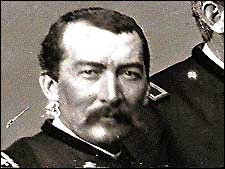 growled.
As he tore the moist stub of a cigar from his thin lips, General Sheridan studied each of his staff in turn.
Lt. Col. Sheridan was the first to speak, answering his older brother's question. “I don't understand what's eating at you, Philip. Custer won the victory we were certain could be won.” “And a stunning success it was at that, General,” echoed Major Sweitzer of the Second Cavalry. “No mistake about that, Nelson.” Sheridan used his cigar to jab home the point. “Still. A voice inside troubles me.”
In silence, the commander of the Department of the Missouri turned back to the wide window behind his massive oak desk, his eyes gazing far beyond the bustling Topeka, Kansas, street below. Though he stood shorter than most of the officers gathered around him, Sheridan somehow conveyed a greater stature than most men of the day. Here stood a confident man, every inch of muscle rippling with the martial fervor that had made him the hero of countless cavalry battles in the last War Between the States.
The rebellion lay some four and a half years behind him. Today Sheridan has a new type war to fight.
The sky, heavy with wet, icy snow was forced to drop its contents into the Topeka streets creating a barnyard mass. Sheridan turned back to his staff and sank heavily into his chair at last. “Sandy! Tell me what you're thinking.”
Major Forsythe cleared his throat. “Undoubtedly, Custer did more at the Washita than my frontier scouts ever hoped of doing, pinned down on Beecher's Island, General I can't fault him his success.”
He damn well could have gotten himself wiped out!” blurted Col. Forsythe, Sandy's brother. “Himself, along with a good piece of his regiment. But we all know that, don't we? That's something no one in this room has had the guts to mention. Begging the General's pardon—“
Sheridan waved his hand; flakes of ash littered the papers scattered across his desk. “No offense, Tony. We all know—don't we, gentlemen—that Tony's right. But that's not all that bothers me.” He rose stiffly, the cold in the offices penetrating to the marrow more of late. At the nearby hutch where the ever-present bottles and glasses waited, Sheridan poured himself some amber liquid. Without ceremony or inviting his staff members to join him, he tossed the drink down a throat more parched these days with the burn of long hours and too many cigars. All knew was that Custer was the only one who could march into Indian Territory .
”Is this damned Custer doing a single thing different than he ever has in his military career, sir? Michael Sheridan asked.
“Near as I can tell, Custer's still the same cavalry magician he was at Gettysburg. Shenandoah, and Appomattox Wood.” He slammed the empty whiskey glass down. “And frankly, gentlemen— Philip H. Sheridan isn't a man to argue with success.”
“All of us need reminding that those victories were exactly why we wanted Custer brought out of that year of his…. unofficial retirement.” Major Ashe uttered the words the rest of Sheridan's staff wouldn't admit to. “All of us asked for him back before his court-martial was over. Anyone here who says he didn't believe Custer was the only one who could slash his way through the hostile tribes last year is a damned liar.”
“Strong words, Major.” Michael Sheridan said.
“But true, sir,” Ashe said, “Wasn't a one of us didn't know what Custer could accomplish…what Custer is.”
“Sounds like you agree with his tactics, Morris.”
Ashe glared at Michael Sheridan. “He won, didn't he?
Damn it, that's what we're all about, isn't it?” Ache prodded the rest of them.
Breaking the aching silence. “Yes Major. I suppose you are more than right. You're damned right. We are army. It's not just what we do. It's what we are.”
“I beg the General's pardon,” Tony Forsythe said, “Custer's success last winter don't hide the fact that he blundered twice in winning his startling victory.”
“His lack of reconnaissance,” Michael Sheridan added. “The lack of intelligence before attacking Black Kettle's camp is more than appalling, Philip. It could have cost him—us—the entire campaign!”
The general rose. “Were all aware my brother has never shared a high opinion of Custer. What I want to know, Tony, is what was Custer's second blunder.”
Elliott, sir.” Ashe allowed the death knell of that name to hang in the cold air of the room. “Major Joel H. Elliott, Seventh U.S. Cavalry.
Philip Sheridan turned back to the window, peered out into the gray of early winter pounding the plains. “With Grant in the White House and Sheridan replacing Grant as commanding general of the army, we can now focus our attention elsewhere, gentlemen.” Sheridan's breath clouded the window before him. “If Custer's done nothing else, he's brought peace to the southern plains.”
“And the Southwest, Sir?” Major Sweitzer inquired.
“Quiet for now.”
“The Northwest?”
“Nothing stirring there either,” Sheridan sighed.
“All that's left is the northern plains, sir,” Sandy Forsyth said. “Command have someone in mind?”
The question hung like week old smog in a tunnel. This staff that was the cream of the officers corps of Sherman's ‘New Army of the West' could only stare at General Sheridan's back.
“Short of me going personally,” the general replied, “there isn't a man in this room who's up to taking on the likes of those Sioux and Northern Cheyenne. Short of me, there remains only…Custer.”
“That sonuvabitch charges without knowing his enemy's location, strength, or desire to fight!” Michael Sheridan fumed.
“Its not Custer's reconnaissance that wins his battles for him, Michael,” Philip Sheridan said. “It's Custer's bold daring charge into the face of any enemy no matter that enemy's strength. It's always been his damnable Custer's Luck.”
“You'll reassign Custer to the northern plains?” Forsyth asked.
“Not yet. That'll come soon enough. Look around you, goddammit. The whole country's clamoring for him. He's even more of a hero now than he was at the end of the war. Back east they've all heard how he wiped out Black Kettle's village—what the Republican papers called a nest of vipers. And with that reporter Keim accompanying Custer on his winter campaign last year, the public damn well knows how Custer himself brought the Kiowa, Arapaho, and the rest of the Southern Cheyenne back in to their reservations, single handedly putting an end to their bloody forays into the Kansas settlements…all without firing another shot.”
“A stroke of genius? Michael Sheridan asked.
“Damn right it is,” the general; growled. “For those who wants a peaceful resolution to the Indian question, Custer has conquered five bands of hostiles without firing a single bullet. And for those who desired a bloodier close to the problem…well, gentlemen—they got the Washita.” “You make him sound like a publicists' dream,” Switzer said.
“I'm beginning to think that's what he is.” Philip Sheridan admitted.
“So you'll assign him to Terry's Department of Dakota?”
Sheridan glowered at his younger brother. “Not just yet.” He turned back to his window, watching the drizzle becoming a wet snow. Soggy flakes layered the sill outside. The silence in the room turned frigid as the snow lancing down from the heavy cloud underbellies stalled over eastern Kansas.
George Forsythe finally spoke. “General, I can't shake the feeling that something's still bothering you about this whole matter of Custer's success with the southern Indians.”
Without turning, Sheridan said, “You've hit it on dead center, Sandy. Something's revolves around and around, churning inside of me ever since I rode north, leaving Custer at Fort Sill to finish that winter campaign on his own. And the bastard did better than I expected him to. He even followed my orders, for a change.”
The general wheeled on them, his Irish eyes grave. “So somebody tell me why I can't sleep at night. Why I drink more than I should…. why I have the dread feeling that even I, his commanding officer, can no longer check or restrain George Armstrong Custer.”
If Custer had of remembered his wife's advise, “to avoid politics” of a decade earlier, he would not have neither lost his command nor lost respect or prestige. He sought to follow a moderate and prudent course, avoiding prominence. But, in fact, he was neither moderate nor prudent. He lunched with Clymer and other leading Democrats, and in his testimony before the committee, he gave more hearsay than factual evidence implicating Orvil Grant, the president's brother, in the schemes. On April 18 th , he testified before Representative Henry B. Banning's Committee on Military Affairs, presenting again hearsay statements against Major Lewis Merrill of the Seventh Cavalry for alleged bribe taking while on duty in South Carolina. The pro-Republican New York Times observed that Custer is full of it, but somehow it is only hearsay and gossip, and no witnesses appear to corroborate it. If this sort of thing goes too far, the Democrats, if they should have control of the next Administration, may not, after all, make him a Brigadier-General.
Custer left the capital on April 20 th , and in Philadelphia visiting the Centennial Exposition, he received a telegram calling him back to Washington to appear before the Senate if needed. But that body had no need for Custer's testimony, and he soon sought permission to return to Dakota Territory, He met with General-in-Chief Sherman and the new secretary of war, Alphonso Taft, who agreed to write to the Senate and request the Lt. Col. release. The next day at a cabinet meeting, however, Grant, furious with Custer over the testimony and public lunches with Democrats, directed Taft not to write the letter and to assign another commander to the troops at Fort Lincoln.
Evidence indicates that Custer did not know that the president had removed him from command. When the Senate granted him permission to leave on the twenty-ninth, he met with Sherman, who suggested that Custer delay his departure until Monday, May 1 st , to call upon Grant. Twice during the month, Custer had gone to the White House, but the president refused to receive him. On the first Custer waited five hours in anteroom before Grant sent word he would not see him. Before he departed, Custer scribbled a note to his former commander stating that he had come not to solicit a favor but to refute “certain unjust impressions concerning myself which I have reason to believe are entertained against me. I desire this opportunity simply as a matter of justice and I regret that the President has declined to give me an opportunity to submit to him a brief statement which justice to him as well as to me demanded.”
From the White House, Custer walked to the War Department and inquired whether General Sherman was in his office, and learning that he had not returned from New York, received permission from the adjutant and inspector generals to rejoin his command. Boarding a train that evening, he headed west, stopping briefly in Monroe to visit his parents, arriving in Chicago on May 4 th . At the railroad station as he prepared to depart for St. Paul, one of Philip Sheridan's staff officers handed him a telegram fro Sherman. It read: “I am at this moment advised that General Custer started last night for St. Paul and Fort Abraham Lincoln. He was not justified in leaving without seeing the President and myself. Please intercept him and await further orders; meantime let the expedition proceed without him.”
Custer was shocked and embarrassed and wired Sherman the circumstances of his departure, Sherman sympathized with Custer, relented and sent a telegram that night, granting Custer authority to proceed to departmental headquarters in St. Paul.
Alfred Terry, commander of the Department of Dakota, welcomed his subordinate, whom the general confided later to friends “with tears in his eyes, begged my aid,” Terry offered his assistance. Since the War Department had designated him field commander for the summer campaign a week earlier, Terry had tried to persuade superiors that he required Custer's experience and spirit for the operation. Consequently, when the cavalryman arrived, the pair of them prepared a message for the president. “I appeal to you as a soldier,” the telegram read under Custer's name, “to spare me the humiliation of seeing my regiment march to meet the enemy and I not share its dangers.” Terry endorsed it and sent it to headquarters in Chicago.
His longtime friends' activities in Washington before Congress had infuriated Phil Sheridan. The division commander believed that Custer had acted unwisely, even discrediting the army. But Sheridan knew also that the controversial officer was the best man to command the planned expedition against the Sioux. In words critical of the subordinate, the general endorsed the request for clemency.”
In Washington, meanwhile, opponents of the administration had been castigating the president for his treatment of the officer. With Sherman, Sheridan, and Terry supporting Custer's reinstatement, Grant acquiesced, but gave him command only of the Seventh Cavalry. Terry was directed into the field as overall commander. On May 8 th , Grant's decision reached Terry's headquarters. The news elated Custer, Reportedly, a short time later he met Captain Ludlow on the street, exclaiming to the engineer officer that he intended to “cut loose from General Terry during the summer” as he had from David Stanley in 1873. Two days later, Terry and Custer boarded a train for Fort Lincoln.
The up coming campaign against the Indians had been at rest for several months. Its genesis lay in a White House meeting on November 3,1875, attended by President Grant, Secretary Belknap, Secretary of the Interior Zachariah Chandler, Benjamin R. Cowen, Chandler's assistant Secretary, Lt. General Sheridan, and Brigadier General George Crook, commander of the Department of the Platte Sheridan's former Civil War subordinate. The Lakotas' adamant refusal to sell the Black Hills prompted the meeting at the White House. It had been less than a month since the commission sent to negotiate the purchase of the Black Hills from the Sioux had returned and reported to Congress that a price for the region should be established, given to the tribe “as a finality,” and if rejected, their annuities and rations ceased. The commissioners also believed that the Lakota would never accept unless compelled by the military. Such a scenario suited the president.
The participants at the White House meeting, in the word of a historian, “contrived” a war against the Sioux. They decided that the army would not stem the flood of miners into the region, and if the “hostile” or non- treaty band remained away from the reservation the army would move against them. There would be no more negotiations with the tribe&—the power of the military would be the messenger.”
During the next few weeks, the administration prepared the documentation for the justification of war against the Sioux. On December 6 th , at the direction of Secretary Chandler, Indian Commissioner E. P. Smith instructed his agents on the reservation to inform tribal leaders that the non-reservation bands must report to the agencies before January 31, 1876, or the army would force them onto the reservation.
Belknap forwarded authority to Sheridan to commence a winter campaign against the hostiles on the Seventh. The division commander planned a three-pronged strike into the Yellowstone River valley, and its tributaries. From Fort Lincoln. Custer and the Seventh Cavalry would march upriver; from Montana forts, Col. Gibbon with infantry and cavalry would descend the Yellowstone; and from Fort Fetterman, Wyoming, Crook and a combined force would move north into the Powder River region. It was and cooperation similar to the one directed by Sheridan in the winter of 1868.
The campaign fizzled, stalled, and eventually failed. Winter weather locked in the 7 th Cavalry at Fort Lincoln. Crook and Gibbon also had their problems as well.
Consequently, by mid-May, Sheridan's campaign had been reshaped—Gibbon's troopers would combine with Custer's s Dakota column, both under Terry, while Crook returned to the field. Neither the district commander nor the two department commanders knew where the hostiles were or the number of the warriors with the bands. It would be a search across an area of perhaps 100,000 square miles. Sheridan could not direct it from Chicago, so as he informed Sherman later. “I have given no instructions to Generals Crook or Terry as I think it would be unwise to make any combinations in such country as they will have to operate in. Each column will be able to take care of itself.”
Preparation was nearing completion at Fort Lincoln when Terry and Custer arrived May 14 th . So eager to be back, Custer had no trouble getting lost in his work.
The Dakota Column consisted of the entire complement of the Seventh Cavalry, including four companies that had returned recently from occupation duty in the south, three companies of infantry, and a detachment with three Gatling guns. A contingent of Arikara scouts, teamsters and civilian employees completed the force. In the later group were Boston Custer, hired as a forage master, and Harry Armstrong “Autie” Reed eighteen-year-old son of David and Ann Reed. Young Reed had come west on vacation, and his uncle Autie took him along as a herder. By the night of the 16 th , all was readied. Custer spoke with Terry assuring the general that despite rumors he might have heard, he wanted to serve under him.
The members of the Dakota Column awoke to a heavy fog and a raw chill on the morning of May 17 th . By seven o'clock, the column had formed in its campsite outside of Fort Lincoln, stretching for two miles. To the accompaniment of “Garry Owen,” the cavalrymen, infantrymen, wagons, and beef herd marched. Libbie Custer and Maggie Custer Calhoun accompanied their husbands for the day. In the post's “Returns,” under the Seventh Cavalry, a clerk recorded, “Operations in the field against Hostile Indians.”
The command covered thirteen miles that day, and bivouacked along the Heart River. Paymasters distributed pay to the troopers, who resented the facts that Custer had waited until they were beyond the enticements of Bismarck. Custer had purposely ordered him to accompany the troops west on the first day's march so that no soldier could be tempted to spend his meager pay with the post sutler, or with those painted prostitutes at Sadie's Shady Bowser or Clementine's Retreat, Bismarck's infamous fleshpots. Reveille sounded before daybreak on the eighteenth, and the men forded the river, heading due west for the Little Missouri River, where reports placed bands of Sioux. From a bluff above the Heart River crossing, Libbie and Maggie watched them fade beyond the horizon. Libbie had tearfully clung to Autie before he mounted, knowing that the separation could be long. It would be immeasurable.
By the time the Seventh had rendezvoused on the Yellowstone with Col. Gibbon's forces drawn from both Fort Ellis and Fort Shaw in Montana Territory, Custer's troops felt as if they had marched through hell itself to arrive at the mouth of Rosebud Creek.
The troops suffered a snowstorm that kept them sitting for two days back in May, the men had also suffered through drenching spring rains and stinging hail, and more recently had blistered beneath a relentless sun interrupted each afternoon by a brief interlude of thunderstorms before sunset.
Certain fragments of the regiment had marched off on one or the other of two long, tough scouts that convinced the expedition commanders they were narrowing the noose around the hostiles. Now that General Terry's Dakota column had joined up with Gibbon's Mountain column, everyone figured the Sioux were gathering to the south of them.
General Terry, at three p.m. on 21 June, called a high level staff meeting in the dining room on the Far West. “The Commissioner of Indian Affairs claims we might see only some five hundred to eight hundred warriors, counting all of fighting age.” Terry plunged ahead with his introductory remarks as most every man settled back with a glass of trader Coleman's Whiskey.
‘He's wrong,” declared a new voice. The room fell silent as the attention shifted toward Custer. “Care to tell us just how the commissioner's figures could be so wrong, sir?” Custer turned toward the speaker, Col. Gibbon. Above his bulbous nose the colonel's dark eyes peered cold like chips of iron. Gibbon had been Custer's artillery instructor during his studies at West Point
“Those agents, sir with all due respect,' Custer began, “either don't know how to count, or they're nothing more than liars.”
He waited for the murmurs to quiet themselves before continuing. “I prefer to think they are simply lying through their teeth to their superiors.” “Can you substantiate that, General?” Another officer rose to confront Custer. “And why in blazes would they lie to the army about those figures?” inquired another officer. This officer stepped near Custer. “What reason would those agents have to give us bad intelligence?”
Custer measured him a moment. “For exactly the same reason those traders become rich men on their meager salaries—sutlering for the government on hardscrabble reservations.”
“Explain yourself, Custer,” Terry demanded. “Of course.” Custer said, “If those venal traders inform their bosses in the Indian Department how few Indian they really have left on their reservations, they won't get their normal allotments. And when that happens, the traders won't have all those government goods they can continue to sell privately for exorbitant profits at the expense of the Indian living on those godforsaken refuges some call reservations.”
“You're claiming those agents have been lying to us, sir?” Brisbin turned to Gibbon as he asked his question. “For the sake of padding their own pockets?” “Nothing more complicated than that.”
After questioning Custer at length, Terry informed his staff and Commanders that it would be wise to accept Custer's figures that is the number of Indian warriors, which Custer assumed to be about 5000 warriors, rather than the low figure of hostiles that the Indian agents offered. Terry's decision was based on his own observation and experience with the Indian agents.
The staff meeting drug on for over three or more hours, much bickering and hostilities developed because Custer rejected all input of others. For instant he refused the Gatling gun, Brisbin's second Cavalry, but he did accept the scouts. The reason Gibbon and Brisbin was so generous, they knew that Custer would attack immediately when he found the hostiles. Custer also knew this and was using Terry to further his own ambition. As a matter of fact Gibbon and Brisbin made Terry aware that Custer had been brought up on charges for disobeying orders and subjecting his men to unnecessary risk. The meeting closed giving Custer a free hand but cautioning him of his mission “He was to scout the area and when he found the hostiles he would send a scout back to Gibbon to come forward and assist in exterminating the enemy.
After the meeting, Terry and Gibbon walked Custer to his quarters. Evidently neither Terry nor Gibbon felt secure with Custer acting alone. Custer assured both officers that he would cooperate and neither officer had anything to worry about. Terry told Custer in uncertain terms that he might be the last to trust in him. “In fact, this springs it became apparent that not even your old friend Phil Sheridan…”
“I understand fully, sir.” Custer nodded at Gibbon before looking at Terry. “Thank you General. The Seventh won't let you down.” Find the Indians, Custer. We'll help you do the rest.” “I'll do my best, sir.” Custer snapped a smart salute.
After Terry and Gibbon departed for the Far West, Custer called into the twilight. “Cooke!” His adjutant approached at double time. “Sir?” “Have the bugler to sound ‘Officers Call.' I want to speak to the officers in an hour.”
In the mean time, in fresh paint and their finest outfits, Gibbon's Crow scouts presented themselves to Custer. To them the soldier chief would be known as Young Star. An Impression of mutual respect was developed from this meeting.
It is time for Officers Call, and as usual Tom Custer is the first Officer to appear. “Something eating at you, Audie,” as he strode up, watching his older brother slapping the old rawhide quirt against his boot. “Don't often see you this worked up. Reminds me of the time Benteen wrote that letter dragging your name through the mud in papers all over St. Louis, Chicago, and New York.” “Who attacked the Seventh this time?” Custer replied, “that infernal Brisbin, he and that Gibbons are trying to horn in on the action. I told them we did not need their cavalry or Gatlin gun.” The rest of the staff and troop commanders reported and Custer brought the meeting to order. “We will leave some time tomorrow and will be prepared to stay out fifteen days. We'll move up the Rosebud tomorrow, traveling light, leaving the wagons behind. Each troop will be assigned 12 mules. Load them as you feel your needs, but each of you are responsible for your actions.”
Custer expressed fear that the Indians will try to make a break for it and run, and chasing them will be time consuming. But we can corral them if we're prepared to follow.
Benteen stepped into the light between two Lieutenants, “begging your pardon General, are you prepared to support any unit that gets itself into trouble this time out?” Custer tensed, turning slowly toward Benteen, “Captain, care to tell me just what you mean by your question?”
“Why, I was remembering the Washita and Major Elliot….”
Hostilities grew intensely, before calm set in. The meeting ended with each officer having an understanding of his responsibilities. Custer concluded the meeting by advising every one that they would not see the Far West again, and as a regiment they would be on their own.
As the officers were leaving the tent, Custer said, “When I have General Terry's written orders in hand come morning, I'll have Cooke come round. Otherwise, have your sergeants pay heed to the bugle calls. We'll strike camp as soon as the regiment is prepared to move out. That will be all. Good night, gentlemen.”
After the staff meeting or officers call with paper and pencil in hand he began to write to Libbie. “I also wanted you to share in the good news—I have seen that Boston and Autie were transferred from the Quartermaster Corps for the next fifteen days so they can accompany us on our scout up the Rosebud. Along with Tom, Boston, James and Fred Calhoun, I want all the Custer clan in on the fun! We have such a dear, dear family gathered round us, Libbie. We are indeed fortunate in this life to share that family together…. To the end, Custer's all!”
A few yards downstream stood Mark Kellogg's tent where the late-night oil burned just a as brightly a Custer's lamp.
Sherman and Sheridan had warned Custer against taking any reporter with him. The boy wonder could not resist due to the publicity he would miss. So Custer had decided to allow Kellogg to accompany him on this campaign. Besides why shouldn't Bennett's paper get the scoop on everyone else when he defeated the Sioux and became the darling of the Democratic convention about to meet in St. Louis?
By midmorning the adjutant brought Custer Terry's orders, read them an ordered the adjutant to report to Terry's headquarters. Give him my compliments and sincere thanks for the issuance of his orders for the march. Inform him I expect to have the Seventh Cavalry ready sometime between late morning and early afternoon. And be certain to inquire if the general would care to review the troops.
Custer wrote a letter to Libbie and prepared himself for the march while his unit commanders busied themselves with the troops to be sure the 12 mules in each command was properly loaded with the necessities for the march.
By noon Thursday, 22 June, a harsh northwest wind scoured the prairie at the mouth of the Rosebud, tugging at Terry's hat. He reigned up, bringing his staff to a halt beside Colonel Gibbon's officers.
The same stiff wind tousled the fringe worn by Custer's buckskinned officers in emulation of their beloved commander: Tom and Boston also family favorites, and John Calhoun, Myles Keogh, and Billy Cooke.
The tormented guidons snapped like parching corn in the raw wind as Custer pranced up atop the blaze-faced, white-stocking sorrel named Vic, showing his hands into his yellow buckskin gloves. Mark Kellogg rode on his heels mounted on his young, stubborn independent mule.
“Mr. Kellogg!” Col. Gibbon hollered in that characteristically gruff bullfrog voice that years ago had struck mortal fear in the heart of plebe G. A. Custer at the United States Military Academy. Gibbon indicated at his right hand. “Please do me the honor of standing beside me during the review.”
Kellogg glanced at Custer anxiously. With his sapphire eyes twinkling, he nodded with a wide smile that seemed to assure Kellogg that both Custer's superiors were aware the reporter was destined to ride up the Rosebud with the Seventh. Custer himself came to rest at Terry's left hand, watching with a hear-swelling pride as twelve companies, more than six hundred troopers, rode past—backs ramrod straight, lips clenched in determination, and eyes held dead ahead for the hunt at hand. Following the troopers marched a motley procession of some forty scouts: Arikara and crow with half-breed Mitch Bouyer included, while the regimental band, which would be staying behind at the Rosebud to await the Seventh's triumphant return, stood on a nearby knoll blowing out the merry strains of “Garry Owen” before they dived into the sentimental favorite of the older veterans, “The Girl I Left Behind Me.”
“Twelve noon, gentlemen!” Custer roared, and saluted first General Terry then Col. Gibbon. Unexpectedly he nudged Vic out of formation to stop beside James Brisbin. “Major.” Custer presented his hand to Terry's surprise. “Wish me luck?” Damn it all, Terry thought to himself watching Custer. If this doesn't beat all! A smile eventually cracked Grasshopper Jim's face. Good hunting, General! And good luck to all your men!” “Thank you, Major,” Custer replied as he tugged his glove back on the right hand.
In Terry's next heartbeat Custer jabbed the sorrel with those golden spurs and set off at an astonishing gallop, kicking up moist clods of dirt and grass as Vic sped him along the squeaking, jangling column of cavalry and mules, disappearing into the distance, his back to the superiors he was leaving behind at the Yellowstone.
After many hours of council, it was decided the survivors of Red Beard's “General Crook” attack could travel with the Sioux. The three formed an alliance for the protection of those Northern Cheyenne Old Bear. After all, the tribes agreed, the soldiers had attacked a Cheyenne village. Not the Sioux. The soldiers had not burned and plundered an Ogalla or Hunkpapa winter camp.
Discussion was that the soldiers must have been hunting Cheyenne once more, as they did on Little River in Colorado Territory twelve winters ago. As they stalked down the Cheyenne on the Washita eight winters gone.
This three-way alliance was formed for their mutual safety during the buffalo hunting season drawing near. And because the Cheyenne themselves were the hunted ones, they would act as the point of the march on these nomadic wanderings come the short-grass time.
Following the March leaders were the Ogallalas, while the Hunkpapas of Sitting Bull would act as rearguard. It was The Bull's contention that the best way to avoid trouble was to stay as far from the white man as possible. If they could but avoid the army, he reasoned, there would be no worry of attack.
Slow marches of a few miles each day that winter-into-spring as the three villages moved up the Powder. With the full warming of spring awash over the northern prairies, they marched over to the Tongue.
And slowly, on to the Rosebud.
Every day The Bull sent out runners to the other bands trapped in bitter despair on the reservations.
“Look what I have!' Bull boasted. “You on the agencies have nothing but what the whites choose to give you…when he chooses to give it. While the others and I have what Wakan Tanka has always given his people. Come bring your guns! We will hunt in the old way, on our old land, where the white man will bother us no longer.”
All through the spring and the first reaching of the short-grass to the sun, many trails from north and south and east slowly began to merge together like strips of sinew wrapped into bowstring. Days of spring sped into summer, and one by one the little tracks of a lodge or two moved off the agencies, eventually joining others, their travois poles feeding the mighty torrent of a river.
The Sioux were now as they had not been for many, many winters. One again they were gathering with the old spirit, the old courage, and the ageless power. There flowed a new life vibrant in every man, woman, and little babe strapped on the travois. They would go where the white man could not reach them.
Sitting Bull would take his people to those ancient hunting grounds, where the white man would not bother them.
Sitting Bull would take them to the Rosebud.
By four o'clock that first afternoon, Custer halted the command on those open, minty bottomlands fragrant along the west bank of the Rosebud. The river at this point ran some thirty to forty feet in width, only four to six feet in depth, clear running but slightly alkaline, and with a gravel bottom that gave comfort to tired feet of many a trooper wishing to cool himself in its pleasant ripples that evening.
At sunset “Officers Call” was sounded by the chief bugler. Benteen, senior captain in the regiment was the first officer to arrive. He observed Custer, was not as jovial as he had been neither that morning nor the previous evening. Benteen unbuttoned his blue blouse and swatted at a troublesome mosquito, sensing a sudden and serious mood seeping along the Rosebud as the last stragglers trotted up.
During this staff meeting there would be much hostilities. Actually provoked by Custer, but ended by Benteen challenging Custer head on. Custer's attitude tonight is not of the old Custer “normally snappy, and often sarcastic,” now Custer's mood appeared contemplative, brooding. Almost near somber.
The instructions of the March orders given by Custer were repetitive of the other instruction he gave in past meetings. Then he had to repeat why he refused the Second Cavalry and the Gatlin Gun. For some reason he thinks there are no more than 1500 Indian warriors to exterminate, and that the Seventh Cavalry could handle twice that number with the 600-member strength the Seventh now contain.
As Custer droned on, Benteen studied Custer's attitude, and behavior-thinking Custer most certainly felt trapped within the strictures of Terry's rather general and ambiguous orders. He grows despondent; Benteen brooded, yearning to be free of Terry. Instead, the arrogant, crowing bastard may well hamstring himself on the sharp horns Terry's designed for him.
Then, while others studied Custer, Benteen's gaze was drawn to brother Tom.
Benteen figured no others would read that hollow despair round his blue eyes. If he knew any man as well as he knew Custer, Fred Benteen thought he understood Tom Custer.
Yet only Tom would truly understand that ever since the Washita, Autie had grown increasingly afraid. Not of death. Never that. No man could ever seriously entertain the idea of George Armstrong Custer wetting his pants over the thought of death.
No, instead it seemed Custer was afraid of risking his last great victory earned along the Washita in Indian Territory eight long winters behind them. Only Tom realized that his brother now stood the chance of winning for himself a seat among Washington's powerful—and this close to the precipice, Custer might also stand to suffer a complete defeat of all his hopes and dreams.
Benteen understand it now, watching the way Tom gazed at his older brother. Tom looks at him like Peter himself looked at Christ. The young one knows how crucial it is for big brother to have everything successful and glorious. From here on out there can be no taint of defeat or withdrawal for the Seventh, Custer will be satisfied with nothing short of victory. This close to the edge of greatness, a man often teeters when looking back to see how far he's come in so short a time.
Custer continues his instruction and accusation of some officers going over his head and reporting his action to Department Headquarters.
To Benteen, Custer's challenge polluted the air like the acrid stench of burnt gunpowder as the general let his words sink all the way to the core of every man. Benteen couldn't let it pass. As usual in a situation of this nature, Custer backed down, but yet maintained an aggressive attitude. Needless to say, Tom Custer didn't take his eyes off of Benteen, but he had the wisdom to keep his mouth shut and not to be involved.
Custer closed the staff meeting declaring that every officer in the Seventh Calvary was considered family, and yet as any family they would have their differences. As a family we'll succeed only by hanging together, above dissension…. or we'll die alone in miserable solitude because we failed each other.
The officers strolled off downstream, back to their companies and bedrolls. Troubled, Godfrey wasn't sure whether he heard correctly or not during the staff meeting, he is rather deaf in one ear. But, he nonetheless sensed an unexplained anxiety with in himself when he strolled away from Custer's bivouac at that moment. He stopped and turned to glance one last time at the general he had served since the Seventh Cavalry's earliest days at Fort Hayes in Kansas Territory.
In Godfrey's way of thinking, Custer had for the first time shown a genuine reliance on his officers. And with this unexplained openness, Godfrey was more than certain there was something inextricably not Custer at all. Even something more profound than the mere tone, of his voice, while normally brusque and somewhat curt, was on this occasion conciliatory and subdued.
Almost like an appeal for help, Godfrey considered. As close as he can come to making an appeal for help as if something's eating away at him.
A sudden realization of his unshakable Commander shaken in this way touched Godfrey clear to the bone.
Godfrey caught up with two other lieutenants and as they waked along discussing the problem at hand and so worried over Caster. One of the officers said, “I believe the general is going to be killed.” The other two officers enquired. “Why?” Both officers were stunned. Finally the officer said, “Because I have never heard Custer talk that way before.”
Already the nighthawks were out, singing in low overhead, striking a moth or mayfly in the growing darkness. Death leaving no time for a cry for help or a yelp for pain; swift and efficient; no warning; no sound until too late; only the swift wings of death assail on the wind above the faint swish of cavalry boots plodding off through the tall grass growing here beside the gurgling Rosebud, young soldiers returning to bedrolls and their dreams of home.
He left his friends still trying to cope with the problem at hand when he come up on the scouts discussing their findings for the day and how to influence Custer's faith and cooperation. They talked quietly through Bouyer and Fred Gerard, the Arikara interpreter, or conversed silent among themselves, their hands gesturing in quick, darting flight like those nighthawks swooping overhead.
Godfrey, trying to maintain a low profile managed to acquire a vantage point where he could closely observe key scout members.
After Godfrey had attentively listened to the various conversations, studying what he could of the facial expressions and the signs used, he was surprised when he saw one of the scouts nudge the half-breed Sioux interpreter and point out the soldier among them.
Bouyer turned and grunted and studied the two shiny bars on Godfrey's collar for the first time, perhaps remembering that the Indian scouts were officially assigned to Geoffrey's K Company.
“You, pony soldier,” Buyer began, his voice low. “You fight Indians before, eh? Ever fight these Sioux?”
Godfrey swallowed at the coarse directness of the question. Damn, he thought, these scouts have a way of cutting right through the underbrush and getting right down to the root of something, don't they?
Yes . . .” Ed admitted, “Several times down near Nebraska, but our hottest engagements were along the Yellowstone three summers ago now.”
“Hmmm,” Bouyer considered as he turned back round to the fire, dallying at the coals with a twig for a few minutes. Only then did he turn back to stare directly at the lieutenant. “Well, then, pony soldier—just how many of them Sioux do you expect to find up there?” Bouyer pointed in the direction and toward the hulking Wolf Mountains—the direction that Custer was leading them.
“The general briefed us on the reports the army's received.”
“How many warriors the army tell you Duster's going to find?”
“They figure we may find between a thousand to fifteen hundred warriors, if we find them.”
“Oh,” Bouyer laughed mirthlessly, “you'll find them all right.” His teeth flashed beneath the pale thumbnail moon. “You'll find them if you go riding with Custer.”
The half-breed seemed ready to let that settle a moment like a muddy puddle stirred. Then Bouyer continued. “So you tell me your own mind, pony soldier—you think we can whip that many Sioux?”
“Oh, yes,” Godfrey said quietly. “I guess so.”
Bouyer tossed the twig into the little fire at his feet, watching it flare, then die out. “Well pony soldier! I do not know this Custer—but some of the scouts tells me much about him. I do not know him my self, but it's for sure I know the Sioux. Only thing I can tell you, we are going to have one damned big fight. One—damned—big—fight.”
With nothing more than a whisper on the grass, Mitch Bouyer rose, turned on his heel, and disappeared into the purple twilight.
One damned big fight.
Bouyer's remarks clung to Godfrey. Eventually he got to his feet and trudged off, growing nervous, cold and out of place as an outsider among Gerard and the Indians. Godfrey, the outsider who did not understand their mysticism, and who did not even understand why he shuddered uncontrollably as if he were freezing.
On the way to his bedroll, Godfrey came upon a group singing and harmonizing; singing the popular songs as “Dinah's Wedding” and “Grandfather's Clock” and their voices raised to the quiet evening stars and amid complaint from Benteen of disturbing his sleep.
After the singing was finished, Godfrey himself led them in the “Doxology” or the “Olde Hundredth” as it was popular known.
With the nervous stammering of amen's, most of the men bid good night to their fellow officers and slipped off into the darkness to locate their companies and bedrolls while the chorus of coyotes and wolves took up the nightly serenade where the soldiers left off. Beautiful in its own feral way, though eerie to the uninitiated ear—that blending of high –pitched yips from the younger coyote pups, echoed by the deeper howl of a prairie wolf, was a chorus that thrilled a man accustomed to the high plains.
All round the regiment that summer night sang a lullaby meant only for the innocent.
Desertion this night appears in the mind of many a man. One by one the solitary soldiers crept in among the horses and led an animal over the first hills to the east. Climbed aboard the saddle nosing for the Black Hills, or off to the northwest and the Bozeman Road. Wherever some men just wanted across those first low hills and away from the place.
Some people could accuse them of Yellow flu, but this was not their symptom. Rather, these soldiers prefer to take their chances in Alder Gulch digging for gold rather than dying on some nameless little creek with Custer and his army band of zealots. Damned sure better than dying with Custer.
No reveille sounded for the Seventh on the morning of the twenty-third. Entrusted to awaken the camp, the horse guard checked their watches beneath the pale, lonesome starlight before groping their way through the sleeping camp, nudging their relief.
The column moved out on schedule “5:00 A.M.” with the newborn sun peeking red as blood over the eastern rim of the prairie, Lt. Varnum and his scouts had been gone the better part of an hour, their own cold breakfast and boiled coffee laying as heavy as concrete in their bellies.
As the Montana sun streaked like a stalking coyote out of the draws and coulees to the ease, Custer leapt aboard Vic, and set off for the day's scout. Two men directly behind Custer carried the Regimental Standard and Custer's Standard.
The sight of the general heading upriver was the signal for the command to move out.
The regiment had crawled eight miles when that sore-eyed red sun had climbed a hand high. The heat was so tremendous the troopers had to make quick adjustment of their clothes.
Custer joined his scouts at the first deserted Indian campsite the trackers ran across.
Observe quietly, the hostilities and insults will fly between Custer and one of his chief scouts. Too bad the boy wonder hasn't the capabilities of gleaning intelligence out of information. May I remind you? He is your boy wonder, not mine.
Tepee rings and fire pits pocked a large area of bottomland along the Rosebud. As the troops rode up, many of the veterans looked over the trampled ground in awe-struck wonder. More Indians had camped here than those hard files could ever hope to boast of seeing before in one place. In addition, there was a sobering number of wickiukps still present, those willow limbs struck in the ground, their tips tied together to form a dome over which the warriors had thrown a canvas fly, buffalo robe, or wool blanket for shelter.
Varnum chuckled, “I can't believe the Sioux's treat their dogs this damned good.” Fred Gerard dragged to a halt, turning on the lieutenant with a death-cold look smeared across his old, weathered face. “The Sioux didn't put these wickiukps here for their dogs. ”He growled.
Varnum freezes under Gerard's glare. “Not for the dogs, Fred? Then what the hell they put in them wickiups?” “I'm afraid a lot of them wickiups was used by warriors scampering off the reservation. “You tell Custer won't you? Tell him to think hard on all those warriors scampering off the reservations, come to join Sitting Bull. ”Testing the leaves of the limbs used to build the wickiups the scouts believed the camp was about a week old.
Bouyer and Gerard watched Custer remount, signaling his soldiers to resume the march. Angrily Custer hollered for Varnum and Bouyer to get their scouts moving ahead of his blue columns once more.
“Custer's got his hands plenty full right here, I think,” Bouyer whispered gravely from the side of his mouth as he crawled aboard his Crow pony.
“Gerard nodded, flashing a yellowed smile. “He's had his hands full ever since he decided to take these Sioux on. It's like he's got a bone stuck in his throat and can't get shet of it. Shame of it is, I'm afraid the general's gonna choke on that bone.”
Throughout the rest of the morning and into the growing heat of the afternoon, the scouts and a few of the old-timers began to notify a scarcity of game in the area of their march. It's a rare thing in virgin territory such as this. A Calvary column marching across the high plain plains of Montana Territory would surely kick up some antelope, deer, and elk, or scatter off some of the birds normally roosting in the trees or chattering in complaint from the bushes.
Yes, sir, Gerard thought, shifting himself up on the cantle of his damp saddle. Downright spooky to follow the Rosebud and not find a mess o wrens or a flock of sparrows swooping overhead out of the summer blue, damn little life we've found dotting the thick marshes among the eddies near shore either.
Gerard knew his scouts and the Crows understood. They and Bouyer alike understood what had driven the game out of the country for miles around. Only an immense village on the march could have scoured the countryside clean of almost every sign of life.
At four-thirty p.m., Custer ordered his command into camp. The regiment had put nearly thirty-three miles behind them. At each of the three deserted camping places they had run across through the day, the general had ordered a short halt while the scouts inspected the sites.
Somber and silent, both Crow and Rees scouts had walked and thoroughly examined the packed lodge circles. And they did it all without a single word, shrouded in discomforting silence. Gerard watched them, silent as well, noticing that only Rees' dark eyes talked bravely to one another, only their eyes talking.
While stable sergeants cussed and fretting over the lack of grazing, because every blade of grass for some distance on both sides of the trail and been chewed to the ground, the soldiers speculated on the number of Indians they were following now, where the bands were headed, and how long ago the hostiles had left the area. In the last damp they had run across, over three hundred fifty lodge rings had been counted.
It didn't take an interpreter like Gerard to compute the simple plainsman arithmetic that added up to better than a thousand men of fighting age right on that one spot.
He could tell from the look on Bouyer's face that the half-breed understood well enough that the bands were coming together. Gerard himself paid more and more attention to the dark eyes and gloomy faces of his Rees than he did the wild ramblings of loose-lipped army speculators like Varnum.
Gerard tossed an empty whiskey flask in the bushes and while reaching for another, Varnum studied him a moment and asked him if he would share one with him. It startled Gerard because Varnum was not a drinking man. He said, “what the hell? He bent over his saddle and handed a flask to the officer. Gerard let him know right off, that he was a civilian and he could carry as much whiskey as he dared. Just in case you're figuring on showing the general the evidence—“
“I'm not.” Varnum interrupted. “Please, I just want some for myself.”
“Just—with all the…” Varnum's eyes flicked around nervously. “I was with the Rees, the Crows all day.” He wagged his head like someone watching the gallows go up a board and a nail at a time outside his own iron-barred window. “I may be green at this, Gerard. Handling Indians, that is, no old sawbuck like you. But even I could read their eyes, I ain't the smartest man Custer's got working for him, but I can sense we're running right on up the backside of something here that even the general don't know what he's doing.”
“Here” Gerard shoved the flask into Varnum's fist, rode off a few feet, turned and said, “Do me a favor, don't drink all that in one setting,” and then rode away.
Nearly an hour later the Crow scouts came plodding in, their little ponies nearly bottomed out from what had been required of them. Rule of thumb on the plains stated that a scout traveled twice the distance a cavalry column would march in a day, what with all the back-and forth and the up-and-down. That meant those little grass fed Cayuses had done something over sixty miles beneath a cruel summer sun.
Yet right now it wasn't only fatigue that Mitch Bouyer could read on his Crows' faces. Something more, in fact altogether primal, that strained and pinched the normally happy faces he knew as well as he knew any friend.
Bouyer understood as few others would, for he had stood at the center of those deserted chasms with his scouts. He had walked across the worn earth of the central council lodge, visually ticking off that distance to the farthest of the brush arbors and wickiups used by the youthful warriors. Mitch knew his Crow had read such sign as easily as any white man back east picks up and read his daily newspaper.
The half-breed knew there wasn't a bit of good news to be found on the front page today.
Custer sought out the Crows and Bouyer nodded to the ground without a word while Custer squatted in his characteristic manner, one knee on the ground as leaned an elbow on the other.
This is the main point I want you to tell them Bouyer,” Custer began after Mitch had fed the intelligence from the scouts travel. These Sioux has killed lots of white people and that is why the Great Father of Washington sent me here. Most of the meeting is Custer's boastfulness. But he made a big mistake by his dramatics. Relating to the scouts that he might die in battle and displaying an attitude of defeat fighting the Sioux. Bouyer stopped him and advised that he take on a more positive attitude and show a personality of strength and as a leader, if he didn't the Crow scouts would behave badly and probably desert.
Custer turned on his heel after the meeting and strode off at a lively pace. Mitch thought the way the general moved wasn't the plodding of a man seriously contemplating his own mortality.
Custer waved to some troopers and officers bathing in the cool waters of the Rosebud beneath a purple orange glow of sunset. On the opposite bank upstream a ways, Benteen grumbled sourly under his breathe. He had set a seine hoping to snare some trout for suppers. But with all the naked swimmers splashing and setting up a playful howl in the rippling waters, the captain's cutthroat had been scared off.
Custer chuckled over Benteen's predicament, at the same time hoping the Sioux would not be scared away from his own trap the way the trout in the Rosebud were fleeing Benteen's seine.
But then, with “Custer's Luck” you always caught the Cheyenne. Old Black Kettle and Medicine Arrow.
The more Custer thought on it, the more certain he became that his only problem would be one of surprise. The Sioux would run like jackrabbits once they got wind of him on their trail. And that simply wouldn't do.
You need Sitting Bull and the rest to play too important a role in what you've got planned for the rest of your life, Armstrong. Whether it's a big village like those we ran across today or nothing more than five or six lodges. You must have that victory, and you must have it now.
Cooke was already at the Rees' camp with the headquarters' guidons fluttering in the warm, dry breath of early evening. Gerard sat to the side quietly observing what was going on. Custer went down on one knee as he told Gerard to inform the scouts of the news just brought in by the Crows.
“They figure there are a great number of lodges,” Custer started. “A great number of Sioux in many camps coming together. What I want the Rees to tell me: If we catch up to the Sioux, and I can keep them from running, what will happen?”
The medicine man decided to reply for them all. Creaking up on his knees, he to his feet, the old medicine man began to hop around and around, circling, dodging this way, then that. Jumping here, then there, with a sudden youthful vitality marking a warrior.
After a moment of pantomime, Custer nudged Gerard. “What's he trying to say?” “He's showing you how the Sioux warrior will dodge your bullets. Cluster Chuckled at the old man's primitive way of communications. “All right. Now have him tell me what the Rees think will happen to my soldiers.”
Gerard translated, watching the circle of scouts fall silent. The medicine man stiffened his arms at his sides as if marching along in formation then reacted to the impact of a bullet, falling to the ground. Next he rose to one knee, aiming his imaginary carbines at a moving objects; he was again shot and rolled to the grass in death throes. Finally he stretched upon the ground. Again shooting he rifle, when struck by silent arrow falling from the sky. Trying to pull the shaft from his back, the old Ree died.
“What's all that?”
Gerard muttered under his whiskey-soaked breath, “He's telling you the soldiers aren't going to fare all that well when they come up against Crazy Horse's Sioux.”
Custer's nervousness grew in intensity and affected his behavior. “Don't think I can see that?”
“General,” Gerard whispered hoarsely, glancing around. Seeing some officers and a few young troopers ambling up out of curiosity, Gerard decided he didn't want to cause a scene in front of so many of general's men.
It's all right, Fred,” Custer sighed. “You'll tell your boys—word for word—that I never expected them to fight besides me. Or alongside my soldiers. All I want your Rees to do is capture as many of the Sioux ponies as the can run off. Every pony will be theirs. The Sioux won't need all those fine ponies on the reservations, that's for sure.”
After Gerard finished his translation, the Rees bobbed their heads in appreciation.
Growing pensive, Custer sensed a sentimental cord tighten within him. Perhaps the time had arrived for him to let these scouts and others know what the coming fight would mean to him. Another braggadocios Campaign of word to make him mighty. Kellogg joined in, cheering him forward.
Every member of Custer's expedition forces assumed all the deserted camps the regiment ran across during their march of 24 th June was merely successive camping sites of the same village on the move. Ignorance can be devastating including defeat.
The Crow and Rees scouts knew better, particularly the most veteran scouts.
The aging, veteran Arikara tracker understood these converging sites were in fact the continuous camps of several large bands having joined here on the upper Rosebud. What angered him into even stonier silence was that he and the other scouts could not convince the soldiers that they were fools if they refused to see the camps were the same age.
Beginning that long and very hot day, anger became a bitter potion the Indian scouts would be drunk on before another sun had risen.
At each of the abandoned campsites, the convergence of a growing number of lodge rings and fire pits joined the abandoned wickiups along the river's bank. And on the outskirts of every abandoned camp, the grass was found close cropped for miles around, the herd-trampled meadows generously speckled with droppings already dry and crumbly beneath a relentless Montana sun. Here, on the southern edge of every camp, the many trails, converging into one broad road, plowed and furrowed buy Indian ponies, the thousands upon thousands pulling travois. The scouts by now knew the hostiles were heading over the spine of Wolf Mountains, and they also the hostiles were aware of the solders following them.
The Crows and Arikara, what had once been the powerful medicine of this journey to whip their old enemies with the pony soldiers had slowly turned sour in their mouths. Instead of Custer leading them to a great victory and a trip to Washington City, the Long Hair was taking them with him into a valley shadowed by the wings of death.
A young scout began to whimper quietly in fear when the older scout came across a huge stone ate the site of one of the abandoned villages. The stone had between painted with primitive glyphics symbolizing two buffalo bulls. One had been drawn besides a bullet, and the other held a lance—both animals charging one another. The younger scout trembled as he listened to two older scouts discussing the symbolism in the Sioux drawing.
Then the young scout whimpered in fear.
The older scout rushed the shambling, shaken youngster and slapped him hard across the mouth, drawing blood.
That got Custer's attention.
The older scout, turned as well, watching the general droop from his big horse. Custer strode up quickly, examined the stone for himself, and then asked his question in sign of his old friend.
“What does this mean?” His freckled hand pointed the drawings.
“Pony Chief”—the aging Arikara's hands moved more slowly than usual—“it says there will be a hard and long fight for any enemy who chooses to follow the Sioux on this trail.”
Instead of replying, Custer slipped off the big hat and ran a palm over the reddish blond stubble on his head. More trail weary than exasperated, he remounted his mare and loped out of the murmuring ring of scouts without another work.
A few hours later the scouts reached the largest camping site yet seen on the march up the Rosebud.
What now gave them all pause was the sight of the close-cropped grass extending for miles around in all directions across the rolling hills and timbered meadows beside the creek. Clearly the scouts could see that this site had been used for many days.
And then the trackers came to understand why the tribes had halted their leisurely march here at this beautiful spot in the shadow of the Wolf Mountains.
Close by the river on a grassy bottom that, come every spring, was buried beneath the swirl of winter's runoff stood the huge Sun Dance arbor of the Lakota nations.
Mitch Bouyer slipped up silently to stand near a speechless Custer just inside the outer reaches of that massive framework of poles. It was not until the general rose from the ground, a handful of hard-packed earth cupped in his deerskin glove, that he finally noticed the half-breed scout at his shoulder.
“Tell me about this, Bouyer.”
The crow interpreter was a few moments before answering. Then his words filled the brittle, dry silence surrounding the Sun Dance Lodge with a stifling gloom. “Custer, I've never seen one this big. Not in all my years living with the Sioux.”
“That mean something?” Custer snapped. Not looking Bouyer in the eye, but staring instead at the buffalo skulls and the monstrous center pole those skulls surrounded. “For it is to be so big?”
“I think it is safe to say it means something, General.”
The Crow interpreter felt moved by the immense size of the arbor constructed of pine boughs and lodge pole, every trunk showing its recent age and just now beginning to weather beneath the prairie's summer sun. But what was most impressive of all to the scouts and Bouyer both was the size of that massive center pole, where hung some of the tattered rawhide tethers still.
The tethers danced on the late-afternoon breezes.
Bouyer undersold more than any man there that afternoon what all those hundreds of rawhide tethers meant. He had grown up with the Sioux. He had watched men sacrifice themselves and their bodies in thanksgiving to the sun in this way.
What swept over Mitch, shaking him to his core, was the realization that the Lakota were preparing as never before some powerful medicine for a most special purpose.
If the Sioux of Sitting Bull truly did know soldiers were dogging their back trail, then the Lakota were making medicine, as they never had for one powerful big fight.
Near the huge center pole's base the Sioux had driven a tall stake into the hard-packed earth.
Crossing the pounded, baked ground to the center of the lodge now shadow-striped by the afternoon sun, a sergeant knelt to touch the hair tied to that single stake at the foot of the monstrous pole. Immediately he brought the find to Custer's attention. Custer ordered that the scalp be shown to all members of the command to motivate the intensity of their killing instinct.
A Sandbar near the huge Sundance Lodge was found at the bank of the creek where the surface had been purposely smoothed so pictures could be drawn in the flat, sandy surface.
Figures heading south, up the Rosebud, unshod ponies all. Behind them a smaller group rode on shod horses—soldiers, it was plain to see. It didn't take an experienced plainsman like Fred Gerard to understand that.
“They're telling all the Sioux who are still coming to join up, that there's a small bunch of soldiers dogging the main camp's tail,” Gerard interpreted for Custer as two of the scouts bent over the drawing, slowly tracing the lines with their scarred fingertips.
“You telling me the Sioux know we're on their trail?” His voice rose to a pitch.
“No, General,” he replied, shaking his head. “Funny thing of it, from what these Rees are saying, we aren't the soldiers the Sioux know are following ‘em. Maybe so—there are some other soldiers this far south, some of Gibbon's boys, you suppose?”
“Crook!” he roared. That's got to be it. I'll be horn-swoggled. Crook's got thirteen hundred troops marching up from Laramie to join with Gibbon and Terry.” His look cut into Gerard's red-rimmed, hung-over eyes. “Ask your scout if the Sioux know about Crook, do they know about us?”
Evidently Custer's whole day depended on the answer to that solitary question and Gerard was definitely aware of it.
“The scout says the Sioux haven't got an idea one we're on their back trail,” Fred answered.
“By God's back teeth, that's good news!” Custer leapt to his feet, clapping. His smile disappeared. “Except—if Crook gets their ahead of me to snatch my victory right out of my hands!”
Custer wheeled, his boots plowing through the sandbar pictures. “Saddle up, boys! We're on the march!” In the twinkle of an eye, most of his staff saw Custer go from a whispering and worried attitude to one highly aggressive.
Miles Keogh's called out to Custer that he wanted to show him something of importance that the scouts had found. Custer expressed his disgust of wickiups and desired to be on the trail of the hostiles. He mounted his horse, and gave the order to move out when Keogh grabbed his reigns and said, “I think you better take a wee peep at what the Crows wanna show you…now, sir.”
Custer followed the Irishman; Gerard not two steps behind them both.
“Another wickiups Bouyer?”
The Crow interpreter wagged his head as he looked up at the General. “No. A sweat lodge. Pit in the center. Warriors heat up the rocks in this hole over that fire pit there. “They carry ‘em in here…dribble some water on ‘em to make steam.”
“Don't lecture me now, Bouyer!” he barked. “I know what a sweat lodge is. Get back with it and tell me why this one is worth my time.”
Mitch Bouyer squinted at Custer, a look narrowed as hard and as straight as his words had ever been spoken to a white man. Half his blood, after all, came from a white father. Trouble was, that Sioux half to his blood didn't take kindly to an army officer.
You're not here to work for this Custer, he kept reminding himself.
Still he couldn't quite escape the feeling that his own self was about to be slung over the very same fire as Custer's.
“General, what I do is for your soldiers. Not for you.”
Custer turned on Bouyer, a strange look in those sapphire eyes. Mitch figured he had struck some nerve someplace beneath that raw-boarded exterior.
“Just so you understand, I know you don't like me, Custer. But that don't bother me a damn. ‘Cause I'm learning there's not much to like about you either. But what I'm gonna do is put away that bad taste in my mouth while I tell you what the Crow found here. I'll do what I promised No-hip Gibbon I'd do.”
“So why don't you help me, Bouyer? I want this regiment moving again and plenty fast. I've got Sioux to catch.”
The interruption brought Bouyer up short, like some one had struck his funny bone. Shock was unbearable.
“Sioux to catch, General? Well, why don't you take a look over there? Step on up where the Crow boys are. Good. You take a look, and you'll notice a ridge of sand those Sioux've piled up there to snag your attention.”
“Mine?”
”That's right. Now on the other side of that hump of sand, you see some horses drawn with iron shoes.”
“Cavalry?” Custer asked smiling.
“Ain't Brigham Young's Mormons chasing Sioux this far north, General,” Bouyer replied, his voice dripping with scorn.
When a few soldiers behind him snickered at Mitch's joke, Custer whirled and glared flints at them. The troopers snapped silent, as startled as if the general had flung Artic ice water on them all.
“Now you see on the other side of that ridge there…the Sioux've scratched some pony tracks—Indians. This time you make no mistake of it.”
“What are those figures in the middle?” Custer bent over the bank. Peering down at the drawings scratched in the sun-cured sand.
“Soldiers, General, Your soldiers.”
Custer straightened. “I see.”
“No, Custer,” Bouyer bit his words off. “You don't see. Least, you don't see with the eyes of these Sioux warriors you're hell-bent on cornering.”
“What's that suppose to mean?”
“Look again there, and you'll see the soldiers are all pointing headfirst into that Indian camp.”
The General reluctantly tore his eyes from Bouyer's copper face to peer down at the sand drawing while the silent Crows rose, creeping off to their ponies as if some unspoken cue had been given.
“I understand their simple drawings, Bouyer. The Sioux show my soldiers charging their camp.”
No! Bouyer blared. “Dammit! These Sioux are showing your little ragtag outfit here falling right into their camp. To these Sioux falling headfirst means dead. You get it, General? Your men are falling into the Sioux camp like fish flopping on the bank of this river. Dead and drying in the sun.”
For a long moment Bouyer's words stunned Custer and his officers into a granite silence. But as suddenly the general himself started to chuckle, It's bitter sound filled the hot void surrounding them all.
“Well, Mitch…” He laughed louder and strolled up to Bouyer. There he amiably slapped a hand on the short half-breed's should, knocking some powdery alkali dust from the hair-on calfskin vest the interpreter wore. “The joke's on you this time!”
Bouyer's dark eyes flashed over the officers grouped behind Custer. Their faces showed the same sudden relief as their leaders. They too started to laugh with the general.
“General, I'm going to say this simple as I can.” So quiet were Bouyer's word that his voice shut them all up as quickly as began to talk.
“Over yonder by the river, that drawing on the sandbar might be some other army, real big one. Maybe the one you say Red Beard Crook is leading north. But this one,” and he pointed a gnarled finger down at the sweat-lodge scratching, “The Sioux drew themselves as a huge force of warriors butchering a small bunch of soldiers. And that is just what we are, goddammit. Counting every last one of your men, we got less than half the strength of Crook.” He let that sink in a moment. “You think on that, General. We haven't got Gibbon along—and you better believe the Sioux know that too. So you've got plans for us to prance right on in and flop headfirst into their camps, don't you?”
“Balderdash!” Custer spat.
Angrily Custer kicked at the sand ridge, sending grains of sand skidding across the sweat lodge and into the air, scattering those soldiers who stood close to him.
“We've got some Sioux to find, gentlemen!” he announced sharply, ripping Vic's reins from his striker's hand. “Let's be about it, Sergeant! You find the other bugler and the two of you see that Officer Call is given by voice to each company. I want to talk to my officers, right over there. And right now!”
Lt. Godfrey had been close enough to hear the whole thing between Custer and Bouyer. Now Godfrey found himself one of the first waiting for Custer's hastily called conference to get under way.
“Gentlemen, the Crows tell me that they've found some fresh sign ahead.”
It was as if he dropped a sulfur-head Lucifer on a powder keg, waiting to see who would pounce first.
“I figure that's the news we've been waiting to hear, General,” Lt Smith rose to the bait. He wheeled on Smith. “That's right. Trouble is, there's only three or four ponies. And one on foot.”
“Dammit, Autie. Sounds like the scouts ran across some beggar's string along outfit!” Tom said.
He stopped while many of the officers laughed at his comparison of forces. Godfrey knows that such laughter only goaded jokester Tom Custer on all the more.
“Autie, how can we get excited over some fresh sign after seeing where all these Indians camped—when that sign is just five poor Injuns?”
“If I may be so bold, general.” James Calhoun stepped forward. “It appears the Crows are getting desperate to have some fresh sign to show you.”
Custer held up his hand for quiet. “I for one find the new most cheering. Why, those of you who were with me will remember our winter down in Indian Territory chasing the Cheyenne.”
“By God, that's right, General!” Godfrey piped up, watching Bouyer and Gerard join the officers' conference.
“California Joe and his Osages ran across an old trail. Better than a month old, it was, and only one lodge to boot, but we followed it.”
Custer beamed. “Did that trail pay off, Ed?”
“By damn, it did, General!” Godfrey answered on cue. “We caught old Medicine Arrow and all his Cheyenne napping!”
“By Glory we did!” Tom echoed.
“Exactly,” Custer replied quietly. “I want you to realize what happened on the Sweetwater is about to happen here, fellas. The fresh trail we've run across may only be four or five Indians, but that handful will lead us to the mother lode.”
With a brutal, dry gust of wind at that exact moment, Custer's personal standard blew down, falling so that it pointed toward the rear of the column's march.
Back down the Rosebud.
For a moment not a single soldier, officer, or general alike realized the potent symbolism of that fallen flag. But Mitch Bouyer clamped his dark hand over his mouth, Indian fashion, to prevent his half-Sioux soul from flying out in awe and fear.
Godfrey stood where he could watch both Gerard and Bouyer. The Ree interpreter knit his brow, staring at the fallen standard gravely. But what Ed Godfrey read on Bouyer's face frightened him. The lieutenant swallowed hard, then knelt to retrieve Custer's flag from the dirt.
He drove it in the dry ground once more.
No sooner than he let it go and turned back to the conference, another short gust of wind huffed out of nowhere, tearing through that officers' assembly toppling Custer's standard a second time.
No longer was Ed Godfrey merely nervous. He was spooked as he plucked the flag from the ground and bored the shaft down into the summer-crusted, hard-packed surface the Indians had beaten with their moccasins. Only then did he lean the staff back against some sagebrush for additional support.
Godfrey raised his eyes and there met Lt. Wallace's sad expression; a look filled with the tale of something grave and foreboding.
Anxiously Godfrey glanced down at the standard. He suddenly remembered Wallace's warning on the evening of the twenty-second.
“I think General Custer is going to be killed.”
At 9:30P. M. The staff meeting came to a close and the men wondered off in groups knowing in two hours they would be on the move. Some stayed up drinking, telling war stories and singing, while others tried to sleep in spite of the nights gnats and varmints that plagued them unceasing. The heat and dust was also an enemy to man and beast causing unbearable discomfort.
There were too many halts through that long afternoon, each one signaled by Custer so his troops would not overrun the scouts. No one noticed but the scouts were slowing down and not ranging too far off to the left or right of the column.
Remember this is the 3 rd , day out. Over thirty miles each day was covered by the troops, with little food, bad water and scorching weather. All were beat including Custer. Don't forget how exhausted the horses were. And the men and the horses will suffer much more before going into battle. No sane or competent commander will attempt battle with men and horses as exhausted as these troops. I was a horse cavalryman in the 5 th cavalry at Fort Clark, Texas served under then Col. Patton and General Wainright in the middle and late 30's of the twentieth century. I am familiar with the behavior and traits of competent and professional Commanders.
The mighty Lakota has come together for the great buffalo hunt and a celebration of the old life as the great Chief Bull had promised. On and on they came, adding their camp circles and pony herds to that great procession streaming across the plains until they reached the cool waters of the Rosebud, where they would hunt buffalo in the old way, as in the long-ago days of their fathers' grandfathers.
Long last summer in June hung like a whispered benediction over the vast sea of hills and creeks and red people.
And once more the people will offer themselves up to the Great Mystery in thanksgiving.
Along the bubbling snows-melt waters of Rosebud Creek, the Sioux raised their circular arbor of some two hundred feet in circumference, its poles standing better than twenty feet high in supporting the roof beams in their crotches. In prayerful celebration the combined tribes dropped the monstrous center pole in the ground so that it stood more than fifty feet high, reaching in prayer for the sun. Around the pole's base lay a pile of painted buffalo skulls, their eye sockets open and staring, giving praise to the sun—as would those dancers who came in sacrifice to this place of honor.
Long ago, far back into any old man's memory, the Medicine Lodge of the Sioux was believed to have originated from the ancient Cheyenne people, when the Shahiyena first pushed out of the forests and onto the plains. A ceremony held only when all the bands came together for the celebration of life granted them through the Great Mystery.
A warrior noted for his superior courage in battle and his great generosity to those less fortunate than he would be given the single honor of selecting one of the four trees to stand in each of the four cardinal corners of the Medicine Lodge. After each of the four warriors had chosen his tree, the killing of an enemy for the mighty Wakan Tanka. Then other warriors chopped the trees down, trimming their branches, assisted all the time by a group of young virgin women.
After the four trees had been dragged back on the Rosebud camp, each was painted with its significant color: green for the east, where the sun arose each new day bringing life; yellow for the south, whence comes the land of summer each year; red was for the west, where the sun hurries to bed each nigh; and blue for the northlands of Winter Man and brutal cold.
Beneath this huge arbor the tribes would give thanks, offer their flesh, sacrifice their blood, as the sun was reborn again and again during the long summer days of dancing. Around and around that monstrous center pole with its ring of death-eyed buffalo skulls, each painted red with blue stripes or yellow circles, the young men would dance, praying for a vision and giving their thanks for another year of abundant life. A life lived in the old way on the lands of the ones gone before.
For each young man offering himself to the sun, the ordeal began by stripping to his breechclout and painting himself with his most powerful symbols. Only then could he present himself to the medicine men for the season's sacred ceremony.
As he lay in the Sun Dance arbor, the young warrior would have his chest gashed open above each nipple. After the medicine man dug his fingers beneath the pectoral muscles and the blood flowed freely, the shaman would above a short stick of peeled willow through the wound and beneath that muscle. These small sticks would then be attached to long rawhide tethers already lashed to the top of that tall pole erected in the center of Sun Lodge.
Gradually the ropes would be drawn up and tightened until the dancer was forced to stand on his toes, eventually drawing the bleeding, torn muscles of his chest out five inches or more. Between his grim lips would then be placed an eagle wing-bone whistle he would blow upon to draw the attention of the spirits to his prayers.
One after another in that hushed and prayerful sanctuary of the sun, the dancers rose to their feet and began to pull at the rawhide tethers binding them to the center pole they slowly circled, driven by the rhythm of the incessant drums. One after another the warriors joined in that grim, bittersweet dance around that pole, accompanied by the throbbing chant of the spectators and the high, eerie shriek of those bone whistles. With the power of the eagle at his lips, each young warrior raised his private call to the heavens above.
Here they would dance for hour upon hour, staring into the sun as it made its slow, fiery track across she sky. Praise is given to the life-giver to all things.
On the afternoon of that second day of dancing and offering, Sitting Bull surprised everyone gathered at the arbor by presenting himself for this mystic ritual of denial and sacrifice. Never before had he taken part of the Sun Dance. While Crazy Horse himself had never participated either, the decision to dance beneath the sun was considered a highly personal matter by the Sioux, and no man was ever criticized for not joining on the sacrifice of his flesh.
But today The Bull stripped naked and stretched himself up the ground with his back to the center pole as drums and signing and high-pitched whistles droned on hypnotically.
His adopted brother tore at Bull's flesh, in every move as exact as were the great visionaries instructions. He was to use only a bone awl and a stone knife. No metal implement of the white man must touch is body. And with those tools of old, The Bull directed his brother to take fifty bits of flesh from each arm, beginning at the wrist and climbing to the curve of the shoulder; those hundred bits of flesh were to be placed solemnly round the base of the center pole on the painted buffalo skulls circled in offering to the sun and the greatest of all mysteries, life for the red man himself.
While most of the young dancers eventually struggled against their rawhide tethers so they might end their agonizing torture and self-mutilation—and escape the pain ? The Bull instead danced on and on.
The rest of that day and into the night, and then a second, then a second sun rose and fell, stealing its light from the face of the great Sioux mystic. After another night and spectacular would know unless he himself had been touched by the greatest of all mysteries.
Blood trickling down his arms and off his barrel chest, Sitting Bull continued to send his prayers heavenward.
“May the People live as they once did, Great One! May the white man let us be!”
Yes, he danced for guidance in leading his people in the old ways. Yes, he danced to plead for wisdom in stopping the white man's further encroachment on the old lands.
So it was on that morning of the third day that at last he fainted from hunger and thirst and utter fatigue. Sitting Bull crumbled to the hard-packed earth at his feet, ripping the willow sticks from his torn flesh.
As he lay there beneath the arbor of the sun, The Bull finally received his sacred vision.
Hundreds upon hundreds of enemy solders falling into the Sioux camp, headfirst to signify their death before the Lakota people.
And with the mysterious event came the voice of the sun itself ringing in Bull's ears, telling him:
“These I give you . . . because they have no ears to hear they are wrong.”
Hours later when Sitting Bull had revived, returning from the land of spirits to tell others of that dream's great portent, the story was pictured on the smooth sand of a sweat lodge. Crude pictographs showing soldiers careening head down into the Hunkpapa camp. Now the Sioux came to know Sitting Bull had long been right. There was to be one last great fight against the white man. Through the power of the Great Mystery, it was told they would defeat the soldieries who marched against them.
So great was the renewed celebration for this coming fight that inside another sweat lodge three round stones were painted red and set in a row to signify a great victor in war.
Likewise a large cairn of rocks gathered up from the banks of the Rosebud was constructed with the skull of a buffalo bull on one side and the skull of a buffalo cow on the other. The bull was painted red, the color of war, and there was an arrow left pointing at the cow to show all who passed this place that Sioux warriors would fall upon the soldiers like mighty bulls while the white men would run like frightened cows.
And the final offering was placed just outside the Sun Dance arbor itself: four upright and painted stakes upon which this summer's medicine men stretched a buffalo calfskin that had been tied with strips of bright trade cloth and hung with large beads…all to show that the Sioux understood the Great Powers were granting them a momentous victory over the white man. Even more so this primitive offering boasted that if the white man did not come to hunt the Sioux, the great Lakota nations would themselves hunt down the soldiers and destroy them.
The awesome power of one man's prophetic vision surged through the veins of all, pumping them full with the fire of fight and courage. Sitting Bull had electrified his people and made them one against that white tide seeking to seep over their ancient lands.
Their time had come.
There would be no other.
Only a few hour left before Custer will commit his forces. There will be marches, Officers Call and more and more arguments with his scouts because he refuses to learn from his scouts. And the troops and the horses will be subjected to an excess of mistreatment due to mismanagement on Custer's part. The curtain comes down on the stage to be raised just prior to Custer's order of battle with the Sioux.
Custer ordered officer's call and so instructed Cooke to have the officers at the head of column. “The General's compliments, Captain Benteen, we ‘re ready to deploy for the attack.” Cooke instructed.
Surrounded by the three officers and his adjutant a few yards from the column, Custer issued his orders, “For the purpose of our attack, Captain Weir's D Company and Lt. Godfrey's K Company are placed under your command, Captain Benteen.
“Begging pardon, General.” Benteen cleared his dry throat, straightening himself in the saddle. “Don't you think we'd better keep the regiment together? If it's truly as big a camp as the scouts claim it is, you're going to need the whole regiment standing together.”
Cooke watched a cloud pass over Custer's face before he answered.
“Thank you for your consideration of my orders, Captain,” he replied acidly, eyes filled with icy fire. “Right now I can't think of a reason why my battle plan would fail. Suppose you just remember that I give the commands, and you follow them.”
“Very good, General,” Benteen replied stiffly. “Where am I headed?”
Custer pointed to the southwest, toward the rolling hills, deep valleys, and endless bare ridges that rise to meet the pale, sun-bleached prairie sky.
“Take your battalion in that direction. Watch for an Indian village, and pitch into anything you run across.”
Benteen gulped, staring off into that nothingness of rugged draws and coulees. “Begging consideration, General—why there?
Custer bit his lip. Cooke figured the general forced himself to keep from swearing at this white-headed pain in the ass.
“I want you to continuously feel to our left, if for no other reason than to assure myself that the hostiles—which we know have been warned already—won't flee upriver to the south. That's all I'm going to say, Captain Benteen. You, better than any man I command, ought to know I'm not in the habit of explaining myself.”
The captain must have understood that plain enough, Cooke figured, for Benteen saluted, spoke, “Very well, sir. Understood. As you ordered.”
Benteen nodded at Weir and Godfrey. They followed. Ed Godfrey slipped his watch from his unbuttoned tunic pocket. Twelve-fifteen P.M.
How long will we have to ride through these bare, rocky hills before Benteen will figure out this fool's errand Custer's got him on? Is Custer paying Benteen back for his public criticism following the Elliott affair at the Washita? Or does Custer want to get Benteen's hundred twenty men massacred.
Godfrey felt the cold trickle of water dripping all the way down to the base of his spine and hoped it was only sweat—not his first taste of outright fear. Hell, he hadn't been afraid even when his small platoon had been practically surrounded at the Battle of the Washita. Not even then.
But this is something different, he had to admit, the only reason he could figure that Custer had sent them on this fool's errand chasing down the wind itself, was that Custer wanted Benteen out of the way.
Or killed…
As Benteen's three companies splashed across the summer trickle of Ash Creek, then plodded away beneath a cloud of choking dust. Custer turned back upstream with Cooke at his side to find a suitable place for Dandy to drink. Soon enough they were joined by more of the thirsty command and their dry mouthed animals.
The gallant Seventh marched down into the maw of that valley as surely as if it had been the cool, shady, beckoning halls of Valhalla itself. Less like an army of avenging Norse gods commanded by the all powerful Odin himself—more like a roving band of renegade gypsies—Custer's Cavalry plodded down into the seductive valley of the Greasy Grass while Destiny herself opened her arms at last.
“The general's compliments, Major,” Adjutant Cooke began with a smile, his long, flowing Drudgeries tousled by the hot breeze clinging to the Ash Creek drainage. “He wishes you to take command of Company A under Captain Moylan, G under Lt. McIntosh, and M under Captain French sir. In addition, the general wishes to transfer to your command the services of Crow scouts—also the Arikara interpreter, Gerard”
“Then he wants me to keep the Ree scouts with my command?” Reno inquired suspiciously, scratching his beard.
“It's my opinion that he does—yes sir,” Cooke replied. “He's keeping four of the Crows and Bouyer with him. The rest, I assume, are now to go with you.”
“Anything more in the way of orders?”
“No, Major,” Billie Cooke glanced back at Custer, sitting loosely atop Dandy on the rise above them. Strange, now that I think about it—
“Custer just wants me in command of three companies…is that right?”
Cooke thought Reno sounded more than a bit anxious. But then the skin around the major's eyes sagged again. The bastard's relieved that he's not ordered into battle immediately. If I had my way—
Correct, Major.” Cooke answered. “He orders you to proceed down the left bank of the stream.”
“Very good, Lieutenant.” Reno turned toward his three companies
By the time Cooke galloped back to the head of the columns to rejoin the general, Custer was sending the short, shy Charley Reynolds off to ride with Reno as well. The scout' soulful blue eyes tinkled with a melancholy light as he waved farewell to the general and the swarthy Bouyer, kicking his mount back along the dark snake of cavalry waiting patiently for Custer to complete this division of the troops for what most officers realized was to become a three-winged attack.
“Captain Yates?”
“Yes, sir!” he replied in his best Michigan Yankee accent.
You and Captain Keogh will be in charge of the five remaining companies under my aegis.”
“Sir?” Yates appeared startled.
“You'll take command of C Company under Captain Custer, E under Lieutenant Smith along with your own F Company. Captain Yates.”
Very pleased that he has his intimate friends and family surrounding him, He said with a smile, “Splendid, Now that Reno's moving across the creek, you'll see that I've kept my family with me. Just as I've longed envisioned it on such a day of glory. You'll all ride with me today. What say you friends?”
With every bend and twist of the trail down into the valley, Marcus Reno grew a bit more apprehensive. With every bend and twist of the trail down into the valley, Marcus Reno grew a bit more apprehensive.
What if Custer's taken off, and I suddenly confront the Sioux on my own? Reno's mind faced, burdened by all the dreadful possibilities.
Surely, the camp now knows soldiers are coming; he brooded, an eye twitching. With Reno attacking from the foot of the village, I'll take my five companies and go after the head! Pound them, solidly while Reno holds their feet to the ground.
“Clausewitz, you genius! You'd be mighty proud of your best pupil this day!” Custer muttered excitedly.
Cooke hearing him mutter, said, “What's that, sir?”
“Nothing Lieutenant.” He blinked nervously. The way he always did once the excitement set in. “Let's ride!”
All of a sudden Custer caught sight of a large encampment and suddenly he realized the scouts were feeding him accurate intelligence. He progressed forward, cautiously attempting to revise his plan. He realizes the initiative has vanished, which has upset his timetable and has placed added pressure on Reno.
Custer continued to advance and right ahead of him is an Indian war chief with a rifle bead on him, and when he came in proper view and distance the shootist pulled the trigger and hit him in the chest, knocking him off his horse.
The mayhem and disorganization that follows upset the timetable on the battle. The family and close friends in the officers corps panicked, lost their sense of responsibilities by giving their time to a commander that has become permanently useless, rather than to the objective of defeating the enemy and the welfare of the men and horses
It was my intention to summarize and give a professional evaluation of certain Officers. I will complete and add it to this web page at some future date. I hope I have succeeded in presenting Custer by allowing him to present his own portrait by exercising his own behavior.


